
9. Money Creation and Payment Infrastructure
Money connects the balance sheets of households, firms, commercial banks and the central bank. A deposit is an asset for its holder and a liability for the bank; a reserve balance is an asset for a commercial bank and a liability for the central bank. Following both sides of these claims explains how lending creates money, why payments require settlement resources, and why the banking system cannot expand safely without limits. It also separates the monetary instrument from the technology used to transfer it: a smartphone application, a card and a payment message are not themselves new currencies.
Money, wealth and income
Money consists of instruments that people generally accept to pay for goods and services or discharge debts within a monetary community. This is a functional definition: an asset's role depends on acceptance, convertibility and the institutions supporting its use. A valuable painting is wealth, but it is usually unsuitable for paying rent. A salary is income, a flow measured per month or year; the resulting current-account balance is a stock of money measured at a particular date. Confusing these categories makes statements such as “more wealth means more money in circulation” unreliable.
As a medium of exchange, money removes the double coincidence of wants required by barter. A tutor can accept payment from a student without requiring the student to supply something the tutor personally wants. This reduces search and transaction costs and makes specialisation possible. An effective payment instrument must be recognisable, divisible, transferable, sufficiently durable and widely accepted. With digital money, these properties depend on authentication, record keeping and operating rules rather than the durability of a physical object.
As a unit of account, money provides a common scale for prices, wages, debts and financial statements. Comparing apples and oranges priced in euros is easier than maintaining a separate exchange ratio for every pair of goods. As a store of value, money carries purchasing power through time. It is generally highly liquid but does not guarantee constant real value: inflation reduces what a fixed nominal balance can buy. A bond or a property may offer a better expected return while being less convenient for immediate payment.
| Situation | Main function | Reason |
|---|---|---|
| Brooke accepts a money wage because shops accept it in exchange for goods | Medium of exchange | General acceptance separates the sale of labour from subsequent purchases. |
| Tim compares the currency price per pound of apples and oranges | Unit of account | A common denomination makes relative values directly comparable. |
| Maria increases her savings-account balance before expected family expenses | Store of value | She transfers spending capacity from the present to a future period. |
These functions overlap. Maria's savings are useful partly because they can later become a payment balance, and a wage is both an agreed accounting amount and an eventual means of exchange. The exercise identifies the function emphasised by each decision, not an exclusive classification of the instrument.
What a monetary system must deliver
Transaction efficiency includes reliability, speed and total cost. Financial inclusion concerns the ability to obtain and use a payment instrument regardless of income, location, disability or access to a smartphone. These are practical dimensions of the medium-of-exchange function. A nominally universal payment system may still exclude people if its identity checks, fees, connectivity requirements or interface are unsuitable.
Privacy, prevention of money laundering and countering the financing of terrorism introduce further design requirements. Privacy is not identical to complete anonymity: a system can minimise routine access to personal information while permitting legally authorised investigations. Conversely, a public ledger may be pseudonymous yet reveal extensive transaction histories. Monetary arrangements must also support financial stability, because a disruption to payment or intermediation can harm production and trade. None of these objectives follows automatically from choosing a particular technology.
From commodities to public and private monetary claims
Commodity money has non-monetary uses or value, as with precious metals; cigarettes have also served as money in constrained settings. Fiat money does not promise redemption into a fixed quantity of a commodity. Its monetary role rests on institutions, legal arrangements, acceptance and confidence in purchasing power. Legal-tender status is relevant to the discharge of obligations, but should not be confused with a universal statement that every seller must accept every payment method in every circumstance.
Banknotes and reserve balances are forms of central-bank money. A commercial-bank deposit is a claim against the bank, denominated in the currency and transferable through payment arrangements. Deposit protection, supervision and access to central-bank settlement support its acceptance at par with other monetary claims. They do not make the deposit legally identical to a banknote. A cheque instructs a bank to transfer an existing balance; a debit card normally authorises access to an account. Neither should be added to the money stock as a separate monetary asset.
A useful taxonomy asks four independent questions: is the instrument digital, who issues it, who can access it, and how can it be transferred? “Peer-to-peer” describes transfer between holders without an account intermediary authorising each transfer; it does not imply the absence of all infrastructure, governance or service providers. Retail access also differs from wholesale access restricted to eligible institutions. A central-bank digital currency need not use a public blockchain, and a privately issued token is not central-bank money merely because it represents a national currency.
| Instrument | Digital form | Issuer or claim | Typical access | Transfer architecture |
|---|---|---|---|---|
| Cash | No | Public currency; banknotes are central-bank liabilities | Broad public access | Physical handover between holders |
| Central-bank reserves | Yes | Claim on the central bank | Eligible financial participants | Settlement accounts and system rules |
| Commercial-bank deposit | Usually electronic | Claim on a commercial bank | Customers satisfying account requirements | Bank records, payment schemes and settlement |
| Electronic-money balance | Yes | Claim on an electronic-money issuer under applicable law | Eligible customers | Issuer ledger or associated payment network |
| Reserve-backed stablecoin | Yes | Private token claim with specified redemption arrangements | Depends on token, custody and legal restrictions | Distributed ledger plus issuance and redemption infrastructure |
| Retail central-bank digital currency | Yes | Direct central-bank monetary liability | Public access under the design adopted | Architecture may be account-based, token-based or hybrid |
| Commodity money | Physical in the traditional case | Value in the commodity; no necessary issuer liability | Holders able to acquire it | Physical transfer |
The four classification dimensions follow the BIS monetary taxonomy developed by Bech and Garratt, Central bank cryptocurrencies (2017). The table explains the categories without treating historical proposals as products already available.
Euro-area monetary aggregates and their boundaries
Monetary aggregates classify instruments by liquidity and maturity. Euro-area M1 includes currency in circulation and overnight deposits. M2 adds deposits with agreed maturity up to two years and deposits redeemable at notice up to three months. M3 adds repurchase agreements, money-market fund shares or units, and debt securities with maturity up to two years. The statistics use specified issuing and holding sectors: they do not simply add every financial asset held by every institution. In particular, interbank claims are consolidated rather than counted as additional money held by the public.
Because these aggregates are nested, moving €5,000 from a current account to a one-year deposit reduces M1 by €5,000 but leaves M2 and M3 unchanged. Purchasing a longer-term instrument outside M3 can reduce the measured monetary aggregate, even though the investor's financial wealth does not disappear. An aggregate's statistical perimeter matters as much as the word “money” in its title.
| Component or total | December 2000 | December 2010 | December 2020 | October 2025 |
|---|---|---|---|---|
| Currency in circulation | 347 | 790 | 1,338 | 1,579 |
| Overnight deposits | 1,727 | 3,912 | 8,682 | 9,416 |
| M1 | 2,074 | 4,702 | 10,020 | 10,995 |
| Deposits with agreed maturity up to two years | 992 | 1,775 | 1,060 | 2,364 |
| Deposits redeemable at notice up to three months | 1,221 | 1,909 | 2,432 | 2,543 |
| M2 | 4,287 | 8,386 | 13,512 | 15,902 |
| Repurchase agreements | 175 | 442 | 96 | 248 |
| Money-market fund shares | 511 | 577 | 614 | 911 |
| Debt securities with maturity up to two years | 107 | 120 | 15 | 25 |
| M3 | 5,080 | 9,525 | 14,237 | 17,086 |
| GDP benchmark used for the comparison | 6,803 | 9,487 | 11,936 | 15,231 |
The table is a historical comparison, not a live monetary release. It uses a changing euro-area composition and the GDP benchmarks associated with the comparison; revisions and methodological choices can affect comparison with a later download. Its arithmetic is transparent: October 2025 M2 equals 10,995 + 2,364 + 2,543 = 15,902, and M3 equals 15,902 + 248 + 911 + 25 = 17,086. Component shares can be recovered by dividing any row by M3; ratios to the displayed GDP benchmark use the GDP row instead.
| Ratio | December 2000 | December 2010 | December 2020 | October 2025 |
|---|---|---|---|---|
| M1 / M3 | 40.8% | 49.4% | 70.4% | 64.4% |
| M2 / M3 | 84.4% | 88.0% | 94.9% | 93.1% |
| M3 / GDP benchmark | 74.7% | 100.4% | 119.3% | 112.2% |
| Overnight deposits / M1 | 83.3% | 83.2% | 86.6% | 85.6% |
Overnight deposits dominate M1 in all four observations. Their increasing share within broad money up to 2020 is consistent with the attraction of immediately accessible balances when the opportunity cost of holding them is low; the partial reversal by 2025 illustrates that composition can change as interest incentives change. This comparison alone does not establish a causal effect of interest rates. In a separate numerical snapshot, currency of EUR 1,531 billion and overnight deposits of EUR 8,712 billion give M1 of EUR 10,243 billion: deposits are 8,712/10,243 = 85.1% of M1 and currency 14.9%. The conclusion is the same, but the two snapshots must not be mixed.
Definitions: ECB, What are monetary aggregates? Historical amounts are retained with their stated dates; they should not be presented as current balances.
Lending creates a deposit and an equal debt
Suppose Bank A grants a €10,000 loan and credits the borrower's current account. The bank records a new loan asset and a new deposit liability. The borrower records a new deposit asset and a new loan liability. No prior depositor's balance has to be reduced in this particular accounting entry. The loan therefore creates deposit money, but neither the borrower nor the bank becomes €10,000 richer merely because both sides of a balance sheet increase.
At origination, ignoring fees and expected-credit-loss accounting to isolate the monetary mechanism, the entries are:
| Entity | Change in assets | Change in liabilities | Immediate change in net worth |
|---|---|---|---|
| Bank A | Loan +10,000 | Customer deposit +10,000 | 0 |
| Borrower | Bank deposit +10,000 | Loan payable +10,000 | 0 |
| Central bank | 0 | 0 | 0 |
In symbols, with denoting loans and deposits, the immediate banking-sector entry is
This is a statement about origination, not an identity asserting that every monetary aggregate must always equal total bank lending. Asset purchases, repayments, bank bond issuance, sector boundaries and international transactions all change the later relationship.
Following the €10,000 payment between two banks
The borrower uses the deposit to pay a merchant at Bank B. Bank A debits the borrower's deposit and transfers €10,000 of reserves to Bank B; Bank B receives the reserves and credits the merchant's account. The loan remains an asset of Bank A, while the newly created deposit is now owed by Bank B. The following entries are changes during the payment, separate from the preceding origination.
| Entity | Asset entry | Liability entry | Economic consequence |
|---|---|---|---|
| Bank A | Reserves −10,000 | Borrower's deposit −10,000 | The loan remains; liquid settlement assets fall. |
| Bank B | Reserves +10,000 | Merchant's deposit +10,000 | The receiving bank gains both a reserve asset and a deposit liability. |
| Consolidated banking sector | Net reserve change 0 | Net deposit change from this payment 0 | The deposit created at origination remains outstanding. |
| Central bank | No asset change | Reserve account of A −10,000; reserve account of B +10,000 | The distribution of reserve liabilities changes, not their total. |
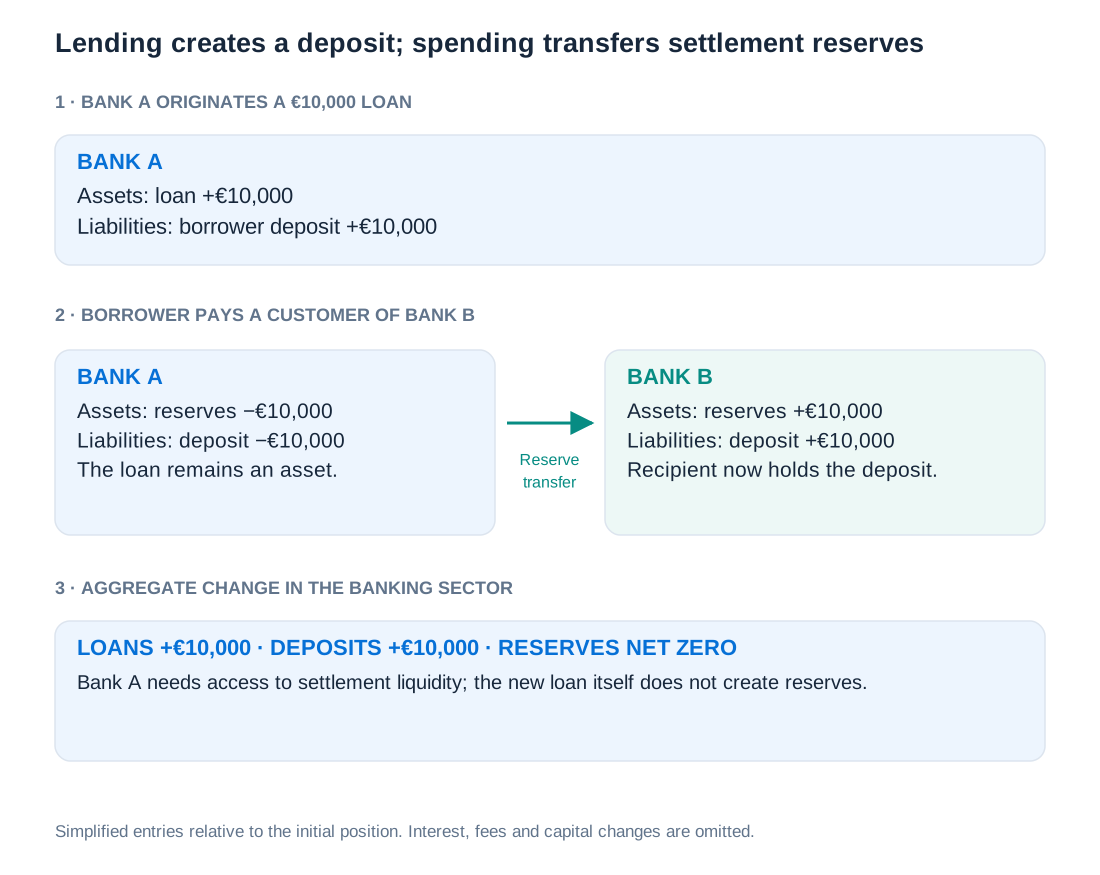
Starting before the loan, the final sector-wide position contains an extra €10,000 loan and an extra €10,000 deposit, with no net increase in reserves caused by the customer transfer itself. This combines the creation and payment exercises into one coherent sequence. If both customers use the same bank, its internal records can transfer the deposit without an interbank reserve transfer. Nevertheless, the bank still has to prepare for later withdrawals and outgoing payments.
The need for settlement funding explains why an individual bank actively attracts deposits. It can also obtain funding through interbank borrowing, securities issuance, secured market borrowing or eligible central-bank facilities. It does not literally require one specific kind of new deposit before every loan can be booked. The accurate conclusion is that lending creates deposits at the system level while the originating bank must manage the funding and liquidity consequences of payments leaving it.
Why bank money cannot expand without limit
A profitable loan must cover funding costs, expected credit losses, operating expenses and the cost of capital and liquidity. Expanding loan demand may require lower lending rates, while attracting stable funding may require higher deposit rates. The resulting compression of margins limits expansion. Poor credit quality can make an apparently high contractual rate unprofitable once defaults and recoveries are considered. A bank also needs enough loss-absorbing capital and eligible liquid assets to satisfy its risk management and regulatory constraints.
These limits operate differently for one bank and for the sector. If only Bank A expands, much of the newly created deposit may leave for competitors. If many banks expand simultaneously, some outgoing deposits are offset by incoming payments. That does not eliminate credit risk, system-wide leverage or the possibility that banks collectively underestimate risk. Capital and macroprudential constraints remain relevant even when the distribution of deposits appears comfortable.
Borrowers and deposit holders provide a second constraint. Creditworthy customers may not want additional debt at the terms offered. Recipients of new deposits may use them to repay existing bank loans, reversing money creation. Third, monetary policy influences the interest rates and financial conditions on which borrowing, saving and portfolio decisions depend. Central-bank support for settlement does not give a commercial bank an unconditional right to borrow unlimited amounts without collateral, eligibility requirements or a viable balance sheet.
Money destruction, asset purchases and the behaviour of deposit holders
Repayment of loan principal using a deposit contracts the banking system's balance sheet: the bank's loan asset and its deposit liability both fall. If the merchant in the €10,000 example uses €4,000 of the proceeds to repay an existing bank loan, the original €10,000 increase in sector deposits is reduced to €6,000, other things equal. A loan loss is different. Writing off an uncollectible loan reduces a bank asset and equity or an existing allowance; it does not automatically cancel the deposit that the original borrower previously spent.
A bank can also create deposits by purchasing a security from a non-bank customer and crediting the customer's account. The new asset is then a security rather than a loan. Conversely, a bank selling a security to a non-bank customer against a deposit can reduce deposit money. When a non-bank investor subscribes to newly issued bank equity or a long-term bank bond using deposits, the bank changes its liability structure: money-like deposits are replaced by equity or debt outside the relevant aggregate. This can improve funding resilience even as measured deposits fall.
If a household merely decides to save rather than spend an existing deposit, the aggregate stock does not necessarily increase. The household retains money that otherwise would have become a firm's deposit. When a recipient repays debt, economists sometimes describe the reversal of deposit creation as reflux. When recipients instead pass unwanted balances to others by buying goods or assets, the process is sometimes called the hot-potato effect. An individual can reduce their deposit by spending it, but the banking-sector deposit normally passes to someone else unless a money-destroying transaction occurs. Prices, spending, desired liquidity and debt repayment jointly determine the eventual adjustment.
Reserves, policy rates and the limits of the money multiplier
Reserves are central-bank liabilities held by eligible institutions, not ordinary household current accounts. A bank can transfer reserves to another eligible participant; it does not lend the same reserve account balance directly to a household. Lending to a household normally creates a bank deposit. Reserve demand follows from settlement needs, regulation, precautionary liquidity management and the opportunity cost of holding balances.
In a deliberately simplified fractional-reserve model, a fixed reserve requirement and a fixed supply of reserves imply a maximum deposit quantity . This requires restrictive assumptions: banks lend up to the limit, the public does not withdraw currency, no excess reserves are held, and reserve supply is the binding exogenous constraint. A broader accounting ratio can be written
where is the model's money stock, its monetary base, the currency-to-deposit ratio and the excess-reserve-to-deposit ratio. Even when this identity is useful, the ratios are not generally fixed behavioural constants.
Modern interest-rate implementation therefore cannot be inferred from a mechanical fixed multiplier. The central bank influences the price of reserve funding, often through remuneration and lending facilities, and supplies or absorbs liquidity under its operating framework. Policy rates feed into money-market rates, deposit and loan prices, asset valuations, exchange rates and expectations. Reserve abundance does not force banks to find creditworthy customers, while expensive funding can restrain credit even when there is no shortage of reserve balances in aggregate. The details differ across monetary systems and over time.
Quantitative easing: a complete balance-sheet example
Quantitative easing (QE) involves central-bank asset purchases, often of government bonds. It became especially important when short-term rates approached their effective lower bound and further conventional easing was constrained. The lower bound is not a universal fixed positive number: holding physical currency has costs, and institutional conditions influence how far rates can fall. The 0.5% UK policy rate discussed in the 2014 account describes that historical setting, not a permanent technical minimum. Consider a stylised purchase of GBP 1 billion of bonds from a pension fund. The fund does not hold an ordinary reserve account at the central bank, so its commercial bank intermediates the settlement. The central bank acquires the bonds and credits the commercial bank's reserve balance; the commercial bank credits the fund's deposit. The entries below omit any separate asset-purchase vehicle and show the consolidated monetary mechanism.
| Entity | Asset changes | Liability changes | Immediate net-worth change at the transaction price |
|---|---|---|---|
| Central bank | Government bonds +1 | Bank reserve balance +1 | 0 |
| Commercial bank | Reserves +1 | Pension-fund deposit +1 | 0 |
| Pension fund | Government bonds −1; deposit +1 | 0 | 0 |
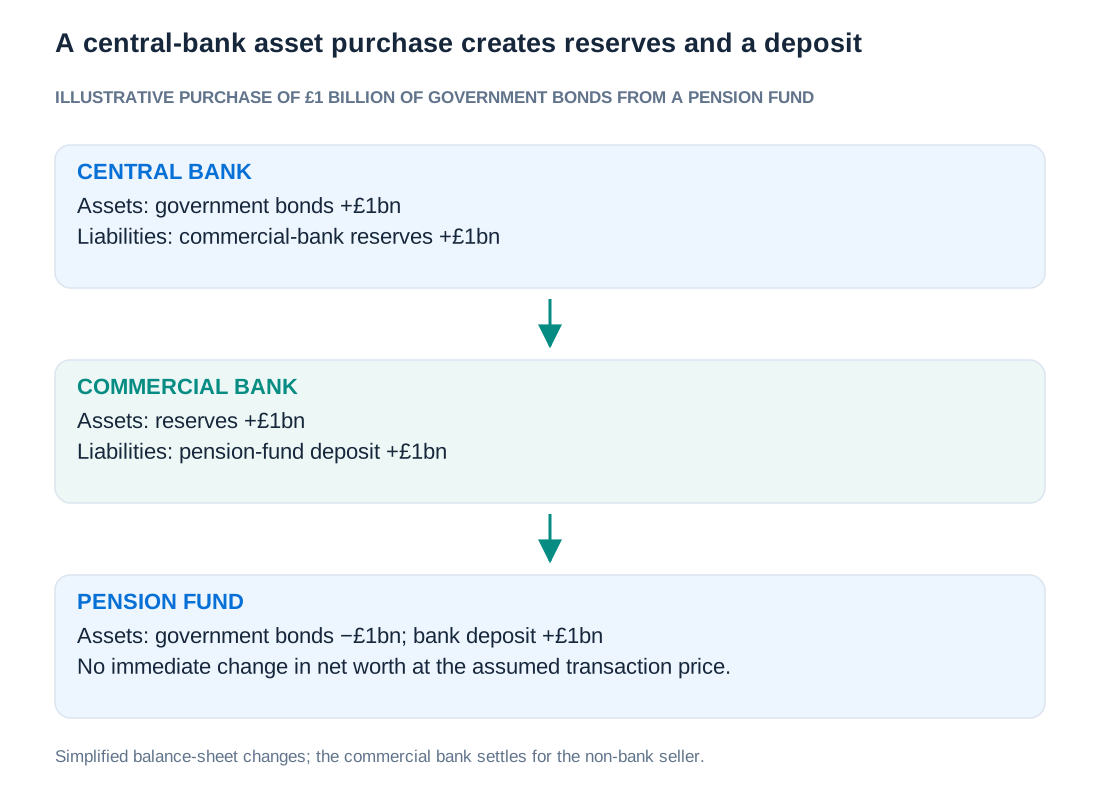
Both reserve money and deposits increase in this example, without a new commercial-bank loan. If the central bank instead buys a bond already owned by a commercial bank, that bank exchanges a bond for reserves; an additional non-bank deposit is not required by that transaction. The identity of the seller is therefore essential.
The pension fund may rebalance away from its larger cash position by buying corporate bonds or equities. Such purchases can affect prices, yields and financing conditions, influencing spending and investment. QE can also operate through expectations and other channels; no fixed ratio converts a given reserve increase into new loans or inflation. It may indirectly encourage bank lending, but a company that raises market finance and repays a bank loan can reduce bank credit instead. The new reserves are not a free addition to bank equity: in the non-bank purchase example they are matched by a deposit liability, and the associated interest income, deposit cost and regulatory effects must all be considered.
Why monetary measurement varies across countries and periods
The Bank of England's 2014 analysis distinguishes several historical UK measures. M0 combined notes and coins with banks' operational balances at the central bank before its publication was discontinued after the 2006 operating-framework reform. Measures such as non-interest-bearing M1, money of zero maturity (MZM), retail M4, M4 and M4ex used different instruments and sectors. M4ex excludes intermediate other financial corporations to reduce the influence of financial-sector intermediation that may be less closely connected to final spending. These are historical statistical definitions, not interchangeable names for euro-area M1, M2 and M3.
| Measure | Main included instruments | Measurement purpose or limitation |
|---|---|---|
| Notes and coin | Currency outside the Bank of England | Narrow indicator of cash-based transactions. |
| M0 | Notes, coin and central-bank reserves | Historical base-money measure; publication changed after the 2006 operating reform. |
| Non-interest-bearing M1 | Currency and non-interest-bearing sight deposits of the non-bank private sector | Can shift strongly when the opportunity cost of non-remunerated balances changes. |
| MZM | Currency and all sight deposits of the non-bank private sector | Zero-maturity balances available without waiting for a term deposit to mature. |
| M2 or retail M4 | Currency and retail deposits, including retail time deposits | Broader household-oriented liquidity measure, with some corporate retail deposits. |
| Historical M3 | Currency and sight and time deposits at banks, excluding building societies | Historical broad-money series; not the euro-area M3 definition. |
| M4 | Currency, deposits, certificates of deposit, repos and eligible securities with maturity below five years held by the non-bank private sector | Broad range of money-like bank liabilities. |
| M4ex | M4 excluding deposits of intermediate other financial corporations | Reduces the weight of intermediation within the financial system. |
| Divisia | Weighted growth of different monetary instruments | Attempts to reflect transaction services rather than giving every instrument the same weight. |
Definitions and publication practices evolve; the table describes the comparison made in 2014, not an assurance that every historical series is still published unchanged. Narrow transaction balances can corroborate current spending, while broader or sector-specific deposits can reveal portfolio adjustment and sometimes provide information about future expenditure. For example, corporate deposit movements may help interpret investment capacity. Repos can resemble secured deposits economically, while collateral used in financing raises further questions about the boundary between money and other liquid assets.
A simple-sum aggregate assigns one pound of weight to one pound in each included instrument. A Divisia monetary index instead weights growth in components according to the monetary services they provide, using opportunity-cost information. A highly liquid, low-yielding transaction balance may provide more transaction services than a higher-yielding less liquid claim. These approaches can diverge during financial innovation or large shifts in interest incentives.
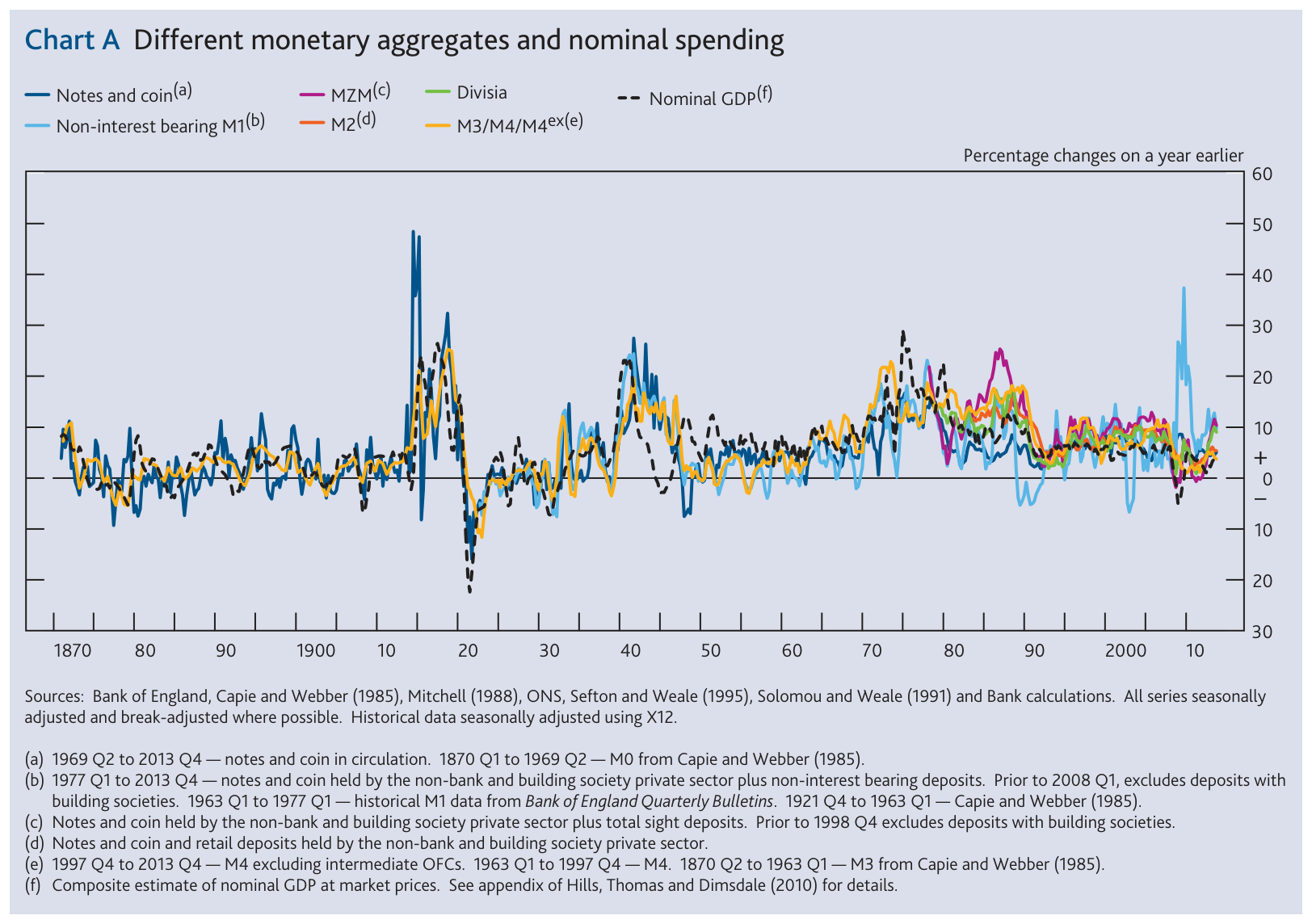
The historical UK comparison shows that monetary aggregates and nominal spending can move together over long periods while diverging sharply over particular episodes. Changes in bank regulation, financial innovation, portfolio preferences, statistical definitions and financial-sector transactions alter the information contained in each series. The accounting relation , with money, velocity, the price level and real output, defines a useful relationship once its components are measured consistently. It does not establish that velocity and output are fixed, or that a money increase translates one-for-one into immediate inflation.
Monetary accounting, constraints, QE and the historical UK comparison are developed from McLeay, Radia and Thomas, Bank of England, Money creation in the modern economy (2014). Its discussion of operating procedures is read in its historical UK setting.
Payment instructions, clearing and final settlement
A payment has several layers. The customer initiates and authenticates an instruction; providers transmit information; clearing determines obligations; settlement discharges those obligations using an agreed asset. A message confirming that an instruction was received is not necessarily final settlement. Finality concerns the point beyond which a transfer is unconditional and irrevocable under the applicable system rules and law. An economic comparison must also consider how mistakes, fraud and customer disputes are handled.
The Single Euro Payments Area (SEPA) harmonises important euro payment instruments across participating jurisdictions. The European Payments Council's credit-transfer and direct-debit schemes specify rules and standards; they are not themselves one universal settlement account. The SEPA Instant Credit Transfer scheme, introduced in 2017, supports transfers available around the clock, with a ten-second execution requirement under the applicable framework. A bank or payment institution connects the customer-facing service to the necessary clearing and settlement arrangements.
T2 is the Eurosystem's real-time gross settlement service, which replaced TARGET2 in March 2023. Gross settlement processes payment obligations individually in central-bank money. The TARGET2 historical annual report for 2022 recorded approximately 108 million transactions with a value of EUR 464 trillion, 99.73% processed in under two minutes and annual costs of EUR 42.7 million. These statistics describe that infrastructure and reporting year; they are neither today's figures nor a retail bank's all-in cost per customer payment.
TARGET Instant Payment Settlement (TIPS), launched in 2018, provides continuous instant settlement in central-bank money. Its published transaction fee of €0.002 is shared between the sending and receiving participants, €0.001 each, under the stated tariff; monthly account-holder fees also apply. That is a settlement-service price, not the entire cost of an account, compliance, fraud prevention, customer support or merchant integration. Participation and account conditions depend on the current framework; one should not assume that every customer-facing provider necessarily has the same access arrangement. Likewise, a scheme participation fee is a membership charge rather than a per-transfer consumer tariff and changes with the relevant fee schedule.
Instant payments: obligations, pricing and customer protection
Regulation (EU) 2024/886 entered into force on 8 April 2024. For the main euro-area credit-institution timetable, receiving instant euro credit transfers was required by 9 January 2025 and sending them by 9 October 2025. Charges for instant transfers may not exceed those for corresponding non-instant transfers, and verification of the intended payee is an important safeguard. Separate timetables and exceptions apply, including for payment and electronic-money institutions and providers outside the euro area. These are phased legal obligations, not a claim that every provider worldwide already offers the same service.
Instant execution reduces waiting time but does not remove fraud. A payer deceived into authorising a transfer may send money extremely quickly to the wrong recipient. Verification of payee, authentication, transaction monitoring, clear warnings and operational resilience complement settlement speed. A credit card or an online wallet can also bundle dispute handling, buyer protection or credit; an account-to-account transfer should be compared with the same service bundle before asserting that one method is universally superior.
Cross-border payments can involve currency conversion, correspondent accounts, compliance checks and institutions operating under different legal regimes. SWIFT mainly provides financial messaging rather than being the money or settlement asset itself. It is also incorrect to treat crypto-assets as intrinsically an infrastructure for illegal activity: they have lawful and unlawful uses, and service providers can be subject to financial-crime controls. The analytical question is which parties perform identification, screening, monitoring and enforcement, and where gaps remain.
Infrastructure and legal references: ECB, T2; ECB, TIPS; TARGET Annual Report 2022; and Regulation (EU) 2024/886. Payment-rule information was checked on 14 October 2026.