
10. Stablecoins and Digital Money
A stablecoin is a privately arranged digital token designed to maintain a relatively stable value against a reference, often one US dollar or one euro. The word “stable” describes an objective, not an assurance that the market price can never fall. Understanding a stablecoin requires examining its issuer, reserve assets, redemption rights, ledger, custodians and access points. Its economic role cannot be inferred from transfer speed alone: a fast token can still carry issuer risk, liquidity risk or foreign-exchange risk for the person using it.
Distinguishing monetary claims from their digital representation
Digital money already existed before public blockchains. A bank deposit is usually maintained electronically, while electronic-money institutions issue payment claims under a different legal framework. Tokenisation changes how a claim is recorded and transferred; it does not automatically change the identity of the debtor or the holder's legal rights. A tokenised bank deposit remains a bank liability if that is the legal arrangement. A central-bank digital currency is a public monetary liability. A privately issued stablecoin is a different claim even when all three are denominated in euros.
| Arrangement | Underlying claim | How value is supported | Main analytical question |
|---|---|---|---|
| Commercial-bank deposit | Liability of a commercial bank | Bank assets, capital, supervision and applicable protection arrangements | Can the bank meet withdrawals and absorb losses? |
| Tokenised deposit | Bank deposit represented on a tokenised infrastructure | The legal bank claim and the infrastructure supporting transfer | Do transfer rules preserve the deposit's rights and settlement arrangements? |
| Electronic money | Claim on an issuer received in exchange for funds | Safeguarding, redemption and other applicable legal requirements | Who safeguards the backing and who must redeem the balance? |
| Reserve-backed stablecoin | Private token claim under its issuance arrangement | Reserve value, liquidity and enforceable redemption | Can holders obtain the reference currency at par during stress? |
| Algorithmic stablecoin | Arrangement relying substantially on incentives or linked tokens | Market arbitrage, collateral or issuance rules depending on design | Does stabilisation survive a simultaneous loss of confidence? |
| Retail central-bank digital currency | Direct central-bank monetary liability | Public monetary institutions and its legal framework | How should access, privacy, limits and payment services be designed? |
The relevant comparison is not “digital versus traditional” but the combination of claim, backing, convertibility and transfer architecture. A conventional deposit and a stablecoin can both be accessed through a mobile application, yet expose the user to different institutions. Likewise, a token's address is not necessarily the ultimate beneficial owner: exchanges and custodians may hold balances for many customers.
Reserve-backed, crypto-collateralised and algorithmic designs
A fiat-referenced reserve-backed issuer receives funds and issues tokens against assets such as bank balances, short-term government securities or reverse-repurchase claims. Holders expect conversion into the reference currency under specified conditions. The quality of this promise depends on the assets, segregation and custody arrangements, the legal claim against the issuer and the operational ability to redeem. “Fully backed” is incomplete unless the valuation basis, liabilities included and treatment in insolvency are specified.
A crypto-collateralised design can require collateral worth more than the token liability and liquidate positions when collateral falls. Overcollateralisation provides a buffer, but volatile collateral prices, delayed liquidation, congestion and oracle failures can exhaust it. Algorithmic designs may try to maintain a peg through issuance and redemption against a related token. Such arrangements can become circular: confidence in the stable token depends on the value of the other token, while that token's value depends on confidence in the system. The collapse of TerraUSD in May 2022 is a historical warning that a stabilisation rule can amplify a run rather than absorb it.
Reserve-backed arrangements may resemble narrow intermediaries or money-market funds economically, but the analogy has limits. A fund share can represent a variable claim on net assets; a payment token may promise redemption at a fixed nominal value. Fixed-value redemption makes immediate liquidity and first-mover incentives especially important. A stablecoin also need not offer the deposit insurance or central-bank liquidity access associated with a qualifying bank deposit.
Issuance, transfer and redemption on the issuer's balance sheet
Consider a simplified issuer that receives EUR 1 million and mints one million tokens, each redeemable for one euro. Its assets rise by EUR 1 million and its token liabilities rise by the same amount. No profit arises merely from minting the liability. If one holder transfers 100 tokens to another, the issuer's total assets and total token liabilities are unchanged; only the identity of the holder changes. When 100 tokens are redeemed and cancelled, reserve assets and token liabilities both fall by EUR 100.
| Transaction | Issuer assets | Issuer token liabilities | Effect on issuer equity |
|---|---|---|---|
| Receive EUR 1 million and issue one million tokens | +EUR 1 million cash or eligible reserve assets | +EUR 1 million | No immediate change |
| Transfer 100 tokens between holders | No change | No change in total | No change |
| Redeem and cancel 100 tokens at par | −EUR 100 | −EUR 100 | No change if assets realise par |
| Reserve assets suffer a EUR 20,000 loss | −EUR 20,000 | No automatic reduction | −EUR 20,000 |
The reserve-coverage ratio is
A ratio of 100% on one date is not equivalent to uninterrupted liquidity or an adequate capital buffer. A balance sheet containing EUR 100 million of assets and EUR 100 million of token liabilities has no cushion in this stripped-down example. Custodian fees, operational expenses, asset losses or undisclosed senior claims could undermine the promise unless funded separately.
At the banking-sector level, buying a stablecoin can initially transfer a customer's deposit to the issuer's bank account rather than destroy deposits. If the issuer then buys a security from a non-bank investor, the deposit passes to that seller. Other transactions can change deposits, and the type and concentration of deposit funding can change even when the aggregate does not. It is therefore too simple to say that every euro entering a stablecoin permanently removes one euro from the banking system.
Historical growth and the dominance of dollar denomination
Market capitalisation measures the outstanding token quantity multiplied by its market price. For a token trading close to par, it is a useful approximation to outstanding issuance. It is not annual revenue, transaction value or the issuer's equity value. A stablecoin can be transferred repeatedly during a year, so a relatively small outstanding stock can support a large gross flow. Conversely, large trading activity can reflect exchange transfers, automated operations or movements within an intermediary rather than purchases of final goods and services.
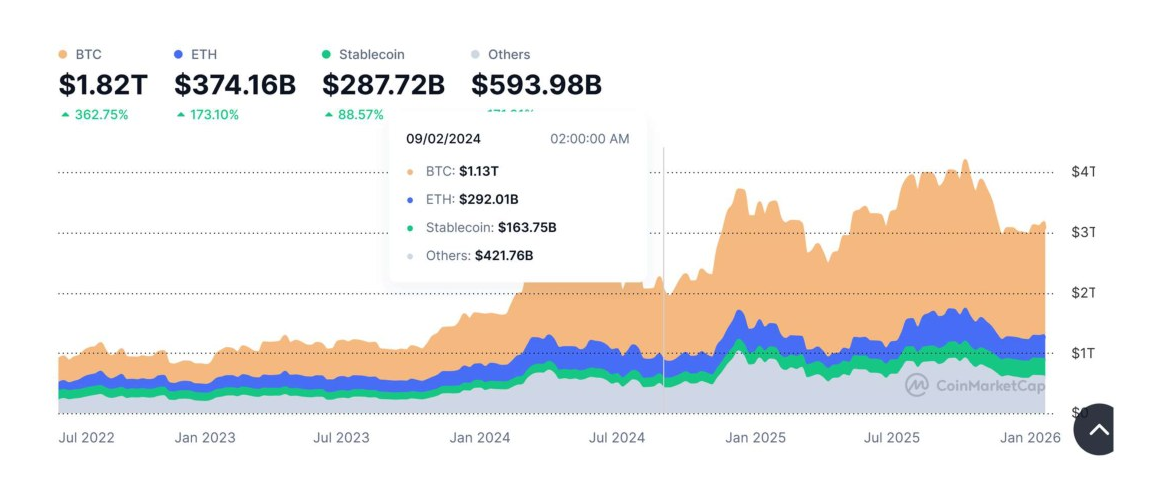
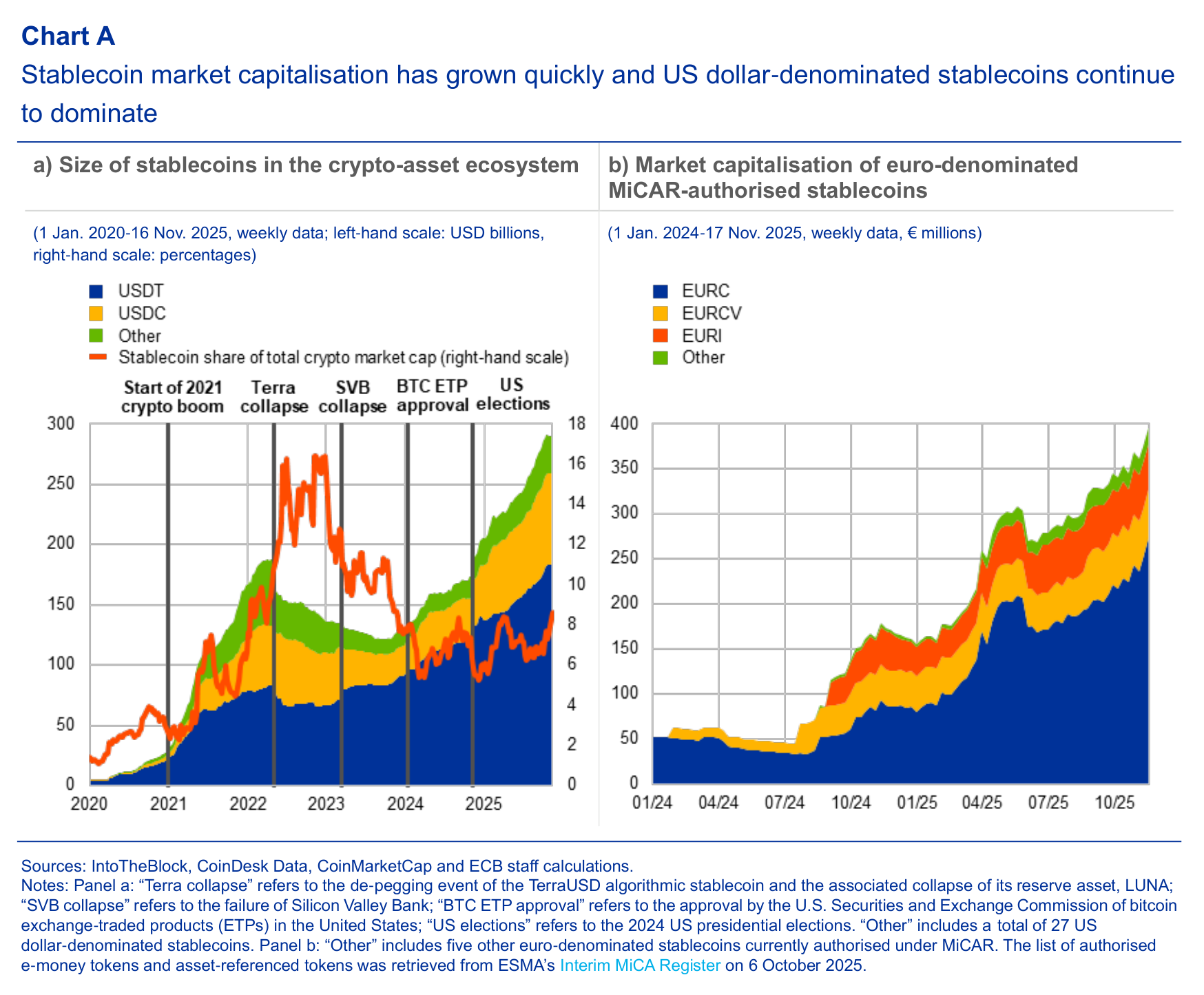
The historical comparisons show the strong role of US-dollar-linked stablecoins and the much smaller scale of euro-linked issuance. This reflects existing dollar use, crypto-market trading conventions, liquidity and issuer networks; the chart alone does not identify the causal contribution of each factor. The euro and dollar panels must be read with their respective units, because millions of euros and billions of dollars are not interchangeable scales.
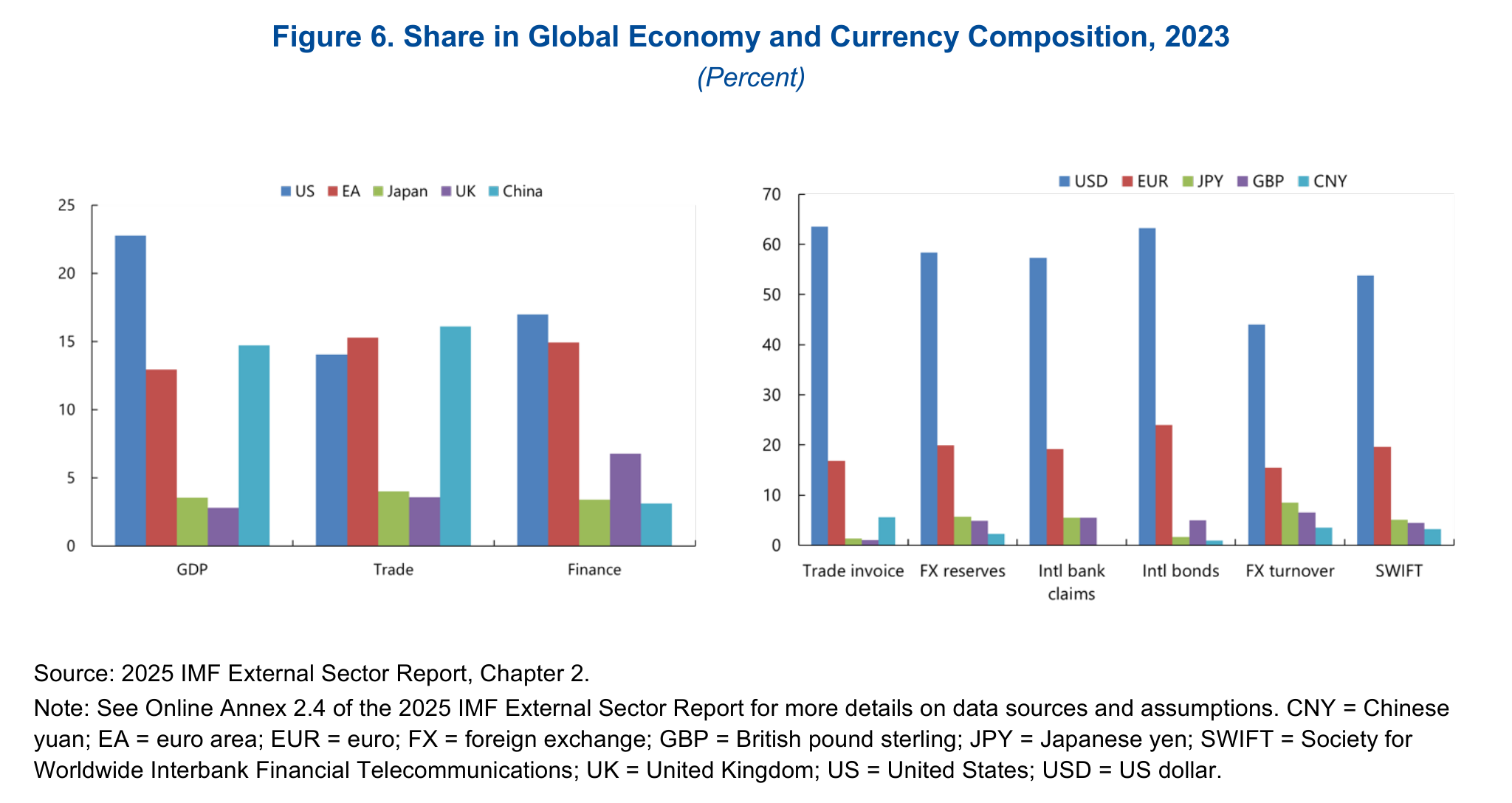
A currency's international role need not match the issuing economy's share of world output. Trade invoicing, foreign-exchange reserves, bank claims, bond issuance, foreign-exchange turnover and payment messages measure different functions, frequently with different denominators. The historical 2023 comparison provides context for stablecoin dollarisation; it is not evidence that stablecoins themselves created the dollar's established international position.
Reserve composition, disclosure and the meaning of assurance
A reserve portfolio composed of short-dated government securities is exposed to different risks from one containing unsecured corporate claims or volatile crypto-assets. Yet even high-quality securities have market prices and settlement times. Maturity, interest-rate sensitivity, currency matching, concentration in particular banks, custody access and encumbrance all affect whether assets can meet redemption requests. A reverse repo is a contractual secured claim, not literally the same balance-sheet item as a Treasury bill held outright.
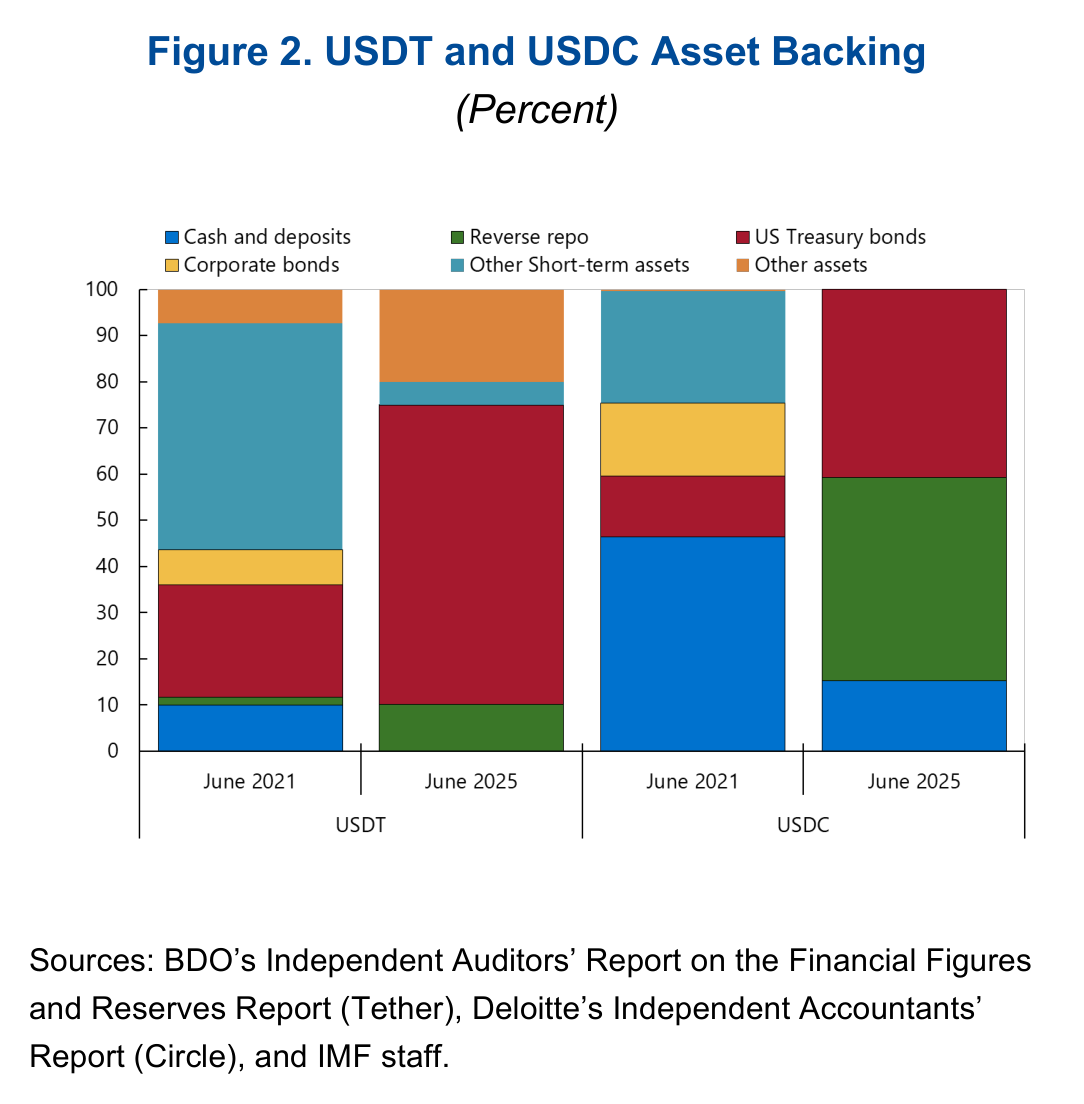
The June 2021 and June 2025 reserve comparison illustrates that backing composition changes over time. Reading a percentage bar requires identifying both the asset categories and what the report covers. An assurance or attestation engagement on a reserve statement at a specified date should not be described automatically as a full audit of every aspect of an issuer's financial statements, internal controls and future liquidity. The report's scope, criteria, date and qualifications determine what can reasonably be concluded.
How a secondary-market peg is maintained and lost
When a token trades below its redemption value, an eligible arbitrageur may buy it and redeem it at par. When it trades above par, an eligible issuer customer may acquire new tokens at par and sell them. These trades tend to narrow deviations, but only if issuance and redemption are accessible, predictable and economical. Minimum transaction sizes, identity checks, banking hours, redemption fees, transfer restrictions or doubts about reserves can interrupt the mechanism. A retail holder selling through an exchange may not have the same direct redemption access as an institutional customer.
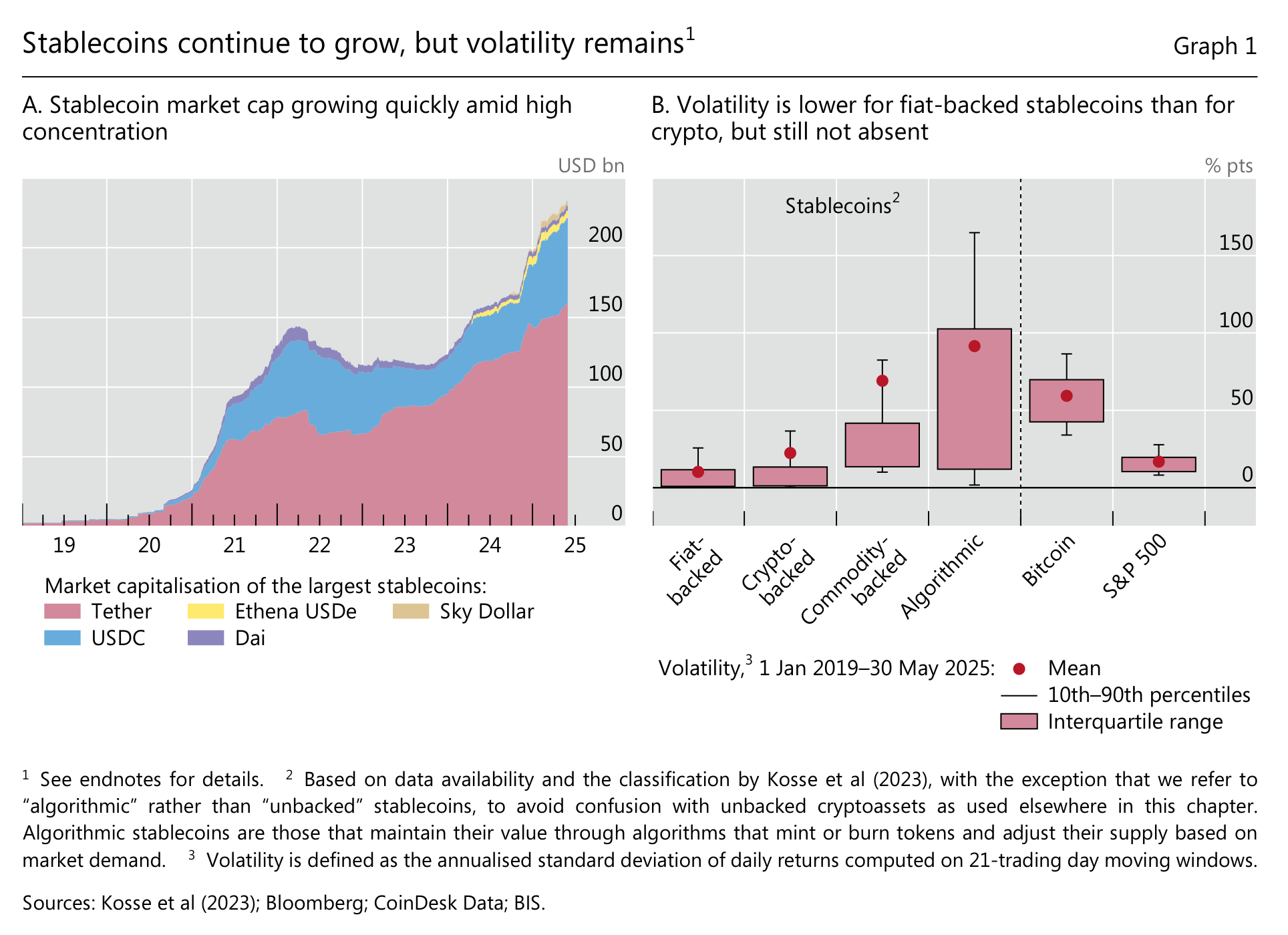
A temporary discount can reflect liquidity constraints rather than a final loss on every reserve asset; a persistent discount can reflect a genuine solvency problem. Distinguishing the two requires evidence. The March 2023 USDC stress illustrates the connection between token confidence and the banks holding reserve cash: uncertainty about access to cash can affect a token trading continuously even while conventional banking operations are constrained. Neither a return to par nor a short historical period of stability proves immunity to future runs.
Worked example: full backing and a redemption shortfall
An illustrative issuer has EUR 100 million of token liabilities, EUR 15 million of immediately available cash and EUR 85 million of securities carried at par. Holders request redemption of 25% of the tokens, or EUR 25 million. The immediate cash shortfall is EUR 10 million. If securities can be sold at par, the issuer sells EUR 10 million, pays EUR 25 million and finishes with EUR 75 million of securities backing EUR 75 million of tokens.
Now suppose an urgent sale produces only 98% of the securities' carrying value, while the unsold securities retain their carrying value for this isolated example. Selling EUR 10 million of face value is insufficient because it raises only EUR 9.8 million. The required sale is
The realised loss is EUR 0.2040816 million. After redemption, remaining assets equal EUR 74.7959184 million while token liabilities equal EUR 75 million. The remaining coverage ratio is approximately 99.728%.
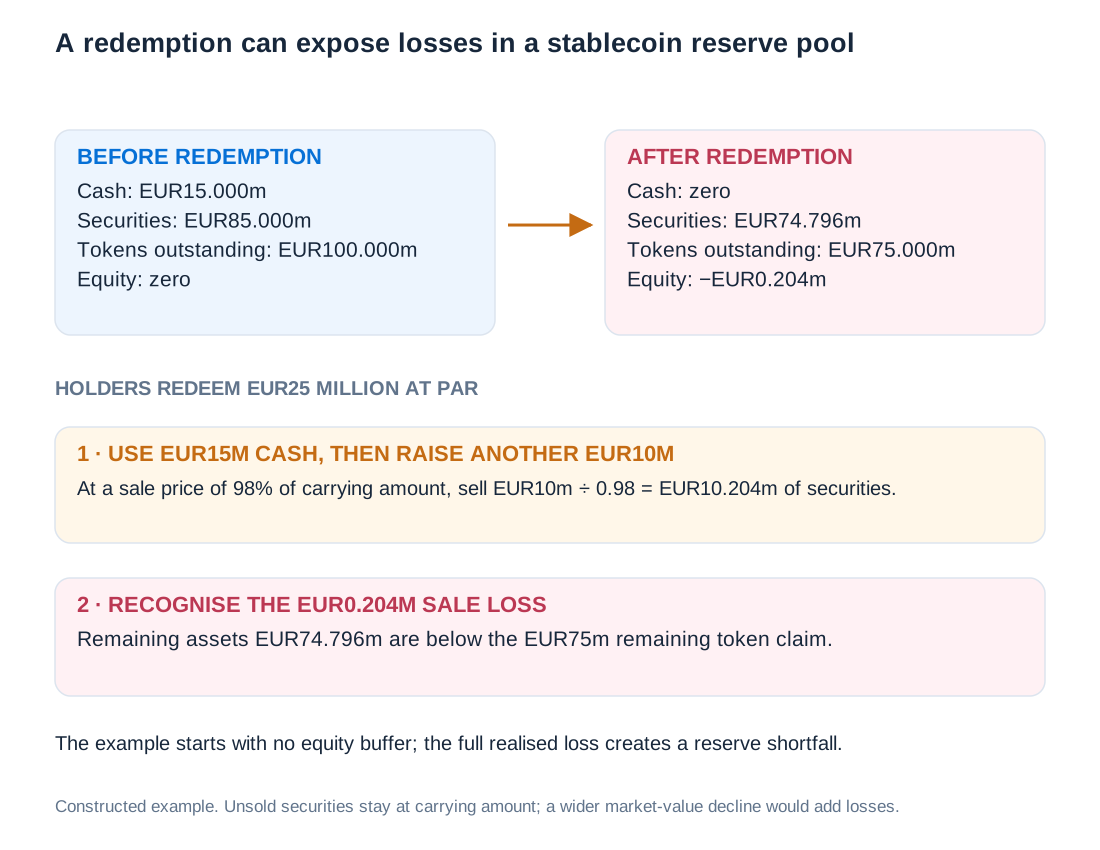
The shortfall is caused by liquidation losses, not by an arithmetic failure to hold EUR 100 million before the run. A separately funded capital buffer of EUR 0.3 million would absorb this particular loss, leaving about EUR 0.0959 million, but would not eliminate other risks. If the price decline also applies to unsold assets, total losses are larger. The example explains why regulation and risk management assess reserve liquidity, valuation, capital and redemption arrangements separately.
Cross-border uses, currency substitution and financial spillovers
Stablecoins can provide a settlement medium within crypto markets and a transferable claim across providers using compatible networks. They may also be useful in particular remittance or business-payment corridors where conventional services are slow, expensive or difficult to access. The complete service still requires conversion, customer identification, secure custody and an accessible endpoint. A token arriving instantly is not equivalent to the recipient having immediately spendable local currency.
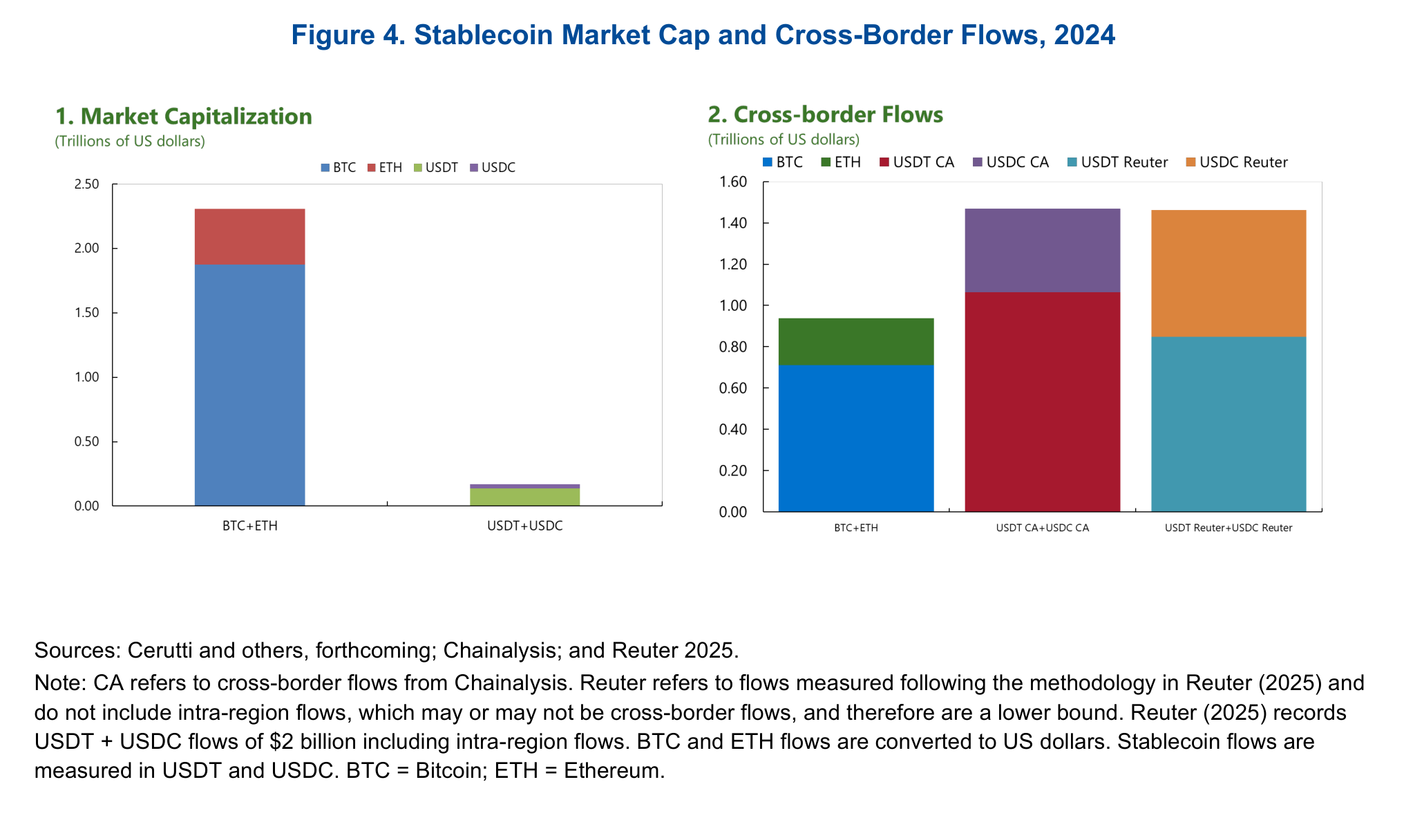
Cross-border estimates depend on identifying where senders and recipients are located, which is difficult when addresses are pseudonymous and exchanges pool customer balances. Gross flows can include repeated transfers and financial trading. The 2024 historical comparison therefore retains alternative estimates and methodological notes instead of presenting one number as a precise measure of global retail remittances.
For a euro-income household, holding a dollar stablecoin adds exchange-rate risk even if the token tracks one dollar perfectly. Widespread foreign-currency token use can support currency substitution, affecting the denomination of prices, savings and contracts. The consequences for domestic monetary policy depend on scale and on what users replace. Access to a foreign unit of account may benefit individuals facing unstable local purchasing power, while creating challenges for the domestic monetary system.
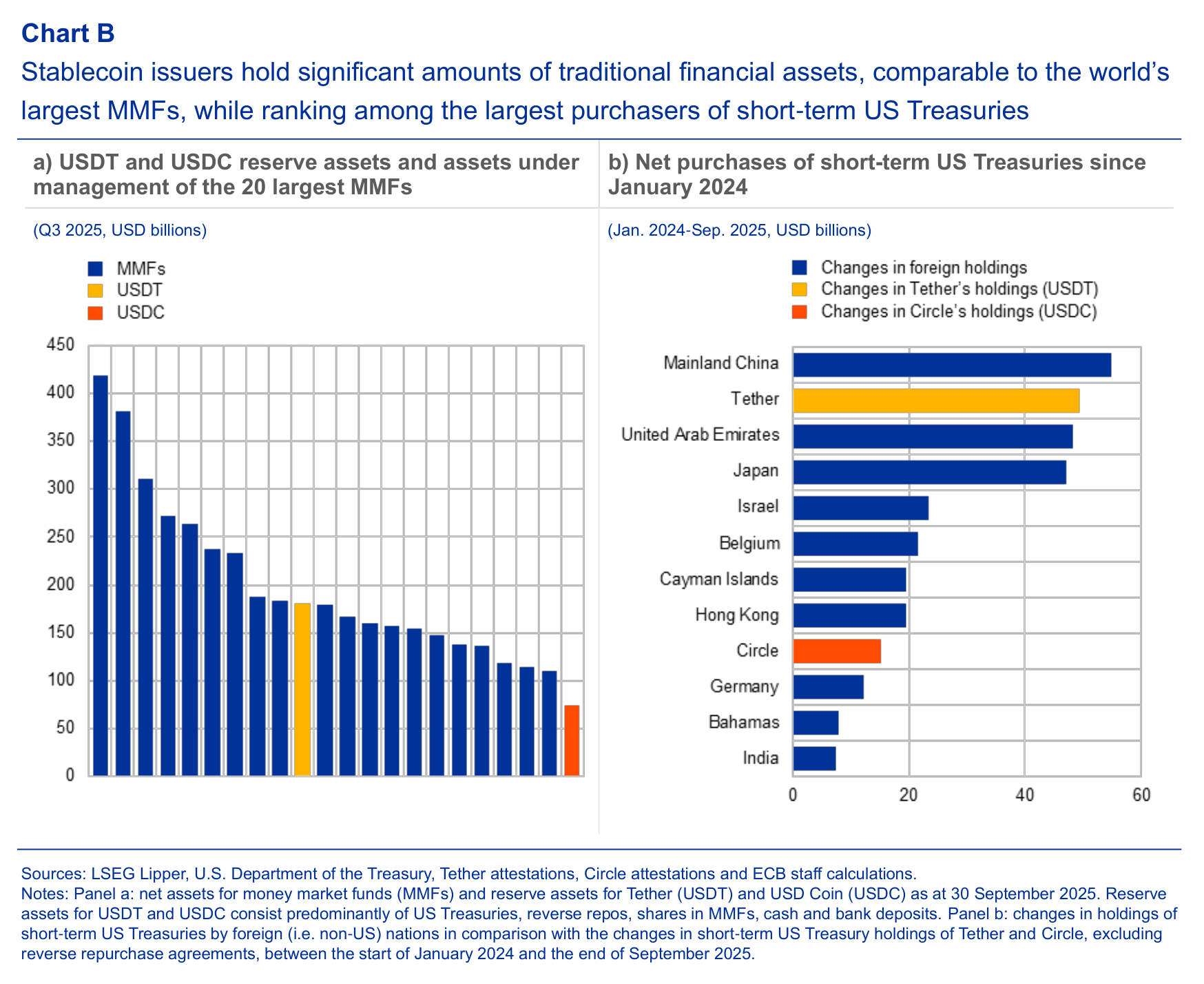
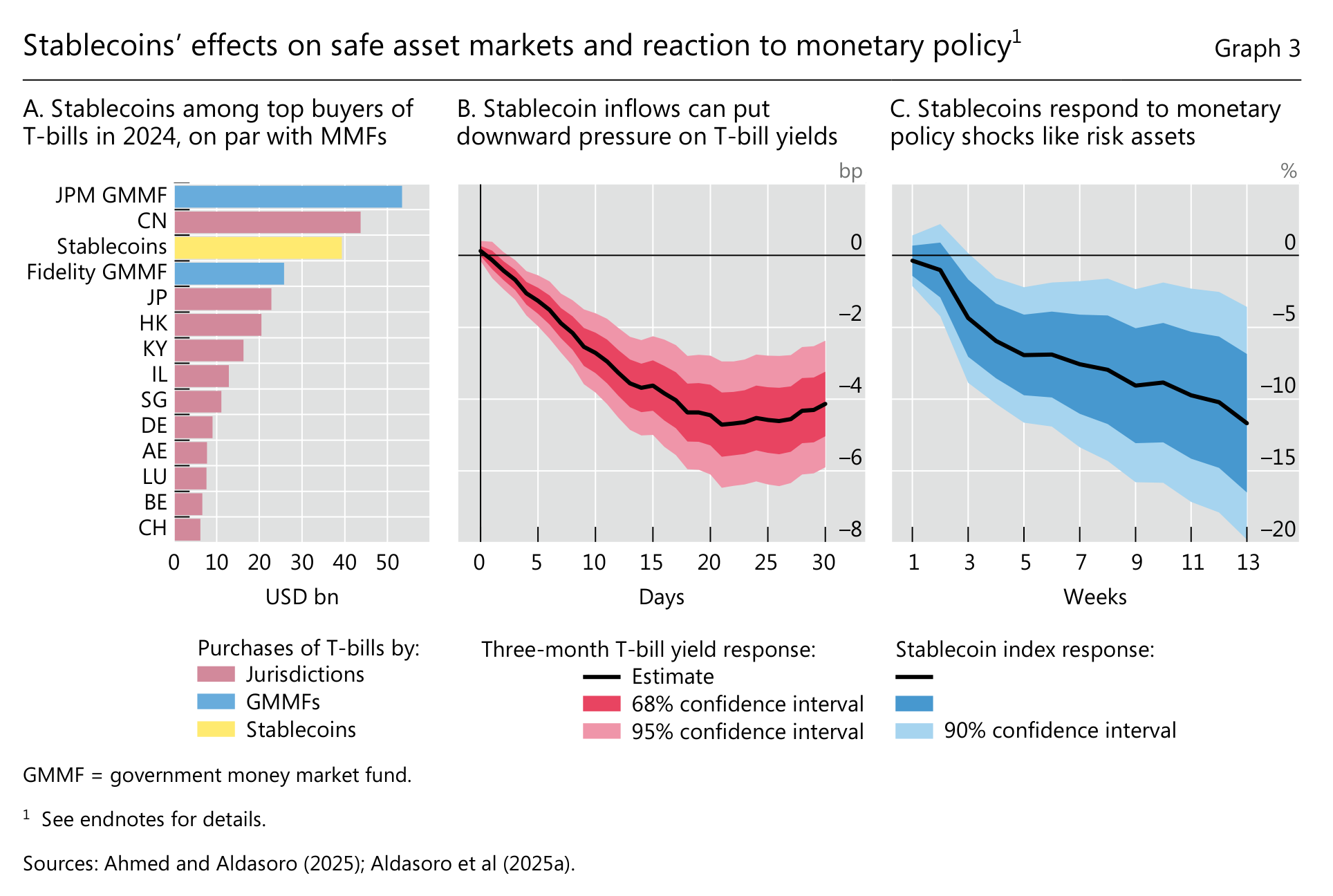
Large reserve portfolios connect stablecoins with banks, money-market funds and government securities. New issuance can increase demand for short-term safe assets; redemptions can require sales or repo unwinding. Empirical estimates of yield responses depend on the sample, shock definition and identification method, and confidence bands must be retained. They do not establish that every inflow lowers yields by a fixed amount, or that every policy-rate increase mechanically causes the same token outflow.
Comparing the full cost of a payment
A fair comparison begins with a specific payer, recipient, currency pair, amount and service requirement. A blockchain fee is one component, while an exchange spread, fiat deposit fee, withdrawal charge, custody service, failed transaction, compliance process or dispute can add others. Conventional providers also differ: a low-cost domestic instant transfer is a different benchmark from a high-friction international retail corridor.
For an illustrative EUR 1,000-equivalent remittance, assume an on-ramp fee of 0.5% (EUR 5), a network fee of EUR 0.50, an off-ramp fee of 0.7% (EUR 7) and an exchange spread of 0.4% (EUR 4), each percentage applied to the original amount for simplicity. Total cost is EUR 16.50, or 1.65%, not merely the EUR 0.50 network fee. A conventional quote of EUR 12 would be cheaper under these assumptions; a quote of EUR 25 would be more expensive. Neither comparison tells us about fraud remedies, execution risk or recipient accessibility unless those features are also specified.
| Dimension | Question to answer | Common misleading shortcut |
|---|---|---|
| Total monetary cost | What does the recipient receive after all fees and exchange spreads? | Comparing only blockchain gas with a bundled bank fee |
| Time | When can the recipient actually use the final currency? | Treating ledger confirmation as completed fiat withdrawal |
| Legal finality | When is the obligation discharged under applicable rules? | Equating a technical confirmation with every legal consequence |
| Consumer protection | Who handles fraud, mistakes and merchant disputes? | Assuming irreversibility is always a consumer benefit |
| Liquidity and credit | Who supplies prefunding, currency conversion and settlement balances? | Assuming intermediaries and liquidity costs disappear |
| Operational resilience | What happens during an outage, key loss or provider failure? | Assuming a decentralised ledger removes all concentrated dependencies |
Atomic settlement, smart contracts and incomplete agreements
Tokenisation can make payment and asset transfers conditional on each other. In delivery-versus-payment, securities should move if and only if the payment leg moves; in payment-versus-payment, the two currency legs are linked. Atomic execution can reduce principal risk arising from one party delivering while the other does not. It does not remove the need for legally enforceable ownership, authorised issuers, custody, access controls and recovery procedures. Requiring both legs to be fully prefunded can also increase liquidity needs compared with arrangements that permit netting or intraday credit.
A smart contract executes a rule using available digital inputs. Paying a freelancer when a file is uploaded is easy to encode; determining whether the work satisfies a disputed quality standard is harder. A supply-chain contract needs reliable evidence that the right goods arrived in acceptable condition. An oracle introduces external information, but then the system depends on that source's accuracy and governance. Automation reallocates some trust; it does not abolish trust.
Conditional payments should also be distinguished from programmable money restricted to particular purposes, dates or recipients. A customer can voluntarily instruct a payment on delivery while holding general-purpose money. Technology can reduce reconciliation and automate well-specified processes, but commercially meaningful agreements remain incomplete and require dispute resolution. A legal remedy can remain necessary even when the ledger transfer itself is technically irreversible.
The European regulatory categories
Under the EU Markets in Crypto-Assets Regulation (MiCA), a token seeking stable value by reference to one official currency falls within the e-money-token category; asset-referenced tokens use a different reference structure. E-money-token issuers must generally be authorised credit institutions or electronic-money institutions. Tokens are issued at par on receipt of funds, holders have a right to redemption at par, and issuers may not grant interest linked to the holding period. The regulation imposes additional requirements on reserves, governance and disclosures according to the relevant category. Its stablecoin provisions applied from 30 June 2024, with most other provisions applying from 30 December 2024.
A legal label does not eliminate operational or market risk. The holder still needs to identify the issuer and understand custody and redemption. A token should not be described as an insured bank deposit simply because a bank is involved. Rules also differ across jurisdictions, so the rights attached to one regulated European arrangement should not be projected onto every token bearing the same currency name.
Legal reference: Regulation (EU) 2023/1114 (MiCA), notably the categories and the e-money-token provisions. Legal description checked on 14 October 2026.
Evaluating claims about financial innovation
An implemented product, a pilot and a proposed use case are different forms of evidence. A persuasive assessment defines the problem, identifies a realistic existing alternative, measures the complete cost and risk allocation, and states circumstances in which the result would reverse. Market capitalisation is evidence of valuation or issuance, not proof of welfare improvement. A demonstration of technical feasibility is not evidence of broad adoption, and a correlation between token flows and financial prices is not automatically causal.
The same discipline applies to automated research and generative-AI output. Fluent explanations can confuse a ledger with a currency, an attestation with an audit, or a fee comparison with a full welfare assessment. Each claim needs a source appropriate to the question: legal texts for rights, audited reports for financial statements, system documentation for operating rules, and research with a credible identification strategy for causal effects. Stablecoins are best understood as institutional arrangements whose benefits and vulnerabilities must be assessed together.
Historical evidence and interpretation: IMF, Understanding Stablecoins (2025); ECB, Stablecoins on the rise (November 2025); and BIS, Annual Economic Report 2025, Chapter III. Graphs retain their historical samples rather than being presented as current market data.