
1. Financial Intermediation and the Banking System
A financial system connects decisions about saving, investment, borrowing and payment. A household may want to preserve purchasing power for retirement, a business may need funds before it can produce and sell its output, and a government may finance infrastructure whose benefits extend over decades. These plans rarely coincide in amount, timing or willingness to bear risk. Financial markets and intermediaries make them more compatible by creating claims, producing information, allocating risk and operating the infrastructure through which money and securities move. Their economic contribution depends on how well they perform these tasks, not simply on the volume of transactions they process.
Banking has both a developmental and a stability dimension. The 2006 Nobel Peace Prize awarded to Muhammad Yunus and Grameen Bank recognised the connection between access to finance and development from below. The 2022 economics prize awarded to Ben Bernanke, Douglas Diamond and Philip Dybvig recognised research on banks and financial crises. These perspectives belong together: institutions that expand access to useful finance can also become fragile when their promises to savers are easier to redeem than their assets are to realise.
How finance contributes to the real economy
Finance can improve production by moving resources toward projects that can use them productively. Mobilising savings allows investments larger than any individual saver could finance. Screening helps distinguish a viable enterprise from an implausible proposal. Monitoring gives the provider of funds an opportunity to detect diversion, excessive risk taking or deteriorating performance. Risk sharing permits investment that a single undiversified household might reject. Payments and settlement enable the resulting goods, services and financial claims to be exchanged reliably. These mechanisms explain why financial development can support economic development even when it does not increase the economy's aggregate saving rate.
There is also a direct household benefit through consumption smoothing. Income and desired expenditure need not occur in the same year. A student may borrow while studying and repay from later earnings; a worker may save during employment and consume those savings in retirement. Insurance transfers resources toward adverse states, such as illness or property damage. The relevant improvement is not a licence to spend without limit: borrowing remains constrained by future repayment capacity, while insurance requires sustainable pricing and incentives. Well-designed finance changes the timing and distribution of consumption without eliminating the economy's resource constraint.
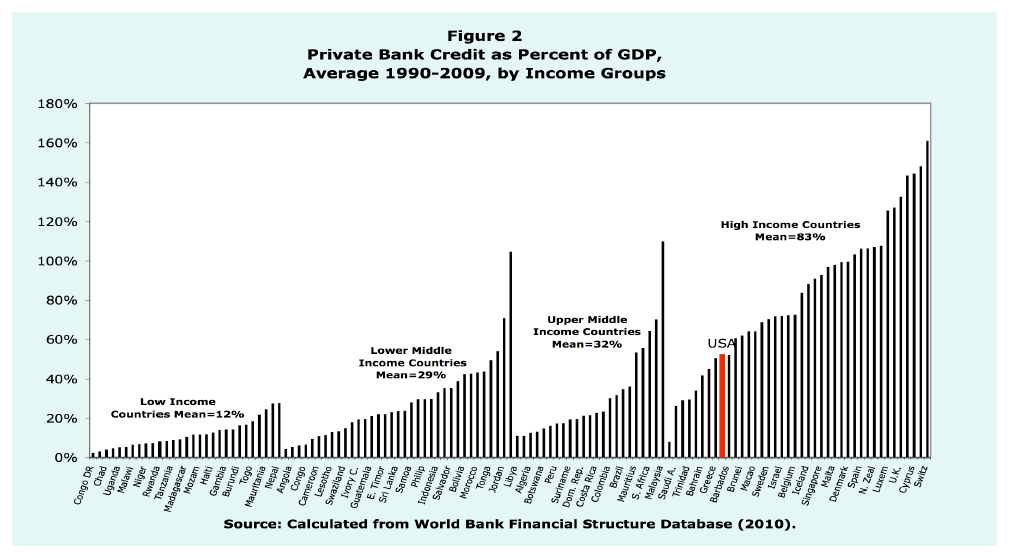
Historical comparisons show much higher private bank credit relative to GDP in many high-income economies than in low-income economies. In the 1990–2009 comparison below, the reported group means are approximately 12% for low-income countries, 29% for lower-middle-income countries, 32% for upper-middle-income countries and 83% for high-income countries. The dispersion within each group is substantial. These numbers describe an association, not a controlled experiment: income may increase the demand for sophisticated finance, effective institutions may encourage both development and lending, and credit may itself support investment. A causal interpretation needs a research design capable of distinguishing these channels.
Capital allocation and the limits of financial expansion
Capital allocation concerns which firms and projects obtain resources, rather than only how many resources are available. If two otherwise comparable firms face very different financing constraints, the more productive firm may remain too small while the less productive firm retains capital. Aggregate output can then be lower than it would be under a more efficient allocation. Financial information, collateral arrangements, legal enforcement and competition all influence this process, but they are not the only sources of distortion: taxation, product-market restrictions, management and technology also matter.
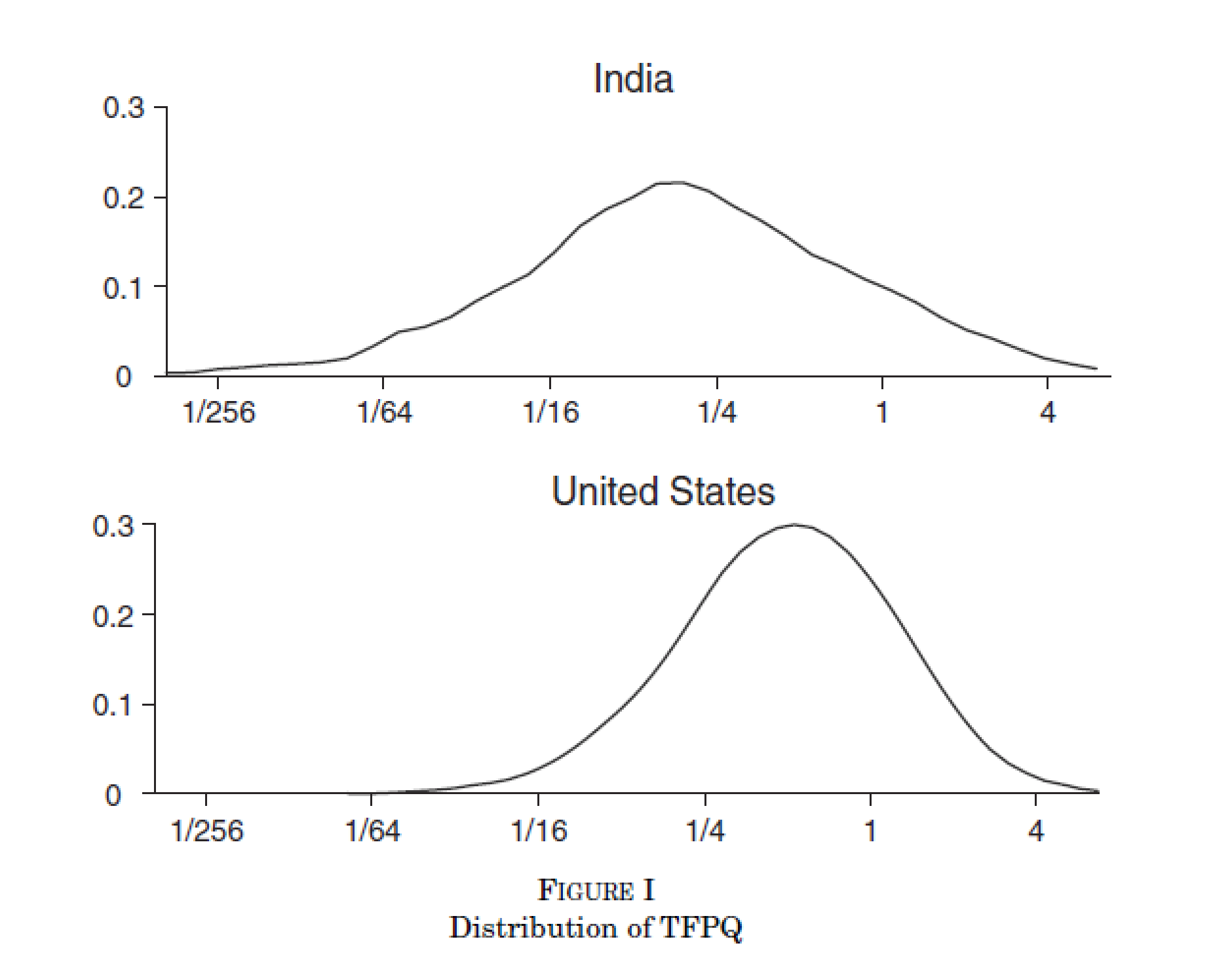
The manufacturing-productivity distributions reproduced below motivate the study of such differences. Physical total factor productivity, abbreviated TFPQ, measures output relative to an input bundle under the study's production assumptions. The distributions for India and the United States differ in location and shape. A distribution of physical productivity alone is not proof that lending is misallocated; the allocation argument requires examining how inputs are distributed across plants and how marginal products differ. Hsieh and Klenow's research uses establishment-level data to investigate these distortions. Its contribution is therefore more precise than the claim that a larger financial sector automatically causes higher productivity.
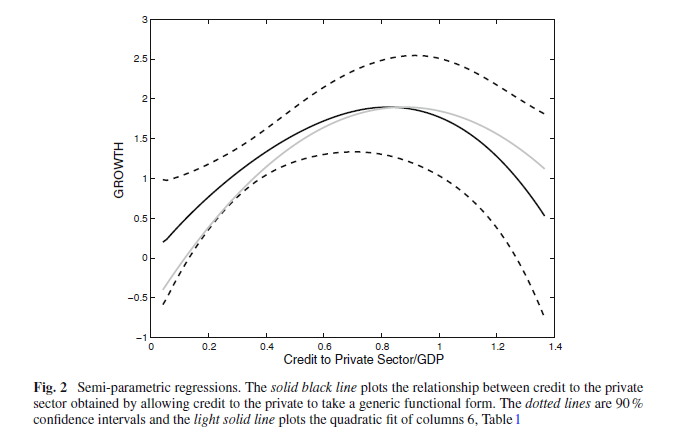
More finance can eventually produce diminishing benefits or accompany worse outcomes. Credit that funds a productive business is economically different from credit that finances a self-reinforcing increase in the price of existing property. A lending boom can relax collateral constraints, raise asset prices, encourage further borrowing and concentrate exposures to the same underlying risk. Resources may also be drawn into financial activities whose private returns exceed their contribution to aggregate production. The important question is whether additional intermediation improves information and investment decisions after allowing for the risks it creates.
The estimated finance–growth relationship below is nonlinear: in this historical sample, growth first rises and later falls as private credit relative to GDP increases. The dashed confidence limits indicate estimation uncertainty. The turning point is not a universal legal limit for an appropriate banking-sector size, and the fitted curve should not be treated as a forecast for a particular country. Results depend on the sample, controls, definition of credit, type of finance and period examined. Nor does a negative relationship at high credit levels establish that every additional loan is harmful; productive financing needs can remain unmet in an economy with a large aggregate banking system.
Research context: Hsieh and Klenow, Misallocation and Manufacturing TFP in China and India (2009); Arcand, Berkes and Panizza, Too Much Finance? (2015). The historical exhibits retain their original definitions and estimation periods.
Financial fragility and the wider cost of banking crises
A financial institution may create private profit while accumulating exposures that later impose costs on customers and the wider economy. Weak underwriting can expand credit in the short run, but losses eventually reduce banks' capacity or willingness to lend. Falling collateral values make refinancing harder; borrowers cut expenditure; investment and employment weaken; further defaults then damage bank balance sheets. The social cost of a crisis consequently extends beyond the losses borne by shareholders of the institutions that fail.
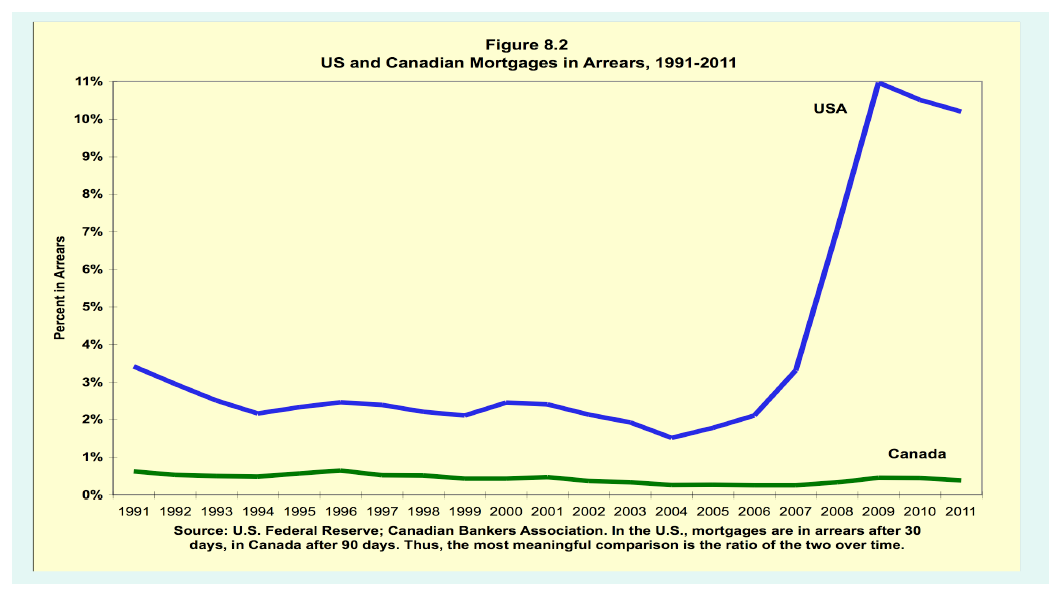
The US–Canada mortgage comparison illustrates the importance of both institutions and measurement. US arrears rose sharply around the global financial crisis, whereas the Canadian series remained much lower and more stable. However, the chart measures US mortgages after 30 days of arrears and Canadian mortgages after 90 days. It is therefore inappropriate to read the vertical gap as a like-for-like default-rate difference. The divergence over time is informative, but any explanation must also consider underwriting standards, mortgage contracts, housing-market conditions and the different arrears definitions.
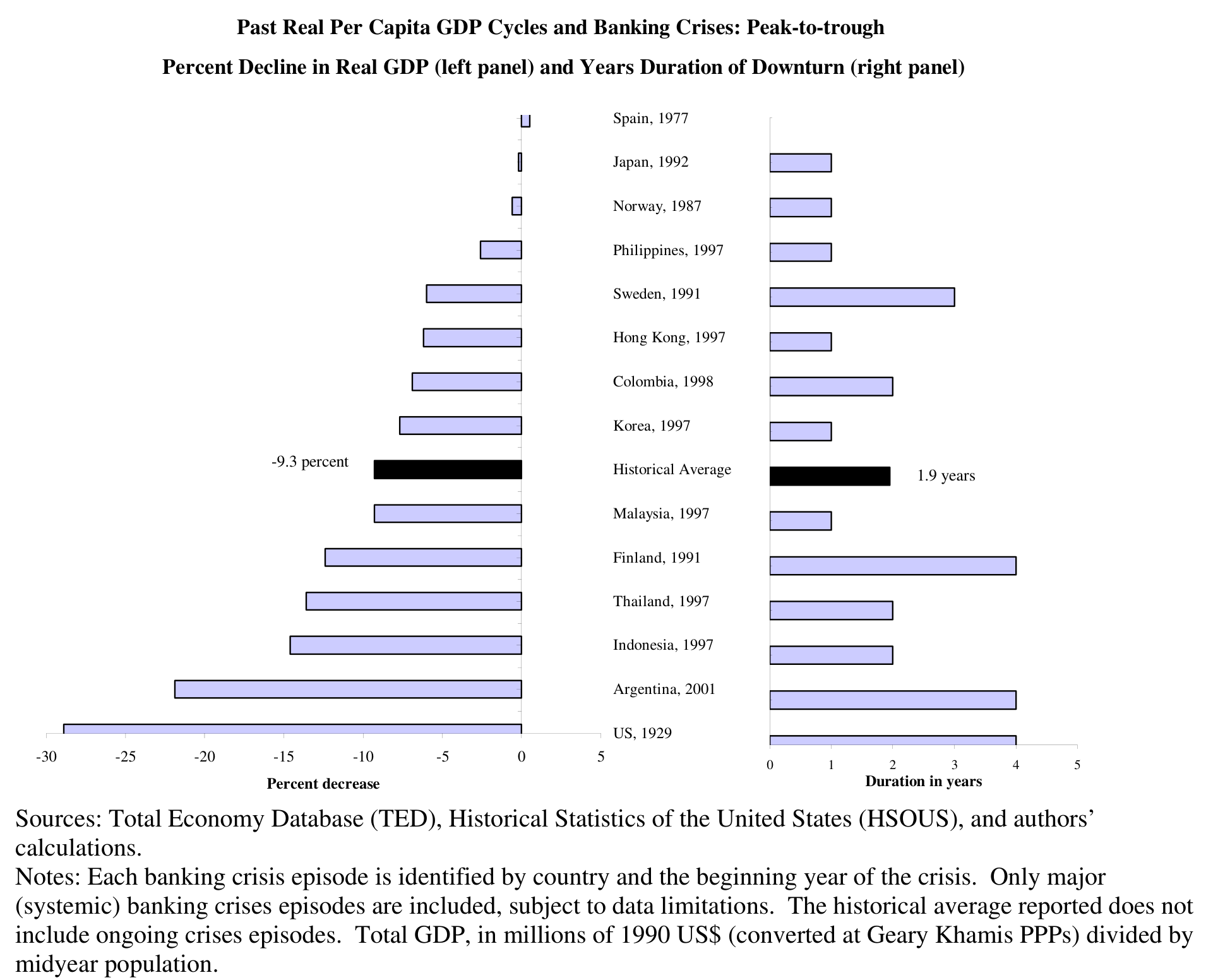
Historical crisis comparisons show substantial declines in output and long recoveries. In the selected episodes illustrated below, the reported average peak-to-trough real GDP decline is 9.3%, with a downturn lasting about 1.9 years. Related historical averages include unemployment increases of roughly seven percentage points, equity-price declines of about 56% and house-price declines of about 36%. These are summaries of selected past crises, not mechanical consequences of every bank failure. Different outcome measures may use different samples and time windows, so they should not be combined into a single representative country trajectory.
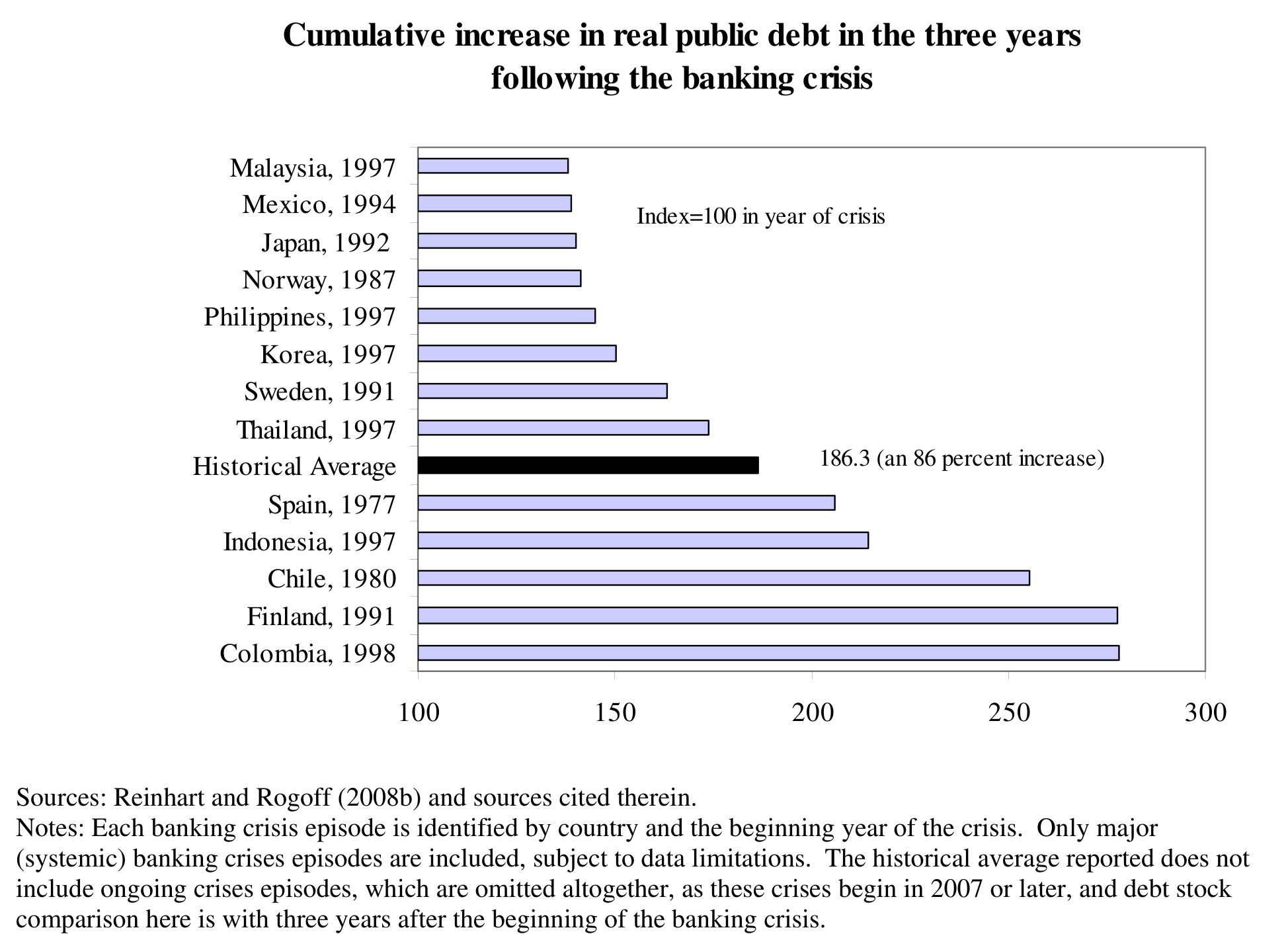
Public debt often increases after a crisis because tax receipts fall, automatic stabilisers support households, governments undertake discretionary measures and, in some cases, public resources support the financial system. The debt exhibit indexes the initial real debt level to 100; an average subsequent index of 186.3 means an increase of 86.3% in the real stock of debt. It does not mean an increase of 86.3 percentage points in the debt-to-GDP ratio, which has a different denominator. A deteriorating denominator can nevertheless make that ratio rise as well.
The problems are not confined to the distant past. Silicon Valley Bank and Signature Bank failed in the United States in March 2023, while Credit Suisse was taken over by UBS through an emergency transaction. Their circumstances differed, but they underline why funding concentration, asset values, confidence and access to liquidity must be assessed jointly. A bank can be vulnerable even when the assets it holds are not the same as those at the centre of the previous crisis. Later chapters develop the distinction between insolvency, illiquidity, contagious runs and the public interventions used to contain them.
Finance, wages and inequality
Financial development also affects the distribution of income. The historical US series below show that relative wages and the educational intensity of employment in finance changed markedly over the twentieth century. Both were high in the early decades, lower during much of the middle of the century, and rose again toward the end of the sample. The two series use different vertical scales: a movement in the education series cannot be read as the same percentage change as a movement in relative wages.
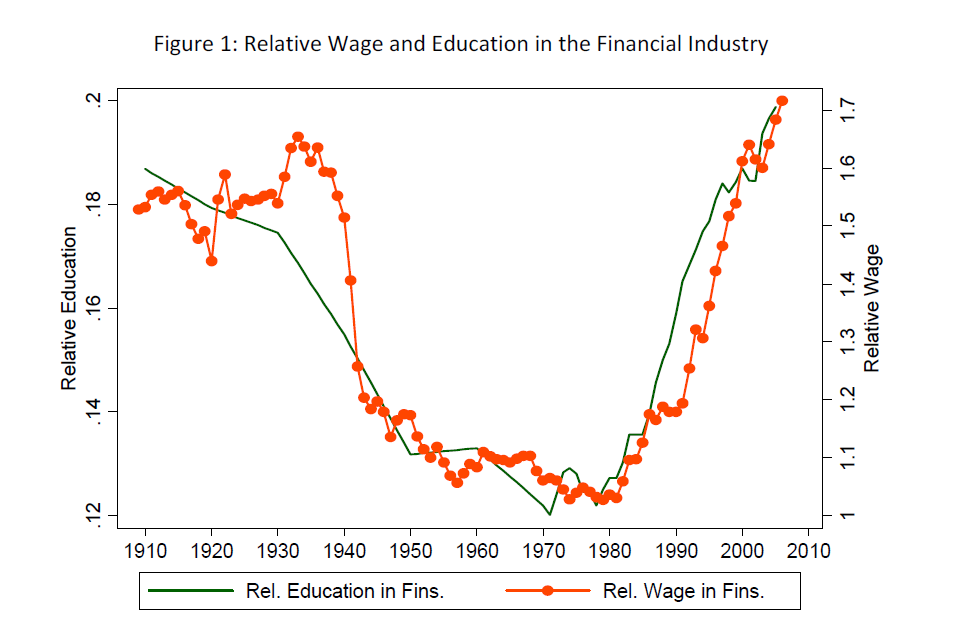
A wage premium may reflect specialised skills, demanding responsibilities, compensation for uncertain income or economic rents associated with market power and regulation. The chart alone does not identify their respective contributions. Likewise, finance may reduce inequality by widening access to credit and insurance while increasing inequality through high remuneration at the top of the sector or unequal access to profitable investment opportunities. Evaluating the distributional effect therefore requires examining who receives financial services, who bears losses and who captures the income generated by intermediation.
Direct finance, intermediated finance and the claims investors hold
A surplus unit has resources available beyond its current expenditure plans; a deficit unit seeks resources beyond its current income or internal funds. Financial markets connect them through securities. In direct finance, the ultimate investor holds a claim issued by the ultimate borrower: for example, a household or fund buys a company's bond, or an investor acquires newly issued shares. In indirect finance, an intermediary holds the claim on the borrower and issues a different claim to its own funders. A depositor has a claim on the bank, while the bank has a loan claim on a business.
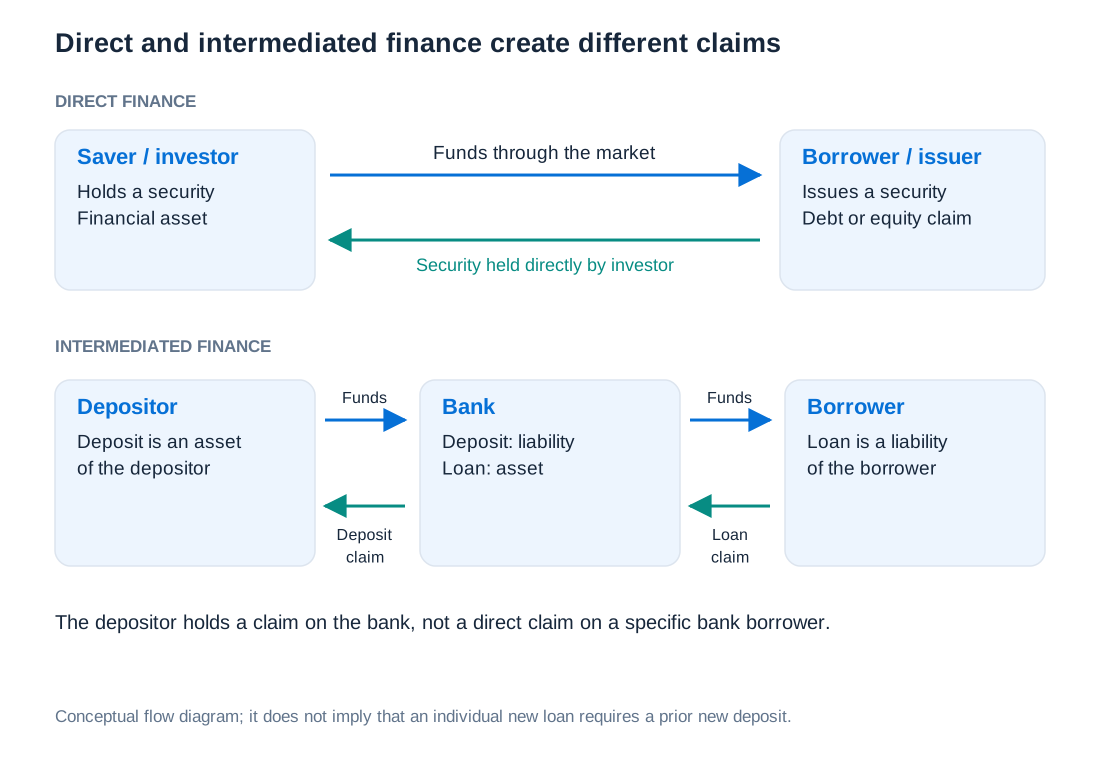
The presence of an intermediary in arranging a transaction does not automatically make the financing indirect in the balance-sheet sense. An investment bank can place a bond with investors while the investors remain creditors of the corporate issuer. A mutual fund pools investors' resources and purchases securities; investors generally bear changes in the value of the fund's portfolio through its net asset value. A commercial bank instead promises repayment of deposits according to their contractual terms even though the borrowers it finances may default. These arrangements differ in risk bearing, redemption rights and information production.
Insurance companies and pension institutions also channel saving into financial assets, typically against longer-horizon obligations. Investment companies, hedge funds and financial-technology businesses provide further combinations of management, matching, risk bearing and transaction services. Legal labels alone are not enough to classify a business. The analyst should ask whose balance sheet carries the exposure, who owes repayment to whom, whether a nominal value is promised and how withdrawal or redemption is funded.
The allocation-of-savings description should not be mistaken for a claim that a bank can lend only after locating an identical amount of pre-existing deposits. A bank can create a deposit when it grants a loan. It still needs capital, an economically viable borrower and a way to finance and settle payments when the newly created balance leaves the institution. The distinction between money creation and funding is developed in the chapter on money; it is already important here because intermediation is more than physically transferring a fixed stock of currency from one saver to one borrower.
Comparing the euro-area and US financial systems
The balance between banks and securities markets differs across economies. The December 2024 exhibits below portray a larger relative role for bank balance sheets in the euro area and a larger role for equity markets and pension funds in the United States. The first compares dollar amounts, while the second scales the aggregates by nominal GDP. Scaling matters: a larger economy can have larger financial markets in currency terms even if those markets are smaller relative to its annual output.
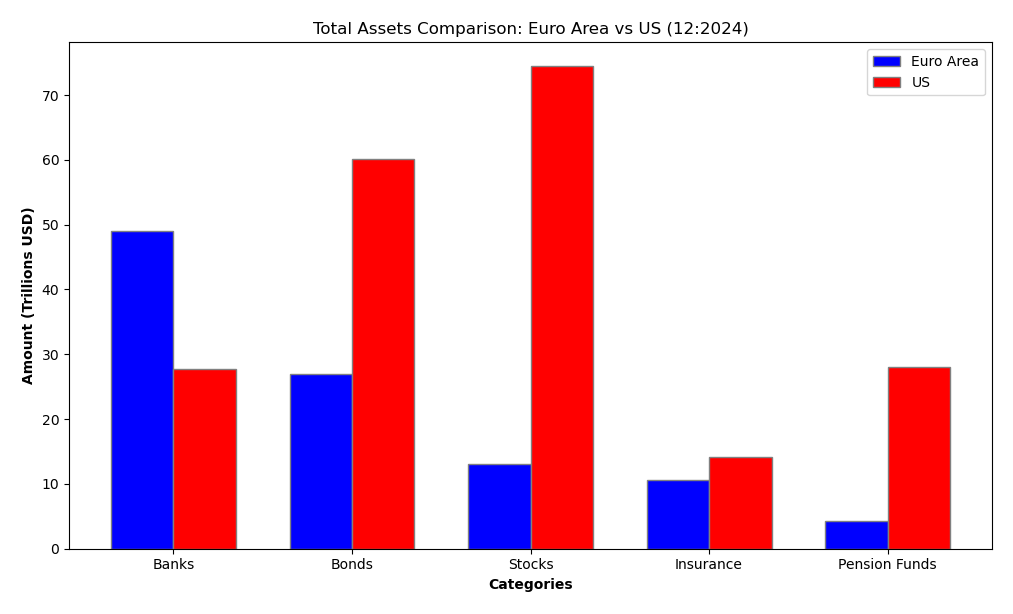
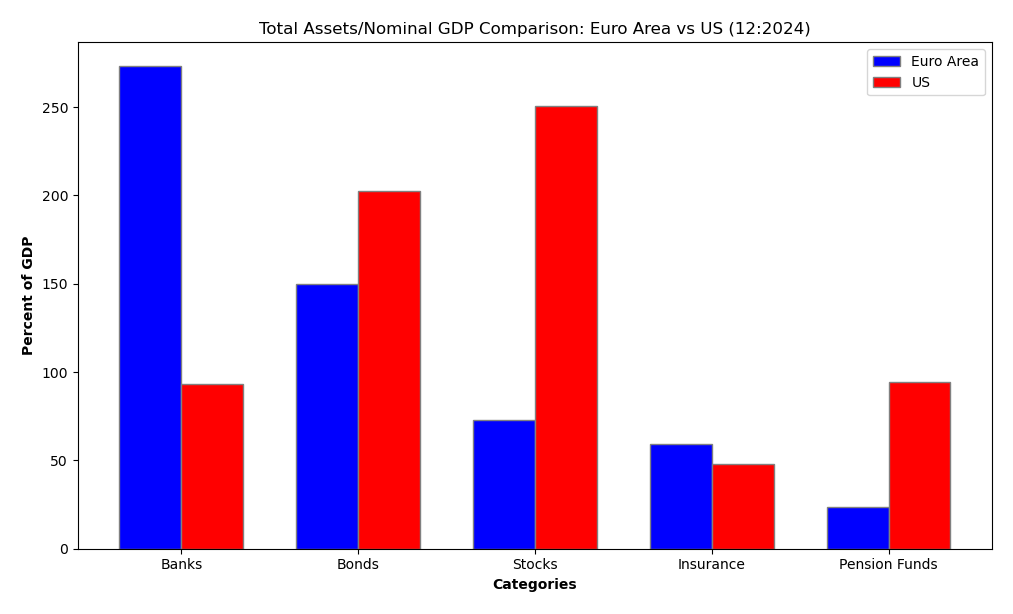
These categories are not mutually exclusive components of a single total. A bank may own bonds, an insurer may own shares, and a pension fund may hold claims on an investment fund. Adding bank assets, bonds, stock-market capitalisation, insurance assets and pension assets therefore double-counts many underlying claims. Moreover, securities outstanding and an institution's total assets are conceptually different aggregates. Exchange rates affect the dollar comparison; national accounting boundaries and consolidation rules affect both comparisons. The exhibits are historical structural illustrations, rather than a substitute for a harmonised financial-accounting dataset.
A bank-oriented system is not inherently superior or inferior to a market-oriented system. Banks can develop private borrower information and negotiate flexible contracts; markets can distribute risk widely and provide transparent prices for standardised claims. In practice they complement one another. A company can borrow from banks, issue bonds and sell equity, while the banks themselves use markets to obtain funding, hedge risks and distribute exposures.
Brokerage and information before a contract
The first core service of an intermediary is brokerage: bringing together parties with complementary needs and helping them transact. In the strict economic sense, a broker acts as an agent rather than purchasing the underlying exposure for its own account. A dealer, by contrast, takes a principal position. The same securities firm may perform both roles in different transactions. Calling an institution a broker consequently does not establish that all of its activities are free of balance-sheet risk.
Brokerage can overcome adverse selection, an information problem present before a contract is signed. A seller may know more about an asset's quality than a prospective purchaser; a borrower may know more about repayment prospects than a lender. If the less-informed party offers terms based on average quality, good-quality counterparties may find the terms unattractive, worsening the mix of those who participate. Screening, reliable disclosure and reputation can help investors distinguish among opportunities rather than pricing every transaction as though it were identical.
A retail investor choosing among investments, a bondholder evaluating an issuer's creditworthiness and an investor considering an initial public offering all confront this problem in different forms. A wealth manager can investigate investments and construct a suitable portfolio. A rating agency can produce a structured assessment of credit risk. An investment bank can organise due diligence, prepare offering documentation and explain the issuer to investors. None of these services guarantees a correct outcome; their value depends on the quality of the information and the incentives of the provider.
Specialisation also reduces duplicated screening. Suppose 100 investors would each spend EUR 200 producing substantially the same assessment of an issuer. Their combined research cost would be EUR 20,000. If a specialist can produce and distribute an equally useful assessment for EUR 5,000 in total, coordination saves EUR 15,000 even if the specialist is no more technically capable than an individual investor. This constructed example isolates a cost saving; fees, conflicts of interest and the value of independent second opinions can reduce the benefit. The correct claim is that brokerage can add value even when investors possess the necessary skills, not that every intermediary is always beneficial.
Monitoring, moral hazard and reusable information
After a contract is signed, the information problem changes. Moral hazard arises when a party's subsequent actions are difficult to observe or constrain and some consequences fall on another party. An insured firm may take less care to prevent damage; a manager may pursue acquisitions that increase personal power while reducing shareholder value; a borrower may shift toward a riskier project after receiving a loan. The defining feature is hidden or imperfectly controlled behaviour after contracting, rather than hidden borrower quality before contracting.
Monitoring responds to this problem by gathering information about actions and outcomes. Shareholders may use specialist advice when exercising voting rights. Lenders can require financial reports and covenants, investigate deterioration and negotiate corrective action. A portfolio manager may reduce exposure to issuers whose behaviour becomes inconsistent with the client's objectives. Selling a security does not itself remove the issuer's risk from the financial system, but the possibility of losing access to funding can affect incentives. Monitoring is costly, and excessive duplication among investors can again waste resources.
Information has value across both clients and time. Cross-sectional reusability means that analysing one firm helps an intermediary assess another: a rating specialist familiar with insurance balance sheets need not relearn the business model for every insurer. Intertemporal reusability means that past interaction improves subsequent assessment: a bank that helped a company issue equity may understand its later bond issue better because it already knows the management, reporting systems and business risks. These economies help explain persistent financial relationships, but also create switching costs and potential market power. A relationship is valuable when accumulated knowledge improves decisions, not merely because it is old.
Qualitative asset transformation
The second core service is qualitative asset transformation, usually abbreviated QAT. An intermediary acquires assets with one set of characteristics and offers its funders claims with another. A residential mortgage may be large, last for decades, trade infrequently and expose its owner to default risk. A household depositor may want a small divisible balance, immediate payment access and limited exposure to any individual mortgage. The bank bridges these demands using a portfolio of assets, funding arrangements, liquidity reserves and loss-absorbing capital.
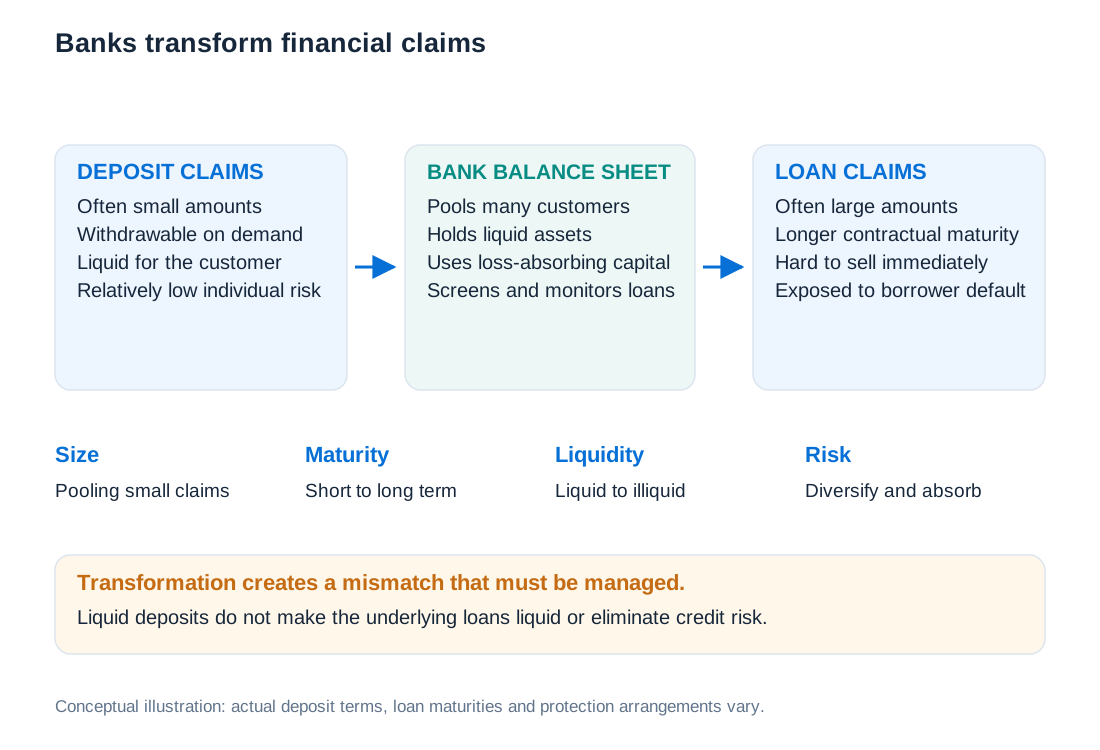
| Transformation | Mismatch the intermediary bridges | Economic implication |
|---|---|---|
| Size or lot size | Many small savings balances support larger loans | Pooling reduces minimum financing sizes and enables diversification |
| Maturity and repricing | Funding may mature or reprice before the assets it supports | Renewal risk and interest-rate risk arise when cash flows respond differently |
| Liquidity | Depositors can demand payment before loans can be sold at reasonable prices | Liquid buffers and reliable access to funding are necessary |
| Risk and conditionality | Risky asset cash flows support claims intended to be more predictable | Diversification, seniority and capital allocate losses rather than abolishing them |
| Currency | Assets and funding may be denominated in different currencies | Exchange-rate exposure and access to currency-specific liquidity require management |
Maturity and liquidity are related but distinct. A long-term bond can be readily marketable; a short-term private loan may be difficult to sell. Repricing maturity also differs from final maturity: a ten-year floating-rate loan may reset its interest rate frequently, whereas a shorter fixed-rate loan has a locked coupon until repayment. Identifying the relevant mismatch requires examining contractual cash flows and realistic customer behaviour, rather than assigning a single maturity number to every asset and liability.
Transformation inevitably places capital at risk. Diversification reduces exposure to an individual borrower's failure but does not eliminate a common recession or a market-wide liquidity shock. Depositors can hold relatively safe claims because losses initially fall on other stakeholders and because safeguards may apply; safety is not created by relabelling risky assets. Pure agency brokerage does not normally expose the intermediary to the customer's loan or market position, but it still involves operational, legal, conduct and reputational risks. The precise distinction is the absence or presence of the underlying principal exposure.
A worked distinction between liquidity and solvency
Consider a simplified institution holding EUR 85 of long-term loans and EUR 15 of immediately available liquid assets, financed by EUR 100 of deposits. Ignore equity only to isolate the liquidity arithmetic; a viable bank would ordinarily need a capital buffer. If depositors request EUR 40 at once, immediately available assets cover only EUR 15, leaving a EUR 25 funding gap. The loans might ultimately repay in full, yet the institution cannot meet the withdrawal without borrowing, selling assets or obtaining another source of liquidity. An inability to pay on time does not, by itself, establish that ultimate asset values are below liabilities.
Conversely, a bank can have enough cash to pay today's withdrawing depositors while the economic value of its remaining assets is less than its obligations. That is a solvency problem. A forced sale can connect the two: an initially solvent institution may realise large discounts while raising liquidity, reducing its equity and making doubts about solvency more credible. In a properly capitalised balance sheet, the first question is therefore whether asset values cover liabilities; the second is whether payment obligations can be met when due. Both need answers.
Payments, custody and the financial infrastructure
The third service is the operation of financial infrastructure. Cash services include access to ATMs and foreign-currency exchange. Transaction services include bank transfers, cheques and debit- or credit-card payments. Securities services include custody, clearing and settlement. Custody records and safeguards ownership; clearing establishes obligations between participants; settlement discharges those obligations through the final transfer of money or securities. These processes make finance usable in daily economic activity, including when the provider makes no loan to the customer.
Infrastructure produces risks of its own. A fault in ATM software can permit unauthorised withdrawals; a payment system may fail to execute instructions; a custodian may lose track of beneficial ownership or misuse client assets. Financial-crime and sanctions controls also matter because transaction networks connect counterparties across jurisdictions. These risks are not adequately measured by a loan default rate or an interest margin.
Two historical enforcement cases show the potential scale. In 2014, BNP Paribas agreed to plead guilty and pay approximately USD 8.9 billion in connection with processing transactions involving countries subject to US sanctions. In the MF Global case, US enforcement actions addressed misuse of segregated customer funds, with restitution obligations and monetary penalties. The economic lesson is that assets held for clients must remain distinguishable from the intermediary's own resources and that access to payment infrastructure carries legal responsibilities. Neither case is simply an example of ordinary borrowers failing to repay.
Historical case documentation: US Department of Justice, BNP Paribas agreement, 30 June 2014; CFTC, MF Global order, 24 December 2014. Prize context: Nobel Peace Prize 2006 and economics prize 2022.
These three services provide a practical way to analyse any financial institution. Ask first what information or matching service it supplies, then whether it transforms claims on its own balance sheet, and finally what infrastructure it operates. A universal bank may perform all three; a specialist platform may concentrate on one. The answers identify the sources of revenue, the risks that require management and the safeguards necessary to preserve the economic value of intermediation.