
3. Bank Lending: Contracts, Credit Analysis and Collateral
A bank loan combines a transfer of purchasing power today with a claim on future payments and a set of rights that govern what happens between those dates. Its value depends on the borrower's cash flows, but also on information, incentives, priority and enforcement. Good lending therefore involves much more than checking whether a borrower owns valuable assets: the bank must understand how the debt will be repaid, how repayment prospects could deteriorate, and what the contract allows it to do when they do.
Loans in the bank's asset portfolio
Lending is the largest asset category in the euro-area banking aggregates below. Its importance does not mean that every loan finances a household purchase or a business investment. Interbank claims and deposits held at the central bank are included in the loan statistics, so changes in aggregate loans can reflect liquidity management and monetary operations as well as credit supplied to the non-financial economy. Securities, meanwhile, include instruments that may expose the bank to credit and interest-rate risks similar to those arising from a loan.
| Asset category | 2000 | 2005 | 2010 | 2020 | June 2025 |
|---|---|---|---|---|---|
| Loans | 63% | 58% | 55% | 61% | 59% |
| Securities | 14% | 15% | 15% | 11% | 12% |
| Other assets | 24% | 27% | 29% | 28% | 29% |
| Total assets (EUR billion) | 16,662 | 23,635 | 32,207 | 35,930 | 41,383 |
| Borrower or loan category | 2000 | 2005 | 2010 | 2020 | June 2025 |
|---|---|---|---|---|---|
| Interbank, including central-bank deposits | 34% | 33% | 31% | 40% | 40% |
| Government | 8% | 6% | 7% | 5% | 4% |
| Corporates | 26% | 25% | 26% | 22% | 21% |
| Retail mortgages | 18% | 21% | 21% | 21% | 22% |
| Other retail | 11% | 9% | 8% | 6% | 6% |
| Other loans | 4% | 5% | 7% | 6% | 7% |
| Total loans (EUR billion) | 10,421 | 13,678 | 17,762 | 21,977 | 24,481.5 |
The percentages are rounded and need not sum to exactly 100%; neither should rounded asset shares be multiplied by totals to manufacture more precise loan amounts. Between 2000 and June 2025, the displayed stock of total assets increased substantially, while loans remained close to three-fifths of the balance sheet. Corporate lending and mortgages are large exposures, but interbank claims are sufficiently important that a bank's funding and counterparty network cannot be ignored in credit analysis.
Data: European Central Bank, aggregated balance sheet of euro-area monetary financial institutions, historical observations through June 2025. These are dated observations, not a statement of the latest balance-sheet position.
Term loans, revolving facilities and letters of credit
From the lender's perspective, granting a loan means acquiring a financial asset: an enforceable claim against the borrower's future cash flows. The principal advanced is the initial investment in that claim. Bank loans are often customised and relatively illiquid because outsiders do not possess all the information collected during negotiation and monitoring. A loan is an asset for the bank and a liability for the borrower; these two perspectives must not be confused when discussing interest income, funding costs or balance-sheet expansion.
A term loan supplies funds for a defined maturity, often to finance a fixed investment or refinance existing debt. A simple term loan is paid out in full at origination. An amortising structure repays principal gradually; a bullet structure leaves principal until maturity. A revolving credit facility instead permits borrowing, repayment and reborrowing during an availability period up to a contractual limit. The undrawn commitment matters because the bank may need to provide cash exactly when the borrower becomes more dependent on it. Interest on amounts drawn and a commitment fee on undrawn amounts perform different economic functions.
A letter of credit is a bank undertaking to pay a beneficiary when specified documentary conditions are satisfied, widely used in trade. It resembles a guarantee in providing the bank's credit standing, but a documentary credit and a standby guarantee need not have the same payment conditions. Its initial exposure may be contingent rather than a cash loan. If the bank pays and the customer does not immediately reimburse it, the contingent commitment becomes a funded credit exposure.
The distinction between loans and bonds is a matter of degree. Both are debt claims, and both can be secured, floating-rate or covenant-protected. Bonds are usually more standardised and easier to trade; loans often involve private information and active monitoring. Loan sales and securitisation can transfer a loan's economic risk beyond the originating bank, so the institution that originates, funds, services and ultimately bears the risk need not be the same.
The lending process and its information problems
Origination begins with identifying a customer's financing need, receiving an application, assessing creditworthiness and negotiating a contract, including its price. Funding then supplies the agreed resources once the relevant conditions are met. Servicing records balances, collects interest and principal, and administers contractual obligations. Risk processing continues after disbursement through monitoring, portfolio diversification, interest-rate management and, when necessary, restructuring or recovery. The bank's credit culture governs who can approve a loan, how exceptions are reported and whether staff are rewarded for sound long-term repayment or simply for lending volume.
| Function | Main task | Reason it matters |
|---|---|---|
| Origination | Application, screening, contract design and pricing | Select viable borrowers and establish terms before exposure arises |
| Funding | Provide funds after approval and fulfilment of drawdown conditions | Convert a commitment into a funded asset without losing liquidity control |
| Servicing | Bookkeeping and collection of contractual payments | Maintain reliable balances and identify arrears promptly |
| Risk processing | Monitoring, diversification, workouts and interest-rate risk management | Control losses and exposures throughout the life of the claim |
| Credit culture | Organisation, reporting, communication and staff incentives | Make individual decisions consistent with the bank's risk capacity |
Adverse selection concerns information hidden before contracting: applicants know more about their ability or intentions than the bank does. Screening and credit analysis try to distinguish these types. Moral hazard concerns actions taken after financing: the borrower may substitute a riskier project, reduce effort, divert assets or prioritise other creditors. Contract design and monitoring seek to influence those actions. A favourable initial credit score cannot prevent an owner from changing business strategy after the loan has been paid out.
Two forms of moral hazard are especially useful to distinguish. Asset substitution increases project risk after the lender has fixed its promised return; limited liability allows shareholders to capture part of the upside while creditors bear more downside. Effort aversion arises when the borrower bears the private cost of careful management but shares the resulting improvement in repayment prospects with the lender. Capital at risk, collateral, covenants and the prospect of future borrowing can all alter these incentives, though none eliminates the need to assess project viability.
Financial terms, covenants and control rights
A loan contract specifies principal, interest, fees, drawdown conditions and repayment dates. A floating interest rate changes with a benchmark plus an agreed margin; a fixed rate remains constant over its specified period. Floating rates reduce some interest-rate mismatch for the lender, but may increase borrower default risk when debt service rises. Fees also matter: an up-front facility fee or a recurring commitment fee means that the borrower's financing cost is not captured by the stated coupon alone.
Representations and warranties establish facts asserted at contracting, such as the accuracy of financial statements, authority to borrow, title to assets and disclosed litigation. Affirmative covenants require continuing actions, including reporting, maintaining insurance and paying taxes. Negative covenants restrict conduct, such as asset sales, additional liens, mergers or dividends. Financial covenants impose measurable thresholds, for example a maximum debt-to-EBITDA ratio or a minimum interest-coverage ratio. A financial covenant is often economically restrictive even if the agreement places it under an affirmative-covenant heading.
These provisions transfer control rights before a borrower necessarily misses a payment. A covenant breach can lead to a waiver, additional reporting, revised pricing, more security or acceleration if the contract and applicable law allow it. The existence of a breach does not mean that immediate liquidation is always the bank's best response. It can be more valuable to renegotiate a viable business than to enforce against assets at distressed prices. Covenant definitions must therefore be read carefully: permitted EBITDA adjustments, accounting conventions, testing dates and cure provisions can materially change the same apparently simple ratio.
| Family | Provision | Investment grade (n = 3,533) | Non-investment grade (n = 945) | Total (n = 4,478) |
|---|---|---|---|---|
| Investment restrictions | Indirect investment restrictions | 7.8 | 42.43 | 15.1 |
| Investment restrictions | Merger restrictions | 91.8 | 93.3 | 92.1 |
| Investment restrictions | Secured | 3.0 | 5.3 | 3.5 |
| Investment restrictions | Stock sale restrictions | 1.5 | 3.7 | 2.0 |
| Investment restrictions | Direct investment restrictions | 0.04 | 2.4 | 0.8 |
| Investment restrictions | Any investment restriction | 93.8 | 94.3 | 93.9 |
| Dividend restrictions | Dividend payment restrictions | 5.5 | 39.0 | 12.6 |
| Dividend restrictions | Restrictions on other payments | 5.0 | 43.0 | 13.1 |
| Dividend restrictions | Dividend or other payment restrictions | 6.2 | 44.0 | 14.2 |
| Subsequent financing | Subordinate debt issuance | 74.1 | 66.6 | 72.5 |
| Subsequent financing | Sale and lease obligations | 58.1 | 40.3 | 54.3 |
| Subsequent financing | Debt priority | 15.8 | 49.5 | 22.9 |
| Subsequent financing | Stock issuance | 5.1 | 28.1 | 10.0 |
| Subsequent financing | Any subsequent financing restriction | 78.4 | 73.2 | 77.3 |
| Event restrictions | Default-related event covenants | 51.7 | 71.0 | 55.8 |
| Event restrictions | Change-of-control poison put | 24.4 | 74.2 | 34.9 |
| Event restrictions | Any event restriction | 60.0 | 88.7 | 66.1 |
The bond sample covers US-domiciled non-financial issuers over 1993–2007. The categories overlap: a bond can restrict dividends and borrowing at the same time, and a family total is not the sum of all its rows. The sharp difference in dividend and change-of-control provisions illustrates how contracts respond to conflicts between shareholders and creditors. It does not imply that every covenant is more common in speculative-grade bonds; the table contains counterexamples.
| Covenant | Loans | Loan packages | Mean amount (USD bn) | Median amount (USD bn) | Total amount (USD bn) |
|---|---|---|---|---|---|
| Maximum debt to EBITDA | 7,544 | 4,417 | 0.20 | 0.09 | 1,480.53 |
| Minimum tangible net worth | 7,196 | 4,931 | 0.13 | 0.03 | 926.67 |
| Minimum fixed-charge coverage | 6,064 | 3,514 | 0.14 | 0.06 | 842.95 |
| Minimum interest coverage | 5,856 | 3,486 | 0.22 | 0.10 | 1,299.70 |
| Maximum leverage ratio | 2,401 | 1,748 | 0.32 | 0.15 | 758.06 |
| Maximum debt to tangible net worth | 2,331 | 1,677 | 0.06 | 0.01 | 137.90 |
| Minimum current ratio | 2,098 | 1,455 | 0.06 | 0.02 | 126.45 |
| Minimum debt-service coverage | 1,906 | 1,186 | 0.07 | 0.01 | 126.08 |
| Maximum senior debt to EBITDA | 1,654 | 857 | 0.14 | 0.09 | 231.34 |
| Minimum EBITDA | 1,556 | 886 | 0.09 | 0.04 | 135.32 |
| Minimum quick ratio | 779 | 555 | 0.02 | 0.01 | 19.16 |
| Minimum cash interest coverage | 321 | 165 | 0.19 | 0.10 | 60.70 |
| Maximum debt to equity | 169 | 119 | 0.17 | 0.04 | 27.95 |
| Maximum senior leverage | 20 | 10 | 0.23 | 0.12 | 4.54 |
| Maximum loan to value | 19 | 8 | 0.05 | 0.02 | 0.97 |
A loan package can contain several facilities, which explains why the number of loans exceeds the number of packages. The amount columns describe the loans associated with each covenant, not the covenant thresholds. For instance, 0.20 billion in the first row is an average loan amount, not a debt-to-EBITDA limit. A single loan can appear under several covenants, so adding the monetary totals across rows would double-count exposures.
Historical covenant tables: Chava, Fang, Kumar and Prabhat (2019), Debt Covenants and Corporate Governance, reviewing the bond evidence of Chava, Kumar and Warga (2010) and the loan evidence of Chava and Roberts (2008). The loan data combine non-financial-firm records from CRSP/Compustat and DealScan; EBITDA means earnings before interest, taxes, depreciation and amortisation.
A real loan agreement: the North Wabash residential financing
The 9 November 2012 residential term-loan agreement between 401 North Wabash Venture LLC, as borrower, and Deutsche Bank Trust Company Americas, as lender, shows how these mechanisms fit together. Its stated maximum principal was USD 53,730,977.65, to be advanced in full at closing. The proceeds refinanced existing debt secured on the mortgaged premises and associated customary closing costs. Principal repaid could not be borrowed again: this was a term loan, not a revolver. The residential facility must also be distinguished from the separate commercial loan to which several provisions referred.
The agreement identified Donald J. Trump as guarantor and Trump Chicago Residential Manager LLC as the manager. Their economic roles differ: the borrower owes the loan, the guarantor supports specified obligations, and the manager operates the relevant property. This is a historical contract study; its rates, dates, thresholds and remedies are the negotiated 2012 terms, not current standard conditions for every property loan.
| Term | Contractual provision | Economic purpose |
|---|---|---|
| Principal and availability | USD 53,730,977.65, fully funded at closing; no reborrowing | Refinancing rather than a continuing working-capital commitment |
| LIBOR option | Relevant USD LIBOR plus 3.35 percentage points annually | Benchmark compensation plus borrower-specific margin |
| Ordinary prime option | Prime rate plus 1.00 percentage point annually | Alternative floating-rate convention |
| LIBOR-failure fallback | Conversion at prime minus 0.50 percentage points under section 2.2(b) | A distinct contingency rule, not the ordinary prime-option margin |
| Interest computation | Actual days/360 for LIBOR; actual days/365 for prime | Day-count conventions affect the cash interest paid |
| Facility fee | 0.625% of initial loan, payable at closing | Up-front compensation of approximately USD 335,818.61 |
| Original maturity | 8 November 2016, unless accelerated or validly extended | Defines the refinancing and final repayment deadline |
| Conditional extension | To 7 November 2017; principal no more than USD 6 million, LTV no more than 25%, no specified continuing defaults and required fees paid | Extension depends on deleveraging and collateral protection |
| Extension fee | 0.25% of outstanding principal | USD 15,000 if principal is exactly USD 6 million |
| Default interest | Greater of prime + 4 percentage points or the otherwise applicable loan rate + 4 percentage points, capped at the maximum permitted rate | Applies during a continuing event of default and replaces ordinary interest |
| Late charge | 5% of overdue amounts after applicable notice/cure periods, subject to contractual and legal limitations | Compensation for handling delinquency, distinct from default interest |
LIBOR interest periods could be 30, 90 or 180 days, or 12 months, subject to the agreement. Interest was payable at the end of the period and, for periods longer than 90 days, also at three-month intervals. Prime-rate interest was payable monthly. The contract limited simultaneous LIBOR advances to five, with at least USD 1 million in each separately selected period. If a swap was chosen, its index and the loan's interest-period election had to be coordinated. A swap was optional, but obligations under it could receive security and guarantee protection under the loan documents.
For an illustrative, unchanged USD 10 million balance at a 4% annual LIBOR-based contractual rate over 90 actual days, the interest is dollars. A 365-day denominator would produce approximately USD 98,630.14 for the same numerical rate and days. The example isolates the day-count effect; it is not a reconstruction of actual payments. LIBOR has since ceased publication, so studying the old clause does not imply that a new loan should use it.
Historical contractual terms: Term Loan Agreement (Residential), 9 November 2012, sections 1.1 and 2.1–2.18. For the subsequent benchmark transition, the Financial Conduct Authority records that the final remaining synthetic LIBOR settings were published on 30 September 2024.
Repayment, property sales and collateral control
The North Wabash loan combined a final maturity with mandatory reductions in principal. Sales of residential units, parking units and storage units generated release payments to the bank. A unit could be released from the mortgage only under the agreed closing and documentation conditions, including receipt of the required payment and the absence of a disqualifying default. The lender therefore did not simply rely on the borrower promising to use sale proceeds responsibly: release of collateral was tied to reduction of its exposure.
| Anniversary of closing | Minimum principal repaid cumulatively (USD) | Initial principal less this cumulative amount (USD) |
|---|---|---|
| First | 11,932,744.41 | 41,798,233.24 |
| Second | 23,865,488.83 | 29,865,488.82 |
| Third | 35,798,233.24 | 17,932,744.41 |
| Fourth | 47,730,977.65 | 6,000,000.00 |
The repayment column is cumulative: the second-anniversary amount already includes the first-anniversary requirement. Excess repayments counted toward subsequent minimums. If sales and other repayments fell short, the borrower or guarantor had to provide the difference from other resources. The USD 6 million balance in the last row is not an unconditional right to leave that amount outstanding beyond the original maturity; without a valid extension, all remaining principal was due at maturity.
The release payment for a unit was the greater of its scheduled minimum release price and its required release price. The latter broadly meant the adjusted gross sales proceeds less permitted selling costs and reimbursable furniture, fixtures and equipment costs for eligible model units. The specified category of customary closing costs, commissions and related deductions was capped at 8% of the gross sales price. Thus a nominal sale price alone does not reveal the amount left for the borrower. The minimum release schedule prevents an unusually low sale price from eroding the lender's remaining collateral cushion without an adequate paydown.
Voluntary prepayments generally required three business days' notice and at least USD 1 million, with USD 100,000 increments above that amount, unless paying the smaller remaining balance in full. The agreement described prepayment as free of a premium or penalty, while still requiring specified LIBOR breakage and increased-cost compensation. Those are economically relevant potential costs: “no prepayment penalty” does not necessarily mean that every early repayment has zero cash consequence. Taxes, withholding gross-ups and changes in regulatory funding costs were also allocated by explicit clauses.
The residential collateral carried a first-priority security interest, subject to permitted encumbrances, and the demand deposit account was part of the collateral package. The residential facility additionally benefited from a second-priority claim on the commercial mortgaged premises, while the commercial facility benefited from cross-collateralisation in the other direction under its documents. These arrangements had defined termination conditions. Priority matters because a second lien only reaches value remaining after the prior claim; saying that two loans are secured by the same building does not mean that their recoveries are identical.
Section 2.10 also provided for an unconditional guarantee of outstanding principal and interest, together with operating shortfalls during the contractually defined coverage period. Its reference to a separate guaranty matters: the loan agreement describes that support, but all detailed limits and mechanics must be read with the actual guaranty rather than invented from a property valuation. A guarantee is a claim on a person; collateral is a claim against identified assets. Their value depends on different recovery channels and can be correlated when guarantor wealth falls with the property market.
Covenants, default and the supporting documents
The historical LTV covenant limited outstanding debt to 57% of appraised mortgaged-property value before the original maturity and to 25% afterward. After the second anniversary, the lender could obtain an appraisal at its own expense to test the ratio. A shortfall could be addressed with a principal paydown, eligible cash or cash-equivalent collateral, or a combination. For this calculation, additional LTV collateral was deducted from the loan numerator rather than treated as another piece of property in the denominator.
With debt , eligible pledged cash and appraised property value , the adjusted test can therefore be expressed as , where is the applicable 0.57 or 0.25 limit. An illustrative debt balance of USD 30 million against USD 50 million of property is at 60% LTV. To reach 57%, the borrower must reduce the adjusted debt by million dollars. The example is a calculation of the contract's mechanism, not a claim about the property's actual historical valuation.
The agreement included notice and appraisal-dispute procedures. Before treating an apparent shortfall as an immediately enforceable default, the bank had to consider the relevant cure and dispute provisions, including the mechanism for an independent third appraisal. A drafting inconsistency in one extension passage used the words “twenty percent” beside “25%”; the repeated substantive extension and covenant provisions specify 25%. This is precisely why a contractual analysis should reconcile the operative clauses rather than copy an isolated phrase.
Information rights required annual financial statements and a compliance certificate within 120 days of calendar-year end, and quarterly sales and unit-closing reports within 45 days of quarter-end. The annual financial statements were specified as unaudited, prepared by independent certified public accountants and certified by a responsible borrower officer; describing them simply as audited accounts would be incorrect. The agreement also required access to records and information about relevant defaults, material changes, taxes and condominium operations.
Other affirmative obligations maintained insurance, property condition, legal permissions, environmental compliance and separate-entity status. Negative covenants restricted new liens, transfers, mergers, additional debt, affiliate transactions and loans to others. Distributions were prohibited while an event of default continued. The special-purpose-entity provisions, management arrangements and insurance obligations all protect the value that ultimately supports repayment; they are economically connected to credit risk even when they do not look like an interest-rate clause.
Events of default extended beyond missed principal. They included unpaid interest or fees after the specified three-business-day period, material misrepresentation, defined covenant failures, relevant insolvency proceedings, loss of security, prohibited assignments, change of control and specified management misconduct. The cross-default provisions linked this loan to other debt, including a threshold above USD 20 million for debt to outside creditors, subject to the detailed acceleration, contest and collateral conditions. Material judgments above USD 10 million were separately addressed. Some breaches had cure periods, some could be accelerated automatically, and some allowed the lender to choose acceleration. None of these distinctions can be collapsed into “any problem makes the loan immediately due.”
On a continuing default, contractual remedies included acceleration, use of cash collateral, foreclosure and exercising specified rights over contracts and receipts. The lender could act as attorney-in-fact for defined protective purposes; this did not make it a partner in the project. This was a bilateral lender-borrower agreement, not evidence of a separate syndicated-loan administrative agent. It allowed assignments and participations under specified consent and counterparty conditions. With a participation, the original lender remained the holder of the agreement and note and the borrower continued dealing directly with it, illustrating how funding or risk can be shared without replacing the borrower's operational counterparty.
The supporting schedules turn broad promises into verifiable procedures. Sales-contract forms cover residential units, parking and storage; the minimum-release-price schedule identifies individual collateral items; the promissory note records indebtedness; conversion notices select interest options; and release forms document removal of a lien. Organisational charts identify ownership and control. The management agreement, service-contract exceptions and the manager's consent address operating continuity, fees, reporting, termination and lender recognition. A compliance-certificate form makes recurring monitoring concrete. The loan agreement generally chose New York law while reserving creation, perfection and enforcement of property liens to the law of the property's location. Conditions precedent required the documentary and due-diligence package to be in place before funding, including executed loan documents, title and security evidence, property and environmental reports, insurance, fees and the related commercial-loan documents. These closing conditions reduce the risk that funds are advanced before promised protections actually exist. These documents are part of the credit design, but individual unit inventories, blank signature blocks and repeated legal forms do not need to be reproduced to understand the lending mechanism.
Creditworthiness through the five Cs
The five Cs organise evidence rather than replace judgement. Capacity asks whether the borrower has both the legal authority to borrow and the economic resources to pay. Corporate assessment connects liquidity, inventory and receivables turnover, profitability, leverage and forward-looking cash flows. Household assessment compares sustainable verified income with expenditure, existing debts and possible changes in interest costs or employment. The analyst should reconcile accounting profit with cash available for debt service: an apparently profitable firm can still be unable to repay because customers have not paid or a large bullet maturity is approaching.
A useful measure is the debt-service-coverage ratio:
Both quantities must cover the same period and follow a defined convention for taxes, working capital, maintenance investment and other commitments. Cash flow of EUR 1.2 million against scheduled debt service of EUR 1 million gives . The EUR 0.2 million cushion may be eroded by a sales decline or unexpected maintenance cost. A ratio above one in the base case therefore does not make stress analysis unnecessary.
Character concerns the willingness to honour obligations, inferred from repayment behaviour, the reliability of information and prior dealings. Credit-bureau records, commercial information providers and the bank's own account history provide different types of evidence. Examples include Creditreform and Dun & Bradstreet for firms and SCHUFA or US consumer credit-bureau reports and FICO scores for households. A bureau and a scoring model are not the same institution or product: the score summarises selected information, whereas the underlying report contains the credit history used to construct it.
Capital means the owner's funds or wealth at risk. It absorbs part of the downside and can signal confidence in the project. Collateral identifies assets the lender may recover under the security arrangement. Inside collateral belongs to the financed business; outside collateral is additional wealth, such as an entrepreneur's personal house. Conditions cover industry competition, customer concentration, supplier dependence, legislation, the business cycle, household job security and the housing market. Weak conditions can reduce both operating cash flow and collateral value at the same time.
| Information source | What it can reveal | Main limitation |
|---|---|---|
| External credit information | Existing obligations, arrears and prior repayment behaviour | Coverage, errors, timing and differing score definitions |
| Relevant applicant and employment characteristics | Income stability and economic circumstances | Predictive association alone does not establish permissible or fair use |
| Income, expenditure, assets and liabilities | Capacity and affordability | Self-reported figures may need verification and stress testing |
| Previous loan performance | Observed willingness and ability to repay | A new customer may have no history with the lender |
| Current-account behaviour | Overdrafts and variability of receipts or spending | Available chiefly to an incumbent bank and subject to data-use constraints |
| Expert review and a second-person check | Context not captured by a mechanical score | Judgement can be inconsistent or biased without documented controls |
Historical retail scorecards also used demographic categories such as age, gender, marital status and occupation. Describing those inputs does not endorse their use: a variable's predictive association and its legal or fair use are separate questions. Some digital lenders also analyse an applicant's digital footprint. More data do not automatically produce a better or acceptable lending decision: data quality, explainability, privacy and discriminatory effects require attention. Historical lists of demographic variables used in scoring describe past practices, not permission to use every such characteristic in a present-day credit model. The incumbent bank's information advantage arises especially from previous loans and account transactions, which competitors may be unable to observe.
For the governance and lifecycle assessment of lending, see the European Banking Authority's Guidelines on loan origination and monitoring. Creditworthiness must be assessed alongside the valuation and monitoring of collateral.
Collateral as recovery, incentive and signal
Collateral has three distinct functions. First, enforceable recovery reduces the lender's loss if default occurs. Second, the prospect of losing pledged assets can encourage effort and repayment after contracting. Third, willingness to pledge assets can reveal information before the bank grants the loan. An observed secured loan can involve all three, but a given example may be driven mainly by one. Collateral can sometimes make a positive-net-present-value investment financeable by reducing agency costs or assigning a new lender a credible recovery claim. This can reduce underinvestment, meaning that a socially or jointly valuable project is not undertaken because the borrower cannot obtain funds or capture enough of its benefit. It does not eliminate every debt-overhang problem, in which existing creditors capture much of the benefit of a new investment. A wealthy borrower with poor prospects can still post security, and a capable but asset-poor borrower may be unable to do so, so collateral is not an infallible signal.
Consider three cases. A government pledges an aircraft but avoids foreign trips after default so that creditors cannot seize it: even if recovery never occurs, the lost use of the aircraft can impose a cost on non-payment, illustrating an incentive effect. A transparent company grants a new bank a first claim on plant and equipment: the central effect is improved priority and recovery relative to other lenders. An opaque entrepreneur is asked to pledge a private home: the willingness to expose personal wealth may help screen project quality before lending.
NPR · Latin America · 10 January 2013, 3:00 PM ET · All Things Considered
Argentine Leader’s Plane Grounded By Credit Holders
The Argentine government has hired a private plane for an upcoming trip for President Cristina Fernandez de Kirchner. They fear that creditors would try to have the official government plane, Tango 01, seized in an effort to collect debts owed to them by the Argentine government. Melissa Block talks with Shane Romig, a foreign correspondent for Dow Jones News Service and the Wall Street Journal, for more on the story.
The historical Argentine aircraft report illustrates how the threat of attachment abroad can change behaviour even when a creditor never obtains the asset. The news episode should not be mistaken for proof that the aircraft had been voluntarily pledged under a particular loan contract. The stylised collateral example isolates the incentive mechanism; the article illustrates the broader role of enforcement risk in a sovereign debtor's decisions.
A familiar early-FedEx anecdote attributed to manager Roger Frock describes Fred Smith risking the company's last USD 5,000 at blackjack when an approximately USD 24,000 fuel bill threatened operations, then returning with USD 27,000. Treated as an anecdote rather than a recommended financing strategy, it illustrates gambling for survival: when ordinary continuation appears impossible, the decision-maker may prefer a small chance of rescue to certain failure. A successful realised gamble does not establish that its expected value was positive or that it protected creditors.
A different historical account concerns the 1990 restructuring of Trump-related businesses. The account describes more than USD 2 billion of debt, a missed USD 30 million interest payment, negotiations with major banks alongside many smaller creditors and secured bondholders, an additional USD 65 million of financing, and deferred interest on about USD 850 million of bank loans. Its economic lesson is creditor coordination: one creditor's enforcement can destroy going-concern value for others, while new financing may preserve that value if the underlying business remains viable. Forbearance is therefore not automatically irrational, but neither does it prove solvency; lenders must distinguish a credible restructuring from postponing recognition of losses.
The aircraft clipping is an NPR report dated 10 January 2013. The FedEx story is a reported management recollection; the 1990 restructuring account follows the historical account attributed to Horowitz and Goodwin (1990). These examples illustrate incentives and coordination rather than establish general causal estimates.
Recovery values and expected credit loss
Nominal collateral value is not the amount a creditor necessarily receives. Prior liens, legal costs, delays, deterioration and the discount required for a forced sale all matter. If is exposure at default and is the present value of proceeds available to this lender after costs, a simplified loss fraction is:
Here is loss given default, measured conditional on default; the formula needs adjustment to the selected accounting or regulatory methodology where applicable. For a EUR 500,000 exposure and recoveries of EUR 300,000, the loss is EUR 200,000 and . With a one-year default probability , expected credit loss is euros. If recoveries fall to EUR 150,000, rises to 70% and expected loss to EUR 10,500, although the assumed probability of default is unchanged.
This distinction separates frequency from severity. A recession can worsen both, especially when collateral is closely tied to the borrower's business. A EUR 4 million facility with and has euros over the specified horizon. Expected loss is a probability-weighted average, not a maximum possible loss, a capital requirement or an automatic accounting entry. Pricing, provisioning and capital models use related information for different purposes.
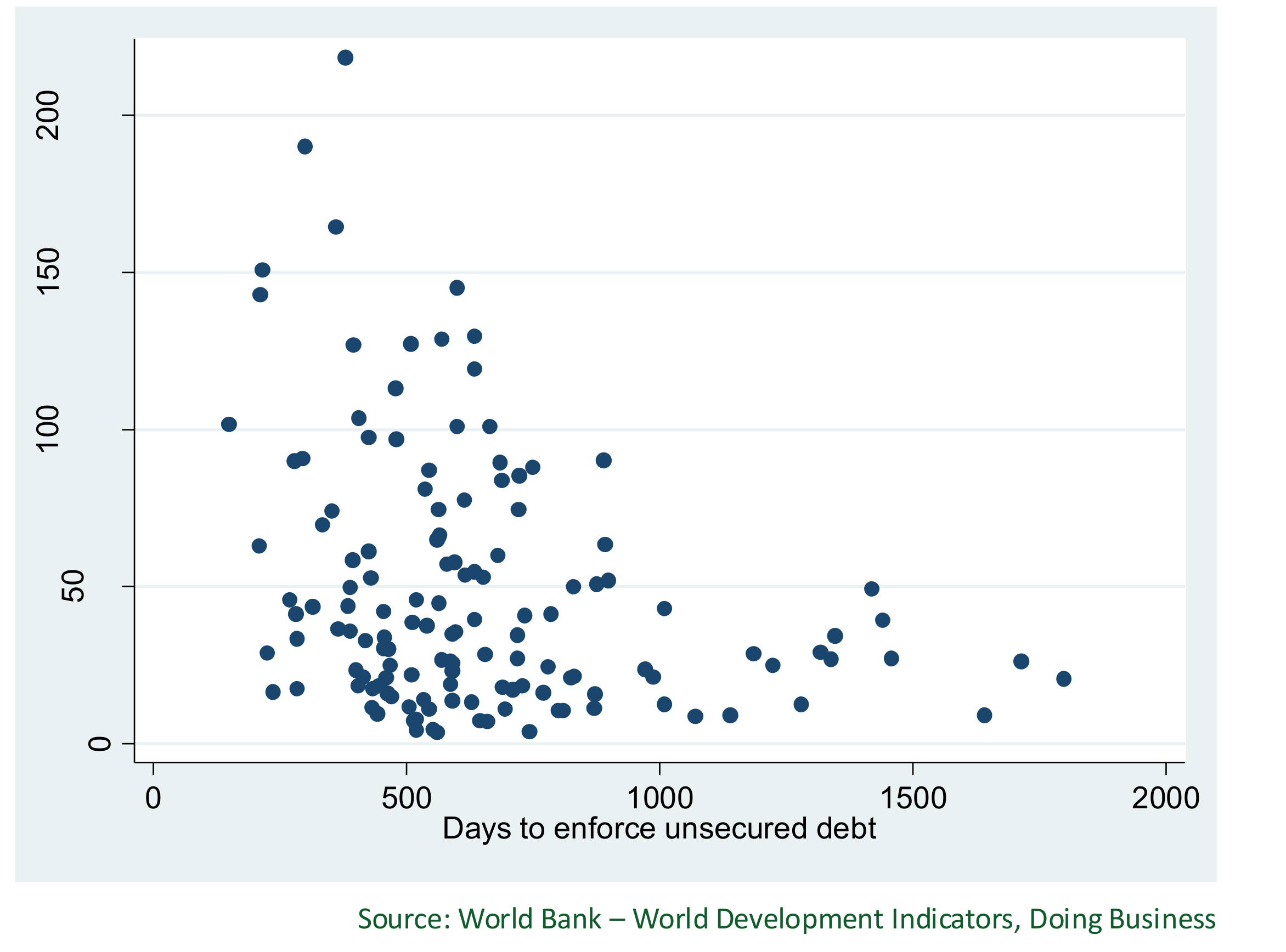
The historical scatter relates the time required to enforce unsecured debt to a credit-development indicator. Its pattern is consistent with slower enforcement being associated with less developed credit markets, but the supplied chart does not label the vertical measure precisely. It supports a qualitative illustration, not a numerical estimate of an effect or an assertion about a particular country's current credit-to-GDP ratio. Income, institutions and reverse causality could also contribute to the association. The contractual lesson remains that a claim's value depends on how and when it can be enforced.
A complete screening example with and without collateral
Two risk-neutral entrepreneurs each need EUR 100. The safe entrepreneur produces EUR 140 with certainty. The risky entrepreneur produces EUR 140 with probability one-half and EUR 50 with probability one-half. The bank cannot identify their types and initially lends to both in equal proportions. Funding costs are zero, there are no enforcement costs and borrowers have limited liability unless they explicitly pledge outside wealth. Let be the one-period interest rate and the promised repayment.
In the unsecured contract, the safe entrepreneur pays and the risky entrepreneur pays in the high state but only EUR 50 in the low state. Provided , the bank's break-even condition for the two loans is:
The safe entrepreneur receives euros with certainty. The risky entrepreneur receives EUR 23.3333 in the good state and zero in the bad state, giving an expected private surplus of EUR 11.6667. Both therefore borrow. Yet the risky project's expected output is only euros, below its EUR 100 resource cost. Limited liability makes the project privately attractive because some downside is shifted to the lender and, through pooled pricing, the safe borrower.
| Outcome | Safe borrower | Risky borrower |
|---|---|---|
| Expected project output | EUR 140 | EUR 95 |
| Project NPV at the zero discount rate | EUR 40 | −EUR 5 |
| Unsecured expected bank receipt at r = 16.6667% | EUR 116.6667 | EUR 83.3333 |
| Unsecured expected borrower surplus | EUR 23.3333 | EUR 11.6667 |
| Secured bank receipt at r = 0% if the contract is accepted | EUR 100 | EUR 100 in either state |
| Secured expected change in borrower wealth | EUR 40 | −EUR 5 |
| Decision under the secured contract | Borrow | Do not borrow |
Now suppose each entrepreneur owns a house worth EUR 80 that can be pledged and sold without cost. At a zero interest rate, even the risky entrepreneur's low project payoff of EUR 50 plus sufficient collateral covers the EUR 100 debt. A competitive break-even secured contract can therefore set . The safe borrower earns EUR 40 and never loses the house. In the risky low state, the bank takes EUR 50 from the house to cover the shortfall; the borrower retains the residual EUR 30 of house value. The entire EUR 80 pledge is not an up-front fee and should not be subtracted in both states.
The risky borrower's change in own wealth is EUR 40 in the high state and minus EUR 50 in the low state. Expected surplus is consequently euros, so this borrower rejects the secured contract. Collateral has screened out the negative-NPV project by making its owner internalise the downside. EUR 80 is sufficient, though EUR 50 of perfectly realisable collateral would already cover the worst repayment shortfall in this particular model.
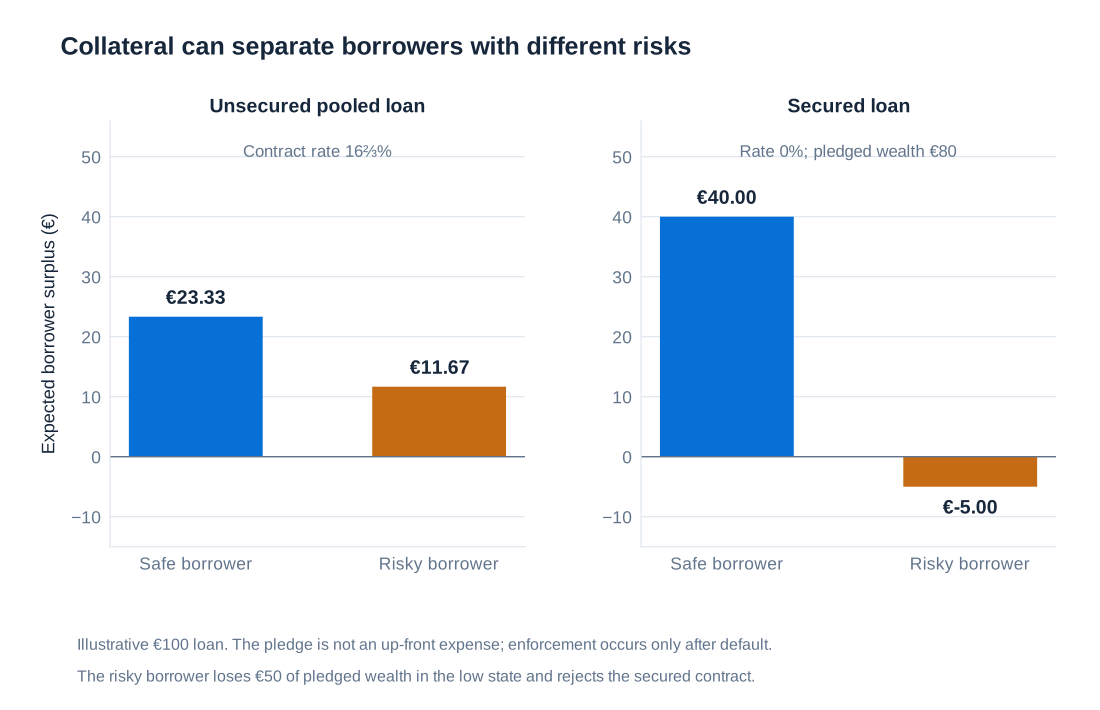
The model also reveals a distributional trade-off. If the safe entrepreneur lacks pledgeable wealth, an otherwise valuable project may fail to obtain the attractive secured contract. Requiring collateral can improve selection among equally wealthy applicants while excluding capable but poorer applicants. Neither “collateral is always efficient” nor “collateral is merely an unnecessary obstacle” follows from the example. The outcome depends on available information, wealth distribution, recoverability and alternative ways to screen borrowers.
The Journal of Finance · Vol. LXXII, No. 1 · February 2017
Housing Collateral and Entrepreneurship
Abstract
We show that collateral constraints restrict firm entry and postentry growth, using French administrative data and cross-sectional variation in local house-price appreciation as shocks to collateral values. We control for local demand shocks by comparing treated homeowners to controls in the same region that do not experience collateral shocks: renters and homeowners with an outstanding mortgage, who (in France) cannot take out a second mortgage. In both comparisons, an increase in collateral value leads to a higher probability of becoming an entrepreneur. Conditional on entry, treated entrepreneurs use more debt, start larger firms, and remain larger in the long run.
Schmalz, Sraer and Thesmar's research on French administrative data uses changes in local house values to study this channel. Greater available housing collateral is associated with increased entry into entrepreneurship and, among entrants, greater debt use and larger firms. The study compares homeowners exposed to collateral gains with local groups that do not experience the same borrowing-capacity change, helping separate collateral from local demand. This empirical setting supports the relevance of pledgeable wealth; it does not turn the two-entrepreneur example into a universal prediction about every credit market.
Schmalz, Sraer and Thesmar, Housing Collateral and Entrepreneurship, Journal of Finance, 2017. The contract, recovery and screening examples together show why lending terms must be designed jointly with the information used to approve the loan.