
8. Credit Default Swaps and Asset-Backed Securities
Credit risk can be transferred through a derivative contract or through the sale and financing of assets. A credit default swap separates a specified credit exposure from ownership of the underlying bond or loan. A securitisation places assets or their risks into a structure that distributes cash flows and losses among investors. Both can change who bears credit losses, but neither removes those losses from the economy. Understanding the contracts requires following the cash flows, the loss allocation and the obligations that remain after the transaction.
The credit default swap contract
A credit default swap, or CDS, is a contract under which a protection buyer pays a premium to a protection seller in exchange for a payment if a specified credit event affects a reference entity or obligation. The economic analogy with insurance is useful: the buyer pays for protection and ordinarily receives no credit-event payment when the covered event does not occur. A CDS is nevertheless a derivative with its own contractual and legal framework; it should not be assumed to have every feature of an ordinary insurance policy.
The contract identifies the reference entity, eligible obligations, notional amount, currency, maturity, premium terms, credit-event definitions and settlement method. A credit event can include failure to pay, bankruptcy or qualifying restructuring, depending on the agreed terms. A fall in the bond price alone does not necessarily trigger settlement. The reference entity whose credit is being transferred is distinct from the protection seller, whose ability to perform creates counterparty risk.
The notional amount is a reference for calculating premiums and settlement. It is not generally a sum that the buyer lends to the seller at inception. The premium rate is quoted annually, often in basis points: one basis point equals 0.01 percentage points or 0.0001 in decimal form. Payment frequency and the day-count convention determine the amount paid on each date. A five-year semiannual example is convenient for learning, but frequency and market conventions must be read from the actual contract.
A five-year protection example
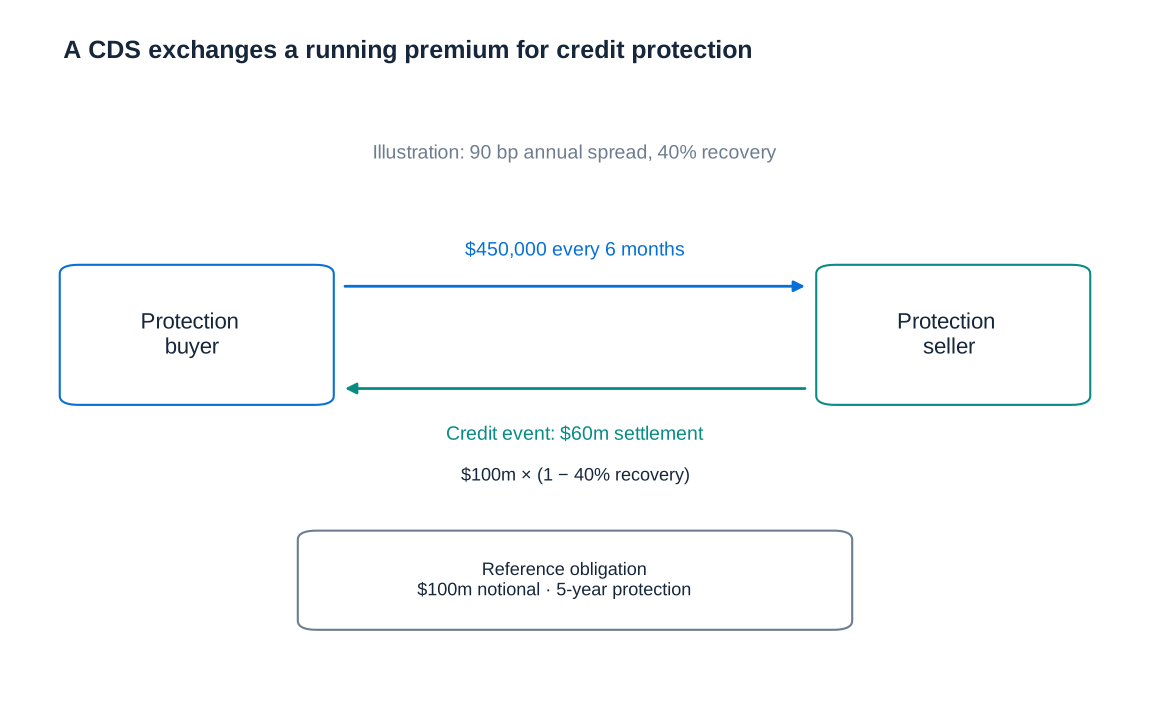
Consider a CDS referencing IBM, with USD 100 million notional, a five-year maturity and a premium of 90 basis points per year. This is a numerical illustration, not a current IBM market quotation. Since 90 basis points equals 0.90%, the annual premium is dollars. Under an exact half-year payment assumption, each semiannual premium is USD 450,000.
| Quantity | Value | Meaning |
|---|---|---|
| Notional | USD 100 million | Reference amount for premiums and protection |
| Annual premium rate | 90 bps = 0.90% = 0.009 | Annualised contractual rate |
| Annual premium | USD 900,000 | 100,000,000 × 0.009 |
| Semiannual premium | USD 450,000 | 900,000 × 0.5 |
| Number of payments without a credit event | 10 | Five years with two payments per year |
| Undiscounted total without a credit event | USD 4.5 million | 10 × 450,000; ignores upfront amounts and fees |
If no credit event occurs before maturity, the buyer pays the scheduled premiums and receives no default settlement. The premiums are the price of the protection already provided; they are not returned because the reference entity survives. If a qualifying event occurs earlier, future scheduled premiums generally stop, while premium accrued up to the event remains payable according to the contract. A default between payment dates therefore cannot be analysed simply by ignoring the incomplete period.
Physical and cash settlement
Under physical settlement, the protection buyer delivers an eligible defaulted obligation and receives the agreed par amount from the protection seller. In the USD 100 million example, a buyer delivering eligible bonds with USD 100 million face value receives USD 100 million. The delivered bonds have a residual value, so the seller's economic loss is less than the gross cash payment whenever recovery is positive. Eligibility, deliverable-obligation provisions and settlement mechanics are material contractual details.
Under cash settlement, the seller pays the difference between the contractual reference amount and the value established for the defaulted obligation. With notional and recovery fraction , the simplified protection payment is . If recovery is 40%, cash settlement on USD 100 million is USD 60 million. In an equivalent physical settlement, the buyer transfers bonds worth USD 40 million and receives USD 100 million, again generating a net economic protection amount of USD 60 million before premiums and other costs.
The protection buyer, not the seller, is entitled to the default payment. The payment compensates for the specified reference-credit loss; it does not necessarily reimburse every loss on a separately held asset. Differences in maturity, currency, seniority, deliverable obligations or contractual credit-event definitions can leave basis risk. A lender hedging a loan must therefore check that the CDS protection actually responds to the scenarios that threaten that loan.
The premium leg, protection leg and market value
At inception, an idealised par CDS with no upfront payment has equal present values for the premium and protection legs. Let be the risk-neutral probability that the reference entity survives to time , the discount factor, a premium date, its year fraction, the annual premium rate and the notional. With deterministic recovery fraction , a useful representation is
The term is the expected discounted premium-accrual fraction paid when default occurs between scheduled dates. Both expressions are in currency units. The protection leg integrates the probability of first default at each time; it must not count the same entity as defaulting repeatedly. The par spread solves . Real valuation also needs the exact contract, discounting conventions and relevant counterparty or collateral treatment.
In a continuous-premium model with constant risk-neutral default intensity and constant recovery, the simple relation is . It provides intuition: a larger default intensity or a larger loss severity requires a larger premium. At 90 basis points and 60% LGD, the implied intensity is , or 1.5% per year. Under these assumptions, five-year risk-neutral cumulative PD is . The annual CDS spread is therefore neither the annual PD nor the five-year PD.
This probability is risk-neutral because it is inferred from prices. It is not an unbiased forecast of real-world defaults. Market spreads can reflect default-risk compensation and liquidity as well as expected loss. The simplified intensity relation also abstracts from term structures, discrete premiums and several contractual effects. It should be used as a transparent approximation, not as an exact recovery of physical PD from an observed quotation.
After inception, a CDS can acquire positive or negative market value. If the market spread rises while the buyer continues to pay an older, lower contractual rate, that protection becomes valuable to the buyer. Approximately, buyer value is , where is the risky premium annuity, expressed in years and incorporating survival and discounting. The seller has the opposite value before counterparty and other asymmetries. If spreads fall, the buyer's position usually loses value. This allows a CDS position to generate gains or losses before any default occurs.
Some market contracts use standardised running coupons with an upfront amount to reconcile that coupon with the current market spread. “No initial exchange of notional” therefore does not mean “no initial cash requirement”: an upfront amount, initial margin and transaction costs may all arise.
For the distinction between a standard coupon, an upfront amount and market value, see ISDA's explanation of CDS collateral and pricing conventions.
Hedging, diversification and taking credit exposure
A bank can buy protection to reduce exposure to a borrower or sector while retaining the underlying customer relationship. It can also sell protection to take credit exposure in a sector where it has little direct lending. This can diversify some risks, but diversification should be evaluated against the bank's entire balance sheet: exposures that appear unrelated in ordinary conditions may become correlated during a downturn.
A non-bank investor selling protection receives premium income in exchange for bearing a contingent credit loss. This resembles taking a funded credit position in its direction of exposure, but the seller must be able to meet margin calls and a potentially large settlement payment. The premium is compensation for risk, not a guaranteed yield free of a corresponding obligation.
Buying protection without owning the reference bond creates a position that can benefit from deterioration or default. Economically this resembles a short-credit position, although its funding, contractual and legal characteristics differ from short-selling a bond. A profitable directional prediction still can be undermined by counterparty default, changing liquidity, transaction costs or a mismatch between the expected event and the contract's actual trigger.
Counterparty exposure before and after a credit event
CDS transfer reference-credit risk while creating exposure to the contractual counterparty. If the protection seller defaults after a covered credit event but before paying, the buyer may be left with an unsecured claim for the settlement amount, reduced by available collateral and enforceable netting. The reference entity and protection seller can fail in the same stressed environment. A hedge that depends on a weak seller may consequently fail just when it is most valuable.
Before a reference-credit event, the buyer's exposure is the positive replacement value of the contract, not automatically its full notional. Suppose market protection has become more expensive than the contractual premium. If the seller fails, replacing that low-premium contract requires paying the higher current price. The resulting loss is associated with the present value of the premium difference, subject to close-out terms, recovery, collateral and netting.
The seller can also have counterparty exposure. If market spreads have fallen below the premium it is entitled to receive, its existing contract is valuable. A default by the protection buyer can force the seller to replace it with a contract paying a lower premium. Losing future gross premiums is not by itself the correct exposure measure because the seller also ceases to bear the original future protection obligation; valuation concerns the net replacement position.
Wrong-way risk arises when counterparty creditworthiness deteriorates as exposure to that counterparty increases. A protection seller heavily exposed to the same sector as the reference entity is an obvious example. Correlated defaults can defeat a simple calculation that multiplies an independently estimated counterparty PD by an average exposure. Effective risk management therefore examines joint stress scenarios and the strength of collateral and close-out arrangements.
Collateral, margin and central clearing
Variation margin addresses changes in the current market value of a derivative. When the contract becomes more valuable to one party, collateral is transferred by the other under the relevant agreement. Initial margin addresses potential changes in exposure over the period needed to close out or replace positions after a default. Both sides can have collateral obligations. Margin reduces unsecured exposure but introduces liquidity needs: an institution may have to deliver cash or eligible securities quickly even though the reference entity has not defaulted.
Collateral protection depends on timely valuation, settlement, enforceability, segregation where required, eligible collateral and haircuts. A haircut reduces the recognised value of collateral to allow for adverse movements or liquidation costs. Collateral closely linked to the counterparty's financial condition can create wrong-way risk. Disputes, market jumps and delays mean that collateralisation does not mechanically eliminate every possible loss.
Central clearing replaces a bilateral relationship with cleared obligations involving a central counterparty, or CCP. The CCP manages exposures through margin, default-management procedures and financial resources. Central clearing is distinct from exchange trading: an OTC contract can be centrally cleared. A CCP is not risk-free and should not be described as possessing a fictitious “AAAA” rating. Clearing concentrates important risk-management functions and creates its own operational, liquidity and default-management requirements.
In the EU, EMIR provides clearing obligations for specified classes of OTC derivatives and relevant categories of counterparties, together with risk-mitigation requirements for non-cleared contracts. Applicability depends on the instrument class, counterparty status, thresholds and exemptions; it is incorrect to say that every CDS must be traded on an exchange or centrally cleared. Exact transaction requirements should be checked against the applicable rules and registers.
Regulatory reference: ESMA on clearing and non-cleared risk mitigation under EMIR.
True-sale securitisation and the special-purpose vehicle
An asset-backed security, or ABS, is financed by cash flows from a defined asset pool. Typical pools contain loans, mortgages, leases or trade and consumer receivables. In a traditional true-sale structure, an originator sells or assigns the assets to a special-purpose vehicle, or SPV. The vehicle raises funding by issuing securities to investors and uses the proceeds to pay for the assets. The borrowers' payments then support the securities, after contractual costs and other senior claims.
The SPV separates the transaction's assets and obligations from the originator's ordinary business, but the legal effectiveness of that separation matters. Bankruptcy remoteness does not mean that the underlying borrowers cannot default. Investors also depend on servicing, collection accounts, documentation and the availability of replacement providers if a service counterparty fails. A diagram showing an asset transfer is the beginning of analysis, not proof that every risk has left the originator.
The originator often continues as servicer, collecting payments and managing the borrower relationship for a fee. Borrowers may continue making payments through the same channels, but legal transfer, notification, data-processing and contractual requirements can still matter. Securitisation should not be described as necessarily changing nothing for every borrower. The operational process and the ownership of the credit exposure are separate questions.
Pass-through securities and cash-flow timing
A pass-through structure distributes the available pool cash flows to investors according to their proportional interests, after fees and other specified deductions. It is simpler than a structure with several different priorities, but it still transmits the risks in those cash flows. Defaults reduce collections, recoveries can be delayed, and early repayments change the timing of principal returned to investors.
Prepayment risk is especially important for assets whose borrowers can repay early. If borrowers refinance when interest rates fall, investors may receive principal back when reinvestment yields are lower. Conversely, slower-than-expected repayment can extend the investment's duration. Credit loss, prepayment and extension risk are distinct, and a high-quality borrower pool can still produce uncertain cash-flow timing. The security's expected maturity need not equal its legal final maturity.
Tranching, subordination and the waterfall
Tranching divides a pool into securities with different priorities. Senior claims are paid before junior or mezzanine claims under the specified payment waterfall, and the equity or first-loss piece receives the residual. Loss allocation ordinarily runs in the opposite direction: equity absorbs losses first, then mezzanine claims, then senior claims. Actual structures can have separate interest and principal waterfalls, reserve accounts and performance triggers, so their detailed documents control the sequence.
Consider a simplified pool with initial principal 100 monetary units. Equity covers the first 20 units of loss, mezzanine the next 20, and senior notes the remaining 60. The mezzanine band can be divided further into a lower band covering losses from 20 to 30 and an upper band covering losses from 30 to 40. Historical illustrations sometimes label these bands BB and BBB and the senior notes AAA. Such labels are illustrative outcomes of a rating process, not a consequence guaranteed solely by drawing the boundaries.
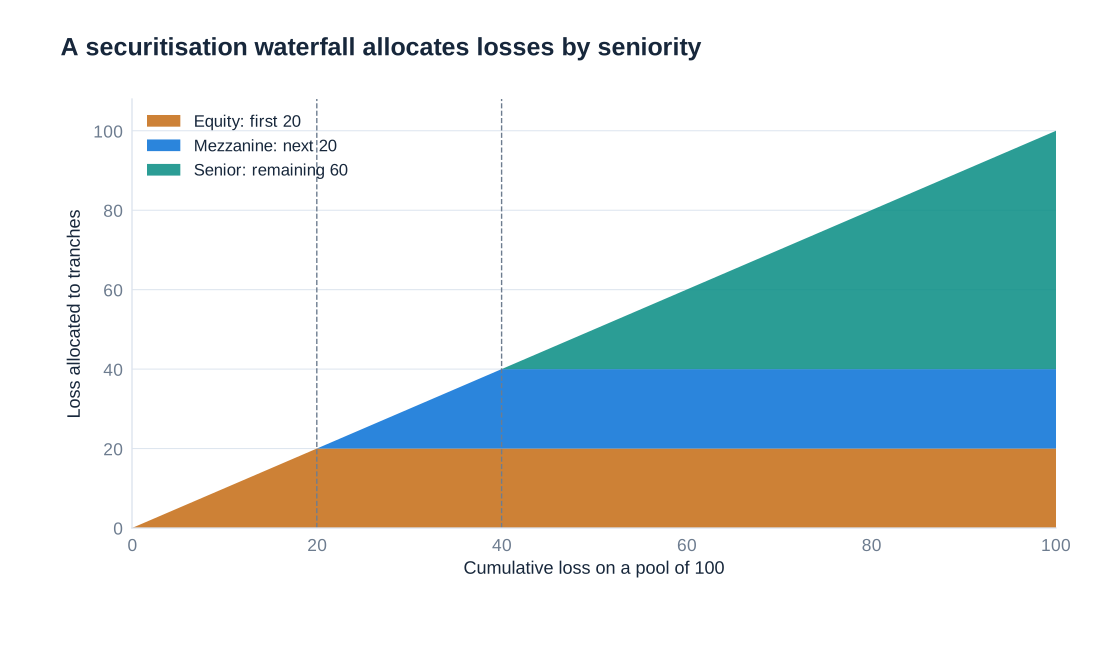
For a tranche attaching at and detaching at , both measured in pool currency units, and cumulative pool loss , the simplified principal loss is
Dividing this amount by the tranche's original principal gives its loss fraction. The formula assumes a static pool, no changing credit enhancement and direct sequential allocation of realised principal losses. It explains subordination transparently without claiming to reproduce every feature of a live securitisation.
| Pool loss | Equity loss: 0–20 band | Mezzanine loss: 20–40 band | Senior loss: 40–100 band | Senior loss fraction |
|---|---|---|---|---|
| 0 | 0 | 0 | 0 | 0% |
| 5 | 5 | 0 | 0 | 0% |
| 25 | 20 | 5 | 0 | 0% |
| 45 | 20 | 20 | 5 | 8.33% |
| 80 | 20 | 20 | 40 | 66.67% |
| 100 | 20 | 20 | 60 | 100% |
A pool loss of 25 therefore destroys the equity piece and one quarter of the 20-unit mezzanine tranche while leaving senior principal intact in this model. A pool loss of 45 reaches the senior notes and removes 5 of their 60 units, or 8.33%. A tranche can be protected against frequent small losses while remaining exposed to infrequent large losses. Ratings, expected losses and tail-loss severity consequently describe different aspects of its risk.
Funding, capital treatment and retained interests
Securitisation can provide funding, diversify funding sources, transfer selected credit exposures and change the maturity or risk profile of the originator's balance sheet. Cash proceeds may be used to repay existing debt, which can reduce leverage under the relevant measurement. However, issuing securities through an SPV does not automatically increase profitability or return on equity. Fees, funding costs, transaction expenses, retained risk and the use of the proceeds all influence the result.
Legal true sale, accounting derecognition, consolidation and regulatory capital relief are separate assessments. An asset transfer does not necessarily remove the assets from consolidated financial statements, and accounting derecognition alone does not establish sufficient prudential risk transfer. Regulatory capital relief depends on the applicable significant-risk-transfer requirements and the treatment of retained or otherwise exposed positions. A claim that RWA must fall by the full amount of the transferred assets would ignore those conditions.
The originator may retain equity, mezzanine or a proportional share of the transaction. Retaining a first-loss tranche can preserve substantial credit exposure even when most of the face value is sold. It is also incorrect to assume that only senior notes can be placed with investors: placement depends on price, structure, market conditions and investor mandates. Liquidity facilities, guarantees or other support can create additional exposures outside the retained securities.
EU rules generally require an originator, sponsor or original lender to retain at least 5% of a material net economic interest, subject to the regulation's specified methods and exceptions. Retention can take different forms, including a vertical share of tranches or an eligible first-loss position; it is not a universal instruction to keep the entire equity tranche. The requirement is intended to maintain an economic stake and does not establish that the retained party bears every possible loss.
References: EBA on significant risk transfer; Article 6 of the EU Securitisation Regulation.
Resecuritisation and the limits of ratings
A collateralised debt obligation, or CDO, can hold debt claims that include tranches from other securitisations. Repackaging mezzanine ABS into a new structure creates another layer of senior, junior and equity claims. It reallocates the losses on the purchased tranches; it does not turn the original borrowers into safer borrowers. The outer structure's risk depends on the attachment points and loss distributions of the inner structures as well as on their dependence.
Correlation is especially important. Under a benign model, losses in different pools may rarely occur together, so a new senior tranche appears well protected. A common housing or funding shock can make many mezzanine tranches lose value at the same time, exhausting that protection. Two layers of modelling can magnify errors in default probabilities, recoveries, dependence and asset selection. Complexity also makes it harder for investors to identify overlapping underlying exposures.
A high rating therefore cannot replace analysis of the pool, waterfall, model assumptions and stress scenarios. A tranche's market liquidity can deteriorate even without realised principal loss, and a mark-to-market loss can be much larger than a near-term expected default loss. The credit-crisis experience with structured products illustrates the importance of separating a contractual priority from an unconditional guarantee of safety.
Comparing funded securities and CDS positions
Buying a credit-sensitive ABS and selling protection both take exposure to adverse credit outcomes, while buying protection takes the opposite direction. Their full economics are different. The ABS buyer ordinarily pays a purchase price and receives the security's cash flows. A CDS seller receives premiums but assumes contingent settlement and collateral obligations. Funding costs, interest-rate exposure, liquidity, counterparty risk and contractual basis can make the two positions behave differently even when their reference credit is closely related.
| Position | Main cash commitment | Effect of worsening reference credit | Additional risks to assess |
|---|---|---|---|
| Long ABS | Purchase price, usually funded at inception | Potential price decline and allocated credit losses | Funding, liquidity, prepayment, servicing and structure |
| Sell CDS protection | Margin or upfront amounts where applicable; contingent default payment | Usually a market-value loss and greater potential settlement exposure | Counterparty exposure, margin liquidity and contract basis |
| Buy CDS protection | Premiums and applicable upfront or margin amounts | Usually a market-value gain; payment after a qualifying event | Seller default, imperfect hedge and settlement terms |
Accounting also depends on classification rules, not an unrestricted choice between reporting gains and hiding losses. Derivatives are generally measured at fair value through profit or loss unless qualifying hedge-accounting treatment changes how effects are presented. A debt security's measurement depends on the relevant business-model and contractual-cash-flow tests, which can lead to amortised cost, fair value through other comprehensive income or fair value through profit or loss. A structured instrument does not automatically qualify for amortised cost merely because the investor plans to hold it.
Accounting reference: IFRS 9 Financial Instruments.
The appropriate comparison starts with a common horizon and scenario: identify who pays, who receives, what event triggers each obligation, how losses are allocated, and what collateral or funding is needed along the way. This makes the transferred credit exposure visible while preserving the distinct risks created by the chosen instrument.