
2. Foreign-exchange exposure and corporate hedging
Foreign-exchange risk is the possibility that currency movements change a firm's cash flows, reported financial position or competitive value. The currency printed on an invoice is only the starting point. A business can have substantial currency exposure without signing a contract in that currency, and a hedge that stabilises an accounting number can create a new cash-flow problem. Effective management begins by defining the exposure, the objective and the exchange-rate quotation before selecting an instrument.
Exchange-rate quotations and transaction exposure
Let denote units of home currency required to buy one unit of foreign currency at time . For a euro-based company receiving dollars, is euros per US dollar. A rise in this rate means dollar appreciation against the euro; a fall means dollar depreciation. If a source instead quotes dollars per euro, the economic interpretation of an increase is reversed. The two rates are reciprocals, so their percentage changes are not exactly equal and opposite for large movements.
A fixed foreign-currency receipt due at time has home-currency value . Its sensitivity to the exchange rate is , and a movement changes its value by . This relationship is exact when the amount received remains fixed. A foreign-currency payment has the opposite exposure from the payer's perspective: an appreciating foreign currency raises its home-currency cost. A forecast sale adds uncertainty about the amount and timing of the receipt, not merely the conversion rate.
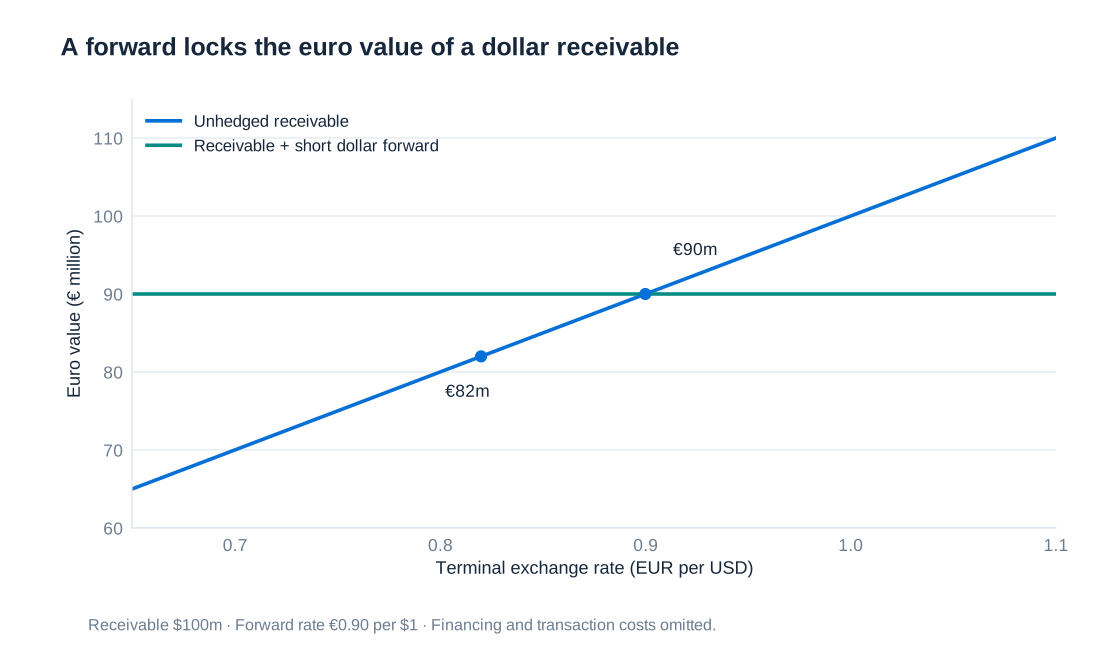
Suppose a German manufacturer plans to sell 1,000 cars in the United States and expects USD 100 million from those sales. At EUR 0.90 per dollar, the expected conversion is EUR 90 million. If the dollar falls to EUR 0.82, the same dollar amount converts to EUR 82 million, a reduction of EUR 8 million. The dollar sales revenue has not changed; its euro value has. Conversely, a euro-based buyer owing USD 100 million benefits from the lower rate. Risk direction must therefore be established from the actual cash flow.
Transaction exposure includes contracted receivables and payables as well as sufficiently identified planned transactions. The distinction matters for hedging. A derivative covering a fixed receivable offsets a known nominal amount. A derivative covering forecast sales can become an unbacked currency position if the sales fail to occur. Netting inflows and outflows in the same currency and period can reduce the amount requiring an external hedge, but netting should respect timing, legal entities and access to the relevant cash.
Operational choices before derivatives
Consider a stylised Porsche example in which the manufacturer produces in Germany, pays its operating costs in euros and sells cars both in the euro area and in the United States. A weaker dollar reduces the euro value of US receipts if dollar prices and quantities remain fixed. One response is to stop serving the US market, avoiding the exposure at the cost of abandoning revenue and strategic opportunities. Another is to raise dollar prices enough to preserve the euro revenue per car.
Passing currency changes to customers does not necessarily remove the business risk. Higher dollar prices can reduce sales when demand is price-sensitive or competitors do not raise their prices. A company may therefore replace exchange-rate risk per unit with quantity risk. Contracts that fix prices for long periods make adjustment slower; strong differentiation or market power can make it easier. Exposure depends on the interaction between currency, prices and volumes.
A natural hedge matches foreign-currency revenue with costs or financing in that currency. Production, procurement, sales activity or research spending in the United States can generate dollar costs against dollar receipts. Dollar borrowing creates dollar interest and principal payments that also offset some inflows. These decisions have consequences beyond currency risk: plant location affects productivity and supply chains, while borrowing affects leverage, maturity structure and credit risk. They should be evaluated as business choices rather than as costless substitutes for derivatives.
Financial hedges, including forwards, futures, options and currency swaps, can then address the residual exposure without moving production. A money-market hedge can create a similar economic offset through borrowing and lending in the relevant currencies. The appropriate combination depends on cash-flow certainty, horizon, market access, transaction costs and the firm's ability to fund collateral or settlement.
Transaction, translation and economic exposure
Transaction exposure focuses on the home-currency value of future receipts and payments. It is often measured over the next quarter or year because contracts and sales forecasts are more identifiable over shorter horizons. Translation exposure concerns the effect of exchange rates on financial statements when foreign-currency balances or the accounts of foreign operations are expressed in the reporting currency. Economic, or operating, exposure concerns the effect of currency movements on the firm's future competitive position and value.
| Exposure | Object being measured | Example | Main difficulty |
|---|---|---|---|
| Transaction | Home-currency cash receipts and payments | A euro-based company expects a fixed dollar receivable | Matching amount and settlement date, especially for forecast transactions |
| Translation | Reported assets, liabilities, equity and results | A foreign subsidiary's net assets are translated into euros | Accounting changes may not generate cash available to fund a hedge |
| Economic or operating | Longer-term cash flows, competitiveness and firm value | A competitor's costs fall when its production currency weakens | Prices, quantities and business responses change together |
The categories can overlap. A foreign subsidiary generates operating cash flows, holds balance-sheet positions and affects the group's competitive strategy. It is still useful to separate the objectives because a hedge designed to stabilise next year's euro earnings may not protect long-term firm value or a regulatory capital ratio. A policy that simply says “hedge currency risk” leaves the most important decision undefined.
Why hedging policies differ across firms
Historical survey evidence from M. Glaum's study of German non-financial corporations illustrates the diversity of practice. The percentages below describe the cited sample rather than current universal frequencies. Most respondents reported flexible hedging, while others used full coverage, a fixed proportion or no hedging. The distinction is economically meaningful: a rule-based hedge stabilises a defined exposure, whereas a flexible policy can incorporate changes in forecasts, costs or management views.
| Policy | Reported share |
|---|---|
| Never hedge | 11% |
| Always hedge 100% | 22% |
| Hedge a fixed percentage | 12% |
| Situational or flexible hedging | 54% |
| Seek additional profit through speculation | 1% |
| Horizon policy | Reported share |
|---|---|
| Three months | 19% |
| Twelve months | 39% |
| Three years | 2% |
| Longer than three years | 2% |
| No fixed rule | 39% |
The horizon percentages sum to 101% because the reported figures are rounded. They should not be rescaled and presented as if more precise information were available. More fundamentally, a five-year hedge can be inappropriate when the quantity of sales five years ahead is highly uncertain. The problem is exposure estimation, even if a sufficiently long-dated derivative can be obtained.
Owners differ in diversification and risk preferences. A family whose wealth is concentrated in one firm may value stable cash flows differently from a globally diversified fund. Managers whose compensation depends on reported earnings may also dislike currency-related earnings surprises. Currency risk can be material for one business and negligible relative to other risks for another. Differences in demand elasticity, price-adjustment frequency, foreign costs and forecasting ability make identical hedge percentages unlikely to suit every firm.
When corporate hedging can create value
In an ideal frictionless capital market, changing the firm's currency payout pattern need not create shareholder value. Investors who can reproduce the hedge themselves at the same cost can choose their own exposure. A globally owned business also has no single currency that represents every shareholder's consumption or liabilities. Stable euro earnings may still be volatile in dollars for a US investor. Hedging is therefore not justified merely by saying that all volatility is undesirable.
Real-world frictions change the argument. Financial distress is costly, and a currency loss can cause a covenant breach, a rating downgrade or forced financing on unattractive terms. Stabilising operating cash flows can help preserve funding for positive-net-present-value investment when external finance is expensive. This is the investment-financing rationale associated with Froot, Scharfstein and Stein: the hedge protects the capacity to undertake valuable projects, not simply the appearance of smooth earnings.
Taxes can also matter when expected tax payments are a convex function of income, although the effect depends on the actual tax system, loss offsets and other circumstances. Firms may execute hedges more cheaply than small shareholders because of scale and market access. Managers and concentrated shareholders may be poorly diversified, creating both reasons to reduce distress and agency concerns about excessive hedging to protect their own positions. The value of a hedge must therefore be assessed against its costs and its effect on the firm's real decisions.
Forwards, options and the mechanics of an offset
A forward fixes today the rate at which currencies will be exchanged at a future date. A company expecting dollars can agree to sell them for euros at maturity. Combining the receipt with the short-dollar forward produces:
With USD 100 million and euros per dollar, the combined amount is EUR 90 million. If the spot rate at receipt is 0.82, the receivable converts to EUR 82 million and the forward contributes EUR 8 million. If the dollar strengthens to 0.98, the receivable converts to EUR 98 million and the forward loses EUR 8 million. The hedge removes the upside and downside around the contracted conversion rate. A derivative loss in the second scenario is the cost of the certainty previously chosen, not proof that the hedge failed.
A foreign-currency payable requires the opposite direction: a forward purchase of foreign currency. Its payoff is , which offsets the increase in the unhedged payment . A call option on the foreign currency offers the right to buy at a strike rate and therefore places a ceiling on the payment, while preserving the benefit of a cheaper foreign currency. The option buyer pays a premium for this asymmetry. A foreign-currency receivable can instead be protected with a put on that currency.
Futures are standardised and settled through daily margining; forwards are typically tailored over-the-counter agreements whose collateral terms depend on the contract. Both can create funding needs before the commercial exposure settles. Options have a different pattern of premiums and potential margin requirements depending on whether the company buys or sells them. A hedge policy should distinguish an option purchase that limits downside from writing options that may add exposures the business never intended to take.
Forward pricing, money-market hedges and cost of carry
A forward rate is not generally equal to today's spot rate and is not simply a prediction of the future spot rate. Under a simplified no-arbitrage framework with continuous compounding, home interest rate , foreign interest rate and maturity years, covered interest parity gives:
The quotation remains home currency per foreign currency. The difference between interest rates determines the forward adjustment because holding foreign currency has a foreign-currency financing or investment return. The formula assumes consistent borrowing and lending opportunities and abstracts from transaction costs, credit effects and cross-currency basis. Those assumptions explain the economic benchmark; observed quotes may reflect additional market frictions.
A money-market hedge reproduces the same logic. To hedge a foreign-currency receipt at , borrow its foreign-currency present value, convert that amount into home currency today and invest the home proceeds until . The actual receipt repays the foreign loan. Using the stated continuous rates, the home proceeds are . The strategy uses borrowing capacity and changes the balance sheet, so an economic equivalence does not make every implementation equally convenient.
The related cost-of-carry principle applies to a non-income-paying investment asset. If it can be bought for and financed at continuously compounded rate , a simple benchmark is . For a spot value of EUR 80, an annual financing rate of 5% and delivery in six months, euros. This example excludes asset income, storage costs and convenience benefits. It must not be confused with the currency formula, in which the foreign interest rate plays the role of a yield on the asset being held.
Translation exposure and the liquidity cost of hedging
A foreign operation may keep its accounts in a functional currency different from the group's presentation currency. Translating those accounts can change reported assets, liabilities and equity even when no sale or cash transfer occurs. If dollar-denominated net assets lose euro value as the dollar weakens, the group's reported equity can decline. The resulting effect on leverage or a covenant can matter even if the subsidiary's local operations are unchanged.
Under IAS 21, ordinary translation of a foreign operation into a different presentation currency generally places resulting exchange differences in other comprehensive income, or OCI, subject to the standard's conditions. This is distinct from remeasuring a foreign-currency monetary receivable in the entity's own functional currency, where exchange differences generally enter profit or loss. Treating every foreign-currency accounting change as the same type of translation exposure obscures this distinction.
Hedging a net investment can create a mismatch between realised cash and unrealised accounting gains. Suppose dollar appreciation raises the euro-translated value of a subsidiary's net assets by EUR 1 billion. A short-dollar hedge intended to offset that rise may require cash settlement or collateral even though the subsidiary has not distributed any cash. The accounting offset can be effective while the parent faces a liquidity demand. This is one reason some translation exposures remain unhedged.
It is too strong to say that translation exposure never affects earnings or is never hedged. Disposals, transaction balances, different functional-currency circumstances and designated hedging relationships can change the accounting treatment. More importantly, a firm may wish to protect a capital ratio or debt capacity rather than current profit. The decision should identify the relevant objective and the cash needed to support the hedge through adverse currency movements.
Why matching foreign assets and liabilities does not fix every ratio
Borrowing in the currency of foreign assets can reduce the sensitivity of net assets. If dollar assets and dollar liabilities are equal in amount, a change in their common euro conversion rate leaves their net contribution to equity approximately unchanged. Yet the gross balance-sheet amounts can still expand. With equity held constant, an increase in total assets raises assets-to-equity leverage and reduces an equity-to-assets capital ratio.
This distinction also applies to the regulatory leverage ratio. In that context the numerator is defined Tier 1 capital and the denominator is a regulatory exposure measure, not simply accounting assets. A stronger foreign currency can increase the denominator even when matched assets and liabilities offset economically. It is therefore essential to state whether “higher leverage” means a higher assets-to-capital multiple or a lower capital-to-exposure ratio.
A historical example is Deutsche Bank's first-quarter 2015 reporting: leverage exposure was EUR 1,549 billion at 31 March 2015, an increase of EUR 104 billion from year-end 2014, attributed almost entirely to exchange-rate movements. The figures illustrate how currency translation can affect a regulated denominator. They do not show that the bank incurred a EUR 104 billion loss, and they should not be interpreted as a current balance-sheet measure.
Foreign-currency instruments and accounting measurement
Accounting classification determines how price changes and exchange differences reach the statements, but banking-book and trading-book labels do not alone resolve every measurement question. Under IFRS, an instrument held for trading is normally measured at fair value through profit or loss. Its home-currency value can change because of the instrument's foreign-currency price and because of the exchange rate. Both components matter even when the issuer's contractual payment remains unchanged.
A foreign-currency government bond qualifying for amortised-cost treatment under IFRS 9 is different. A pure change in market yields does not by itself remeasure its carrying amount to the new market price. Effective-interest accounting, expected-credit-loss requirements and foreign-currency remeasurement still apply. As a monetary item, it is normally translated at the closing rate under IAS 21, with exchange differences generally recognised in profit or loss, subject to specified exceptions. “Held to maturity” is therefore not a reason to ignore exchange-rate movements.
German bank accounts under the HGB require a separate analysis. Section 340e(3) requires financial instruments in the trading portfolio to be measured at fair value less a risk deduction. This is different from a blanket rule that recognises all losses but never unrealised gains. For other assets, classification and the relevant valuation provisions matter. Currency translation must then be considered separately: section 256a provides a closing-spot-rate rule, while section 340h contains bank-specific provisions for positions specially covered in the same currency.
A general statement that a German bank's long-term foreign bond is unaffected by exchange-rate changes unless it suffers permanent impairment is consequently unreliable. Asset valuation, currency conversion, maturity and currency matching are separate parts of the analysis. The accounting result should also be separated from the economic exposure: a stable carrying amount does not mean the position could be sold at that amount or that its future cash flows are riskless in home currency.
Accounting references: IAS 21; HGB section 340e; HGB section 256a; HGB section 340h.
Economic exposure and operational flexibility
Economic exposure concerns changes in future cash flows and firm value caused by currency movements, including effects that are not attached to a booked receivable or payable. A European motorcycle producer can face yen exposure even if it sells few motorcycles in Japan and invoices almost nothing in yen. Japanese competitors pay important costs in yen. Yen depreciation can improve their ability to reduce prices abroad, putting pressure on the European producer's volumes or margins. Yen appreciation can reverse part of that competitive advantage.
The BMW motorcycle example illustrates this mechanism across changing competitive conditions: a largely domestic cost base does not eliminate exposure to the currencies of foreign competitors. A full historical account would also consider technology, product quality and market strategy, so exchange rates should not be presented as the sole explanation of decades of competitive performance. The essential distinction is between direct currency cash flows and indirect competitive sensitivity.
Operational hedging changes the structure of the business. Production and labour costs can be located closer to the markets generating revenue. Procurement can shift toward suppliers in the relevant currency, and shorter sourcing contracts may preserve flexibility. Maintaining the ability to move production between locations creates a real option: management can respond to future conditions instead of committing irrevocably to one cost structure. That flexibility has costs, including spare capacity and organisational complexity.
Financing can also be matched to durable operating inflows through foreign-currency debt or currency swaps. However, a financial derivative is usually tied to a fixed nominal amount and horizon, whereas economic exposure depends on changing prices, quantities and competitive responses. A large hedge based on a weak long-range sales forecast can increase rather than reduce risk. Scenario analysis should therefore examine the business response, not just mechanically translate a fixed cash-flow forecast at different rates.
Transfer restrictions and exchange-rate regime changes
Currency convertibility and the ability to transfer money are separate from the exchange rate itself. A subsidiary can earn profits abroad while capital controls, administrative restrictions or political decisions prevent distribution to the parent. Concerns reported about the transfer of profits from China illustrate this distinction. A derivative that fixes the conversion rate does not necessarily provide legal access to the underlying cash or permission to remit it.
Exchange-rate regimes can also change abruptly. The Swiss franc's history illustrates both safe-haven demand during financial stress and the risk of assuming that an official exchange-rate policy will persist. The Swiss National Bank's removal of its minimum exchange rate against the euro in January 2015 caused a sharp repricing. A period of low observed volatility under a policy regime may therefore understate the losses possible when that regime changes.
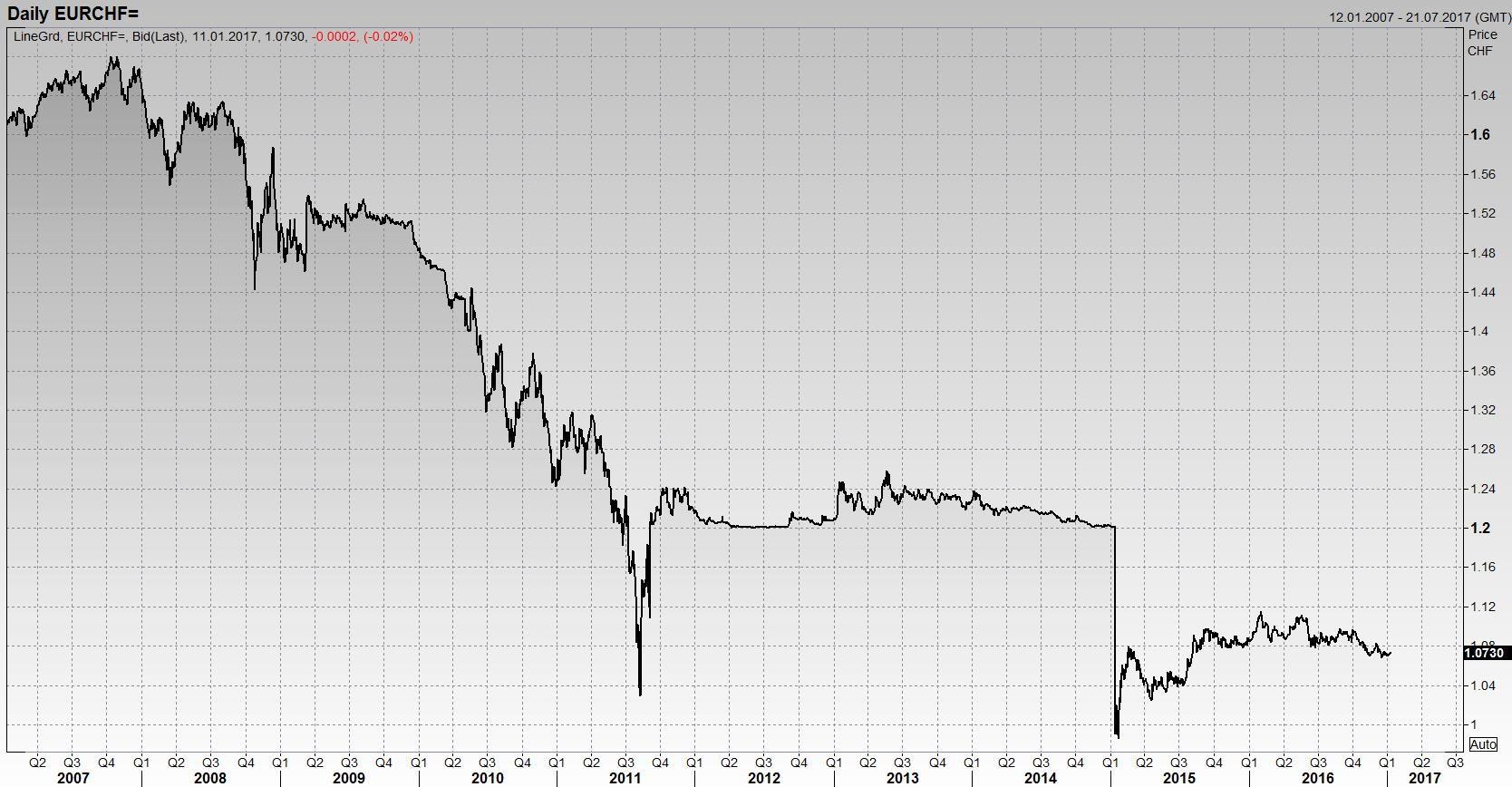
These risks call for controls beyond a statistical estimate based on recent returns. Treasury should consider currency access, legal entities, settlement channels and the possibility that markets become discontinuous. Liquidity planning must allow for adverse collateral calls or the need to obtain currency when ordinary dealing conditions are unavailable.
Historical source: SNB, discontinuation of the minimum exchange rate, 15 January 2015.
The Lufthansa aircraft-purchase decision
The Lufthansa case concerns a decision made in January 1985 to purchase 20 Boeing 737 aircraft for USD 500 million, payable approximately one year later. The dollar had appreciated substantially against the Deutsche mark. The central question was how to manage the mark cost of a fixed dollar payment while preserving the airline's ability to finance its aircraft. A view that the dollar looked expensive was not a guarantee that it would decline before settlement.
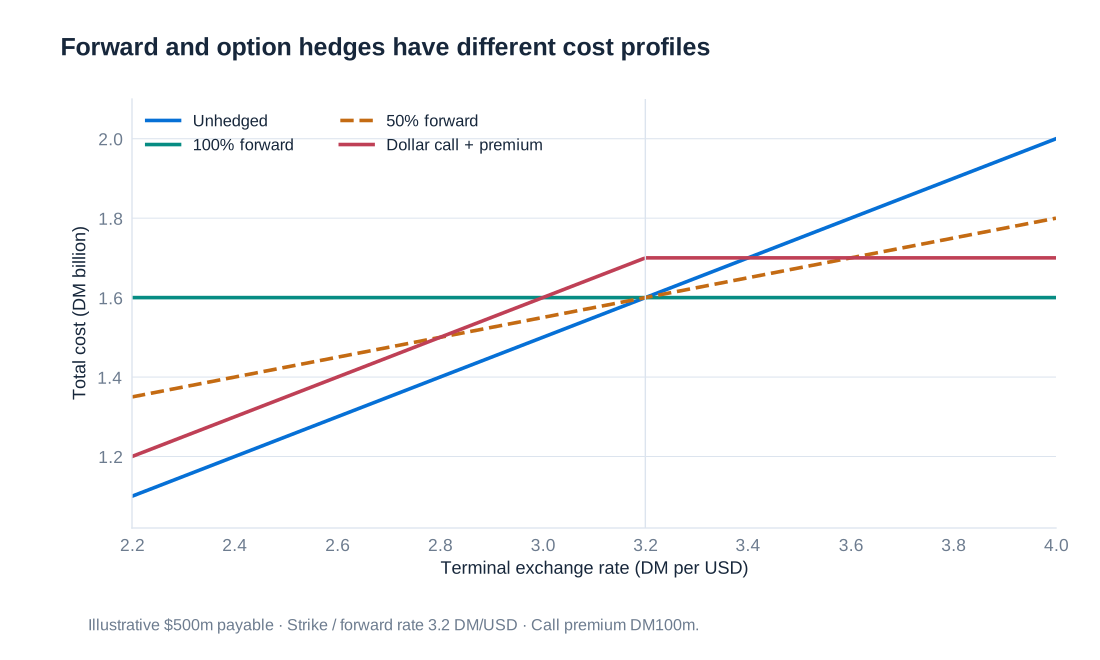
For a transparent numerical comparison, let be the terminal exchange rate in Deutsche marks per dollar, assume a forward rate of DM 3.2 per dollar, and compare four strategies: no hedge, full forward cover, half forward cover and a call option on dollars. For the option example, assume a strike of DM 3.2 and a total premium of DM 100 million. The premium is an explicit illustrative input; its financing cost is ignored so that the payoff comparison remains clear.
With million dollars, the unhedged payment is . A full forward fixes it at million marks. A half hedge fixes USD 250 million at 3.2 and buys the remaining USD 250 million at spot. A dollar call permits purchase at the lower of the spot rate and strike, but requires the premium. In DM billions, the four total costs are:
| Terminal DM per USD | Unhedged | Full forward | Half forward | Call option including premium |
|---|---|---|---|---|
| 2.2 | 1.10 | 1.60 | 1.35 | 1.20 |
| 2.4 | 1.20 | 1.60 | 1.40 | 1.30 |
| 2.6 | 1.30 | 1.60 | 1.45 | 1.40 |
| 2.8 | 1.40 | 1.60 | 1.50 | 1.50 |
| 3.0 | 1.50 | 1.60 | 1.55 | 1.60 |
| 3.2 | 1.60 | 1.60 | 1.60 | 1.70 |
| 3.4 | 1.70 | 1.60 | 1.65 | 1.70 |
| 3.6 | 1.80 | 1.60 | 1.70 | 1.70 |
| 3.8 | 1.90 | 1.60 | 1.75 | 1.70 |
| 4.0 | 2.00 | 1.60 | 1.80 | 1.70 |
The full forward removes exchange-rate uncertainty in this simplified calculation. The half hedge leaves half the slope of the unhedged cost curve. The option caps the total at DM 1.7 billion while retaining gains from a cheaper dollar, after allowing for its premium. The dollar protection is a call on dollars, equivalently involving a put on marks under the reciprocal currency description; calling it a dollar put would reverse the protection.
Ex-ante protection and ex-post regret
The dollar subsequently fell from approximately DM 3.2 to DM 2.2. Buying USD 500 million at the new spot rate would cost DM 1.1 billion instead of DM 1.6 billion. A half forward hedge at 3.2 generates a derivative loss of million marks relative to spot, leaving a combined cost of DM 1.35 billion. The hedge gives up half the favourable currency movement in return for having protected half the payment against an unfavourable movement.
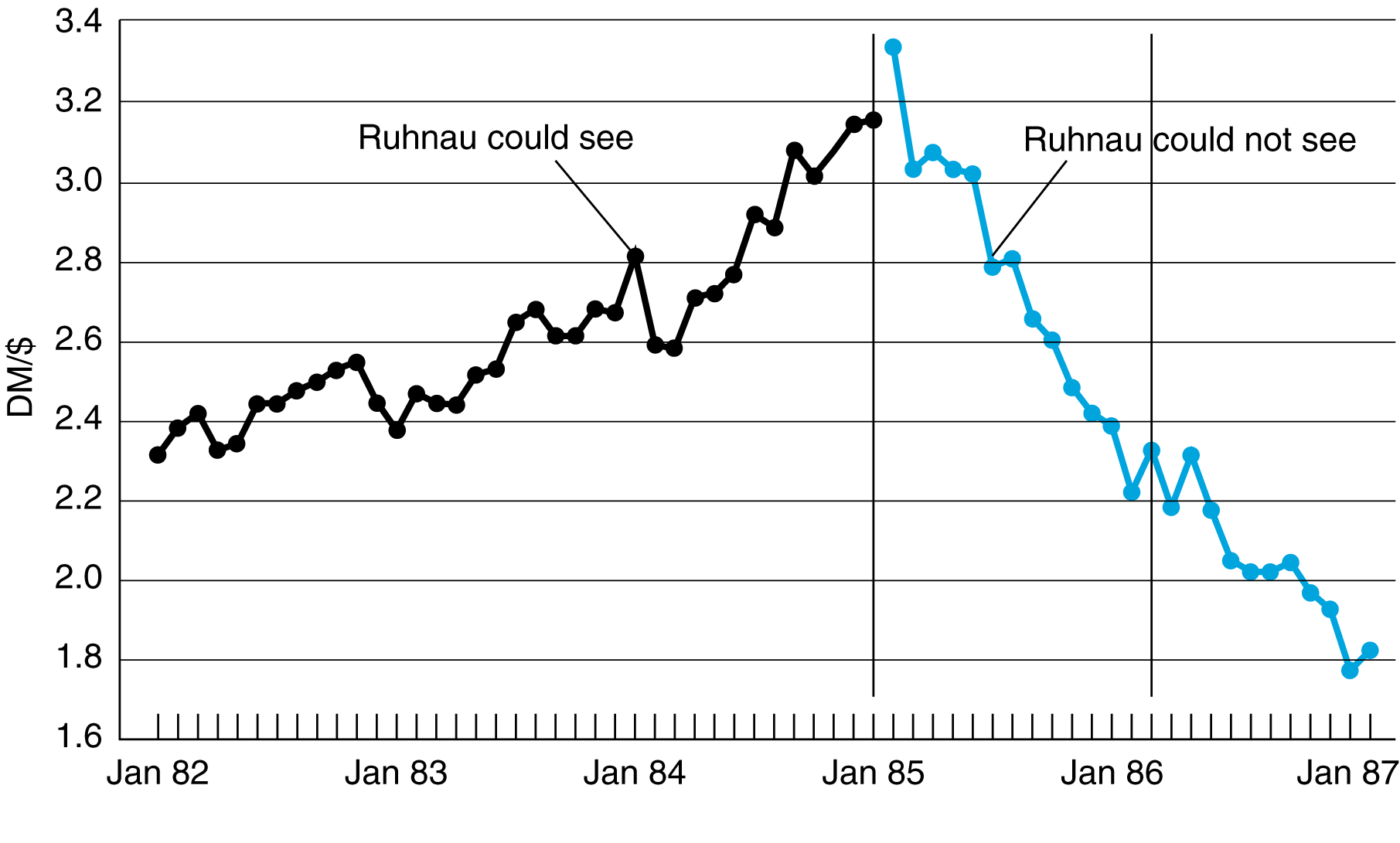
Criticism based only on the realised forward loss ignores the decision's original purpose. Had the dollar risen to DM 4, the half hedge would have gained DM 200 million and reduced the DM 2 billion spot cost to DM 1.8 billion. The appropriate ex-ante assessment asks whether the chosen exposure, certainty and cost suited the airline's objectives using information available at the time. The strategy need not be optimal merely because it was a hedge, but hindsight about the direction of the dollar is not a sufficient performance criterion.
The case also highlights governance. Management and the supervisory board need agreement on whether the objective is to fix an investment budget, protect cash flow, stabilise accounting earnings or express a currency view. A partial hedge can be sensible under a defined policy, but looks arbitrary when no one can explain why that proportion was chosen. Clear reporting should distinguish the derivative result, the underlying purchase cost and the combined outcome.
Why the aircraft and the hedge can affect earnings differently
Buying an aircraft normally exchanges cash for a non-financial asset recognised at its acquisition cost. In a simplified initial-recognition example, that transaction does not immediately produce an operating profit or loss. A cheaper aircraft leaves more cash and a lower recorded asset cost; it does not necessarily create a current-period accounting gain equal to the currency saving. Depreciation and later measurement effects occur subsequently.
| Item | Before purchase | Purchase at DM 4 per USD | Purchase at DM 2 per USD |
|---|---|---|---|
| Cash | 2 | 0 | 1 |
| New aircraft | 0 | 2 | 1 |
| Other assets | 8 | 8 | 8 |
| Total assets | 10 | 10 | 10 |
| Debt | 5 | 5 | 5 |
| Equity | 5 | 5 | 5 |
This balance sheet deliberately excludes derivative settlement and later depreciation. A 50% forward hedge of USD 500 million at 3.2 produces a DM 0.2 billion gain if the terminal rate is 4, and a DM 0.3 billion loss if it is 2. Without an accounting treatment that appropriately aligns the hedge with the exposure, the derivative result can enter earnings while the purchase-price difference is reflected in the aircraft's carrying amount. The economic offset and the timing of reported earnings can therefore differ.
Modern hedge accounting addresses specified mismatches when its designation, documentation and effectiveness requirements are met; it is not automatic simply because management calls a transaction a hedge. Nor should a historical case be used to claim that no form of hedge accounting existed anywhere in 1986. The durable lesson is to analyse both economic protection and accounting presentation before entering the transaction.
Putting the currency policy together
A corporate currency policy starts with the business decisions that generate risk: markets served, locations of operations and currencies used for pricing and financing. It then defines which transaction, translation and economic exposures matter, how confidently they can be forecast, the horizons to be covered and the permitted hedge percentages. The instrument choice follows these objectives rather than preceding them.
Limits can be expressed through nominal exposures, Value at Risk, Cash Flow at Risk or Earnings at Risk, depending on the quantity the firm seeks to protect. Operational hedges, foreign-currency borrowing, money-market transactions and derivatives should be considered together. Treasury also needs a process for exposure updates, collateral funding, counterparty limits and exceptions. A policy that reduces reported currency volatility while creating an unmanageable cash requirement has solved the wrong problem.
Transaction exposure is often the most straightforward to hedge because its amount and date can be identified. Translation exposure requires special attention to the difference between accounting gains and available cash. Economic exposure is often substantial but less directly matched by fixed-notional derivatives. The overall objective is a coherent relationship between the firm's operations, financial capacity and chosen currency risk, with the combined position understandable to those responsible for oversight.