
“I pay less tax” almost automatically sounds like “I am better off”. But an economic decision should not be assessed solely on the tax saving it generates. If saving 1,000 euros in tax requires spending 4,000 euros on something I do not need, my wealth does not improve: I have simply spent 4,000 to recover part of it through the tax system. This reasoning error appears in many contexts: tax-relievable expenses, deductions, business purchases, supplementary pensions, tax-advantaged investments and corporate decisions. Taxation can change a decision's net cost, but rarely turns a poor purchase automatically into a good choice.

Deducting does not mean getting the entire amount back
Suppose, purely as an illustration, that an expense of 1,000 euros reduces taxable income and the effective tax benefit associated with that reduction is 300 euros. The net economic cost remains 700 euros. If I needed to incur that expense anyway, the tax benefit is useful. If I incur it solely to “write it off”, I am spending a net 700 euros that would otherwise have remained part of my wealth. The same principle applies to a reduction in tax due: if an expense of 1,000 produces tax relief of 190 euros, I have not earned 190 euros; I have incurred a net cost of 810 euros in exchange for the goods or services purchased.
The business purchase: “I can write it off anyway”
This is one of the most dangerous phrases in business. A deductible expense may reduce taxable income, but it remains an economic cost. If a business buys equipment costing 10,000 euros that it does not need, deductibility does not return 10,000 euros. Suppose the overall tax benefit, spread according to the applicable rules, amounts to 2,800 euros. The business has still deployed a net 7,200 euros of resources on a useless asset. If the equipment instead increases productivity and generates margins exceeding its cost, the tax benefit becomes an additional element of a decision that already makes economic sense.
A very simple example
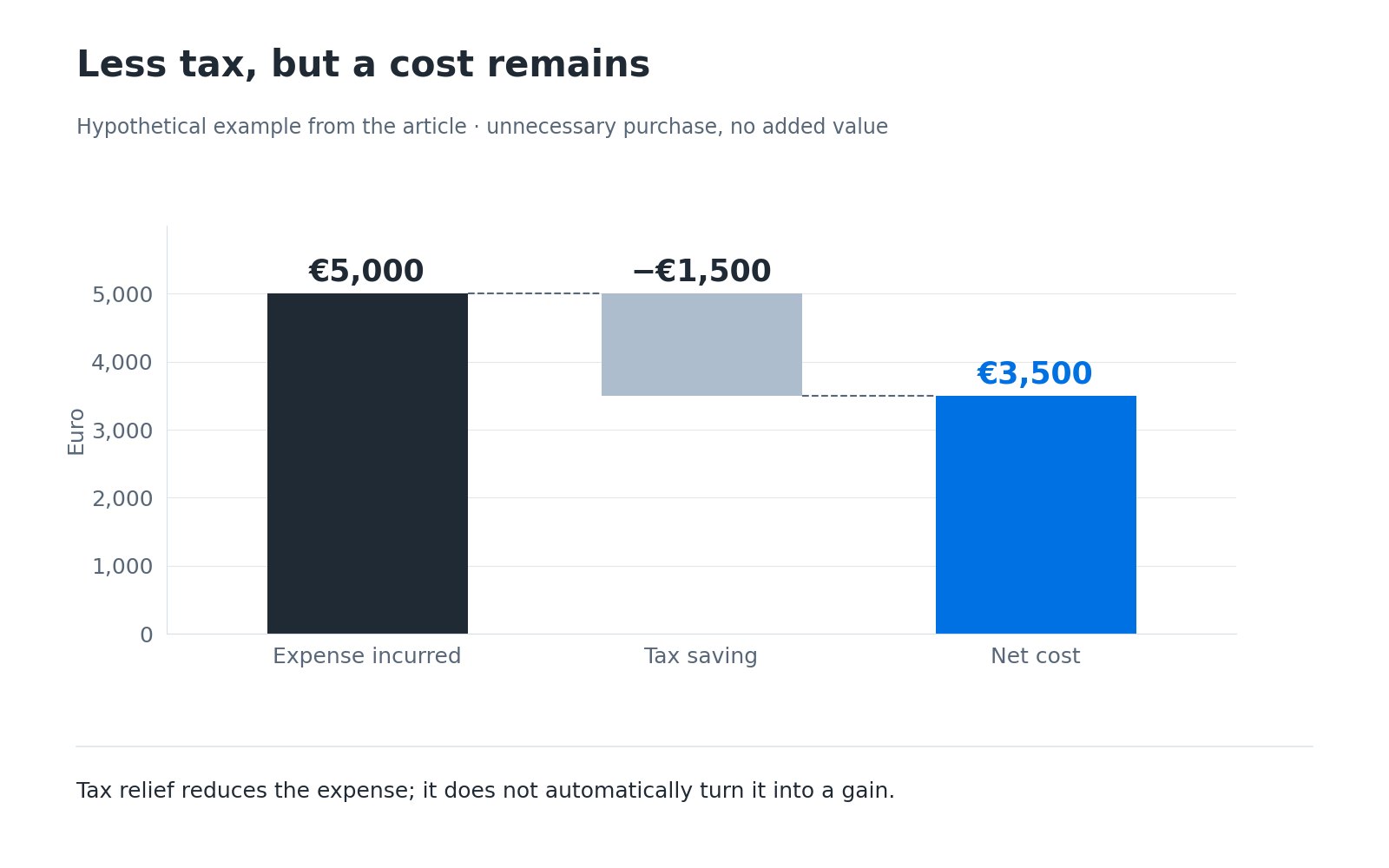
Scenario A: I do not incur an unnecessary expense and pay 2,000 euros in tax. Scenario B: I incur a cost of 5,000 euros and, thanks to its tax effect, my taxes fall by 1,500 euros. In the second scenario, I have “saved” 1,500 euros in tax but spent 5,000 euros. My wealth is 3,500 euros lower than if I had not incurred the cost. Naturally, if those 5,000 euros buy an asset that generates value exceeding the net 3,500 euros, the decision may be excellent. But the reason is the asset's economic value, not the fact that it reduces taxes.
Paying tax can be a consequence of earning more
Another mistake is to view an increase in tax as a deterioration independent of income. If an activity produces 20,000 euros in additional income and generates 6,000 euros in additional tax, the taxpayer still retains a substantial share of the incremental income. Refusing profitable work solely because “it makes me pay more tax” can be irrational, except in specific cases where benefits are lost, thresholds are crossed or regimes change with nonlinear effects. This calls for a marginal calculation: how much additional net income remains after taxes and contributions?
Thresholds really can change the reasoning
There are situations in which a tax, contribution or benefit threshold has significant effects. In these cases, the overall outcome must be calculated rather than automatically applying the rule that “more income is always better”. But myths must also be avoided here. Crossing an IRPEF income-tax bracket, for example, does not mean that all income is suddenly taxed at the higher bracket's rate: progression operates by bands. Other thresholds, however, may affect access to regimes or benefits and require specific assessment.
The timing of the benefit matters
Deductions from income, reductions in tax due and tax credits do not always provide an immediate advantage. They may be spread over time, require sufficient taxable income or tax liability, be subject to limits and depend on continued eligibility. A nominal benefit of 5,000 euros received over several years is economically worth less than 5,000 euros available today and may become unusable if the prescribed conditions are absent. Before a transaction motivated partly by taxation, I would therefore check the eligible base, effective rate, schedule, capacity to use the relief, restrictions and consequences of an early disposal. Tax optimisation is useful when it accompanies an already sound choice. If it becomes the main reason for buying what is unnecessary, the taxpayer risks confusing lower tax with greater wealth.
Pension funds: tax benefits and economic constraints
Supplementary pension provision is a good example of a decision that cannot be assessed solely through tax savings. Deductible contributions may reduce the net cost of paying in, but the money is allocated to a pension arrangement with its own rules on investment, advance withdrawals, redemption and benefits. If the retirement objective is consistent with personal circumstances, the tax advantage can be very important. If someone instead needs liquidity soon, contributing solely to obtain a deduction can create a future availability problem.
Debt to obtain a tax advantage
In some contexts, people also consider retaining debt because the interest may have some tax relevance. But paying 100 in interest to save 24 in tax still means incurring a net cost of 76, unless the borrowed capital generates an economic return sufficient to justify it. The tax advantage can reduce the cost of debt; it does not turn it into a gain.
Financing a purchase changes the result again
If a purchase is debt-financed, interest, fees and financial risk are added to its after-tax net cost. An asset costing 10,000 euros with a tax benefit of 3,000 does not cost 7,000 if financing generates another 1,500 euros in charges. The comparison must include all outflows and their timing, not merely the saving shown in the tax return.
The right order of questions
When assessing a choice with tax consequences, I would begin with these questions in order: does the decision make sense before tax? What economic or personal benefit does it produce? How much does it cost? How does taxation change that cost? Are there restrictions or indirect effects? Reversing the order leads to looking for expenses to incur simply to reduce taxable income. Tax optimisation then becomes the end rather than a means.
Always compare wealth after the transaction
A practical method is to compare two scenarios net of all effects. In the first, I do not incur the expense and pay ordinary taxes; in the second, I make the purchase and account for the tax saving, additional costs and any residual asset value. The decision makes sense if the second scenario produces utility or value exceeding the net cost, not simply because the tax return shows less tax. Suppose a machine costs 20,000 euros, generates a hypothetical total tax benefit of 6,000 and can later be resold for 4,000. The net cost to wealth is still 10,000 euros, before maintenance and the cost of capital. If the machine produces greater savings or margins, the purchase can create value; if it remains unused, the tax benefit has merely reduced an economic loss.
Optimising tax makes sense, but after optimising the economics
There is nothing wrong with efficient tax planning using instruments and reliefs provided by law. Indeed, completely ignoring the tax impact can lead to inefficient decisions. The point is not to confuse minimising taxes with maximising net wealth or disposable income. The economically best choice maximises the outcome after considering costs, benefits, risk, liquidity and taxes together. In many cases, paying more tax is simply the consequence of producing more income or value. The question should therefore not be “how can I pay less tax?”, but “how can I maximise the net outcome while complying with the rules?”. The questions are similar only on the surface.
Note. This article is for information and educational purposes only. Tax treatment depends on the particular case and current legislation; it does not constitute tax advice.