
ECONOMICS · PUBLIC FINANCE · EUROPEAN LAW
Italy holds one of the largest gold reserves in the world, accumulated mainly during the post-war economic miracle. But who actually owns this wealth? Why does politics want to intervene in its ownership, and why has the European Central Bank expressed concern? Understanding the issue requires distinguishing between ownership, reserve management, central bank independence and the possibility of using gold to reduce public debt.
Article contents
Updated on 25 October 2026


A national asset that receives too little attention
Italy is one of the most indebted countries in Western Europe, yet it also holds one of the world's largest gold reserves. This is only an apparent contradiction: public debt measures the financial obligations accumulated by general government, while gold reserves are assets of the central bank, subject to a specific legal and accounting framework.
According to Bank of Italy data, the national reserves amount to approximately 2,451.8 tonnes of gold, placing Italy third in the world, after the United States and Germany.
This is not merely theoretical wealth. Gold is an asset that can be traded on international markets, and its value is continually updated as prices change. However, holding it does not mean that the Government has immediately available financial resources.
This distinction became particularly important in 2025, when the parliamentary majority tabled an amendment to the 2026 Budget Law to clarify who owned Italy's gold reserves.
The proposal prompted objections from the European Central Bank (ECB), which was concerned that recognition of public ownership could become a basis for interfering with the Bank of Italy's autonomy.
However, the outcome of the dispute substantially changes the account presented in some videos circulating online: the provision was actually approved and entered into force on 1 January 2026.
It is contained in Article 1, paragraph 2, of Law No. 199 of 30 December 2025. It did not order the sale of the gold or its transfer to the Ministry of Economy and Finance. It introduced an interpretative provision recognising that the reserves belong to the Italian people, while expressly safeguarding European rules.
To understand whether this decision is economically useful, symbolic or potentially risky, we first need to reconstruct how Italy accumulated such a large quantity of gold and what purpose it serves today.
From the Second World War to the economic miracle: how Italy accumulated its gold
Understanding the origins of Italy's reserves requires going back to the first half of the twentieth century.
The Bank of Italy, founded in 1893, already held gold reserves before the Second World War. Gold was then a fundamental part of the international monetary system, in a context in which currency convertibility and the availability of metal reserves helped determine the credibility of issuing banks.
The situation changed radically after the armistice of 8 September 1943. The German authorities took control of part of the reserves, moving them first to Milan, then to Fortezza in South Tyrol and subsequently, in part, to Germany.
After the war, Italy began a complex diplomatic process to recover the assets that had been taken. According to the historical account published by the Bank of Italy, the country recovered all the gold remaining at Fortezza and, through post-war international agreements, approximately two-thirds of the gold transferred to Germany.
The real turning point, however, came in the fifties and sixties.
During the Italian economic miracle, domestic industry considerably increased its production capacity, and exports generated substantial inflows of foreign currency, particularly US dollars.
Under the Bretton Woods system, characterised by fixed but adjustable exchange rates and the convertibility of the dollar into gold for foreign monetary authorities, some of these dollars were converted into gold reserves.
The Ufficio Italiano dei Cambi (UIC), the Italian Foreign Exchange Office, played a particularly important role, accumulating almost 2,000 tonnes of gold between 1951 and 1960. In 1960 and 1965, two transfers moved 1,890 tonnes into the Bank of Italy's reserves.
This was therefore wealth gradually accumulated through the Italian productive system's ability to generate income from abroad, rather than simply gold purchased by taking on public debt.
Following subsequent transfers and transactions, including those associated with the launch of Economic and Monetary Union, the stock stabilised in the late nineties at approximately its current level of 2,452 tonnes.
Where are Italy's 2,452 tonnes of gold held?
One of the less well-known aspects is the geographical distribution of the reserves.
Contrary to what one might imagine, more than half of Italy's gold is held abroad. This reflects historical reasons, geographical risk diversification and the ability to operate quickly in the main international markets.
The official distribution published by the Bank of Italy is as follows:
| Country of custody | Tonnes | Share |
|---|---|---|
| Italy | 1,100.0 | 44.86% |
| United States | 1,061.5 | 43.29% |
| Switzerland | 149.3 | 6.09% |
| United Kingdom | 141.2 | 5.76% |
| Total | 2,452.0 | 100% |
Rounded quantities.
The gold held in Italy is stored in the Bank of Italy's secure facilities in Rome. For the US portion, it is important to correct a frequently repeated error: the relevant depository is the Federal Reserve Bank of New York, not Fort Knox, which mainly holds US Treasury gold.
The Federal Reserve Bank of New York provides custody services to central banks, governments and international organisations. An Italian gold bar being held in the United States does not mean that it belongs to the United States. Just as with securities deposited with an intermediary, a distinction must be made between the institution holding the asset in custody and the holder of the associated rights.
In terms of security, the Bank of Italy states that the gold held in Rome is checked annually, with the involvement of the audit firm responsible for certifying its financial statements. For reserves held abroad, confirmations are obtained from the custodian central banks, while direct inspections remain possible.
Custody abroad nevertheless involves geopolitical risk: in exceptional circumstances, international financial restrictions or diplomatic conflicts could make it more difficult to access an asset located in another jurisdiction.
The conclusion is not necessarily that all the gold should be brought back to Italy, since concentrating the reserves in a single territory would create other risks. Instead, the discussion should examine the relationship between physical security, accessibility, diversification and operating costs.
How much are Italy's gold reserves worth?
The value of the reserves essentially depends on two factors: the quantity of gold held and the international price of the metal, converted into the currency used in the financial statements.
The relationship is straightforward:
Here, is the quantity of metal held, while is the price per unit of weight.
Since gold is commonly quoted in dollars per troy ounce, a valuation in euros must also take account of the EUR/USD exchange rate.
In its financial statements for the year ended 31 December 2025, the Bank of Italy recorded the value of its gold reserves at 289.2 billion euros, compared with approximately 198 billion at the end of 2024.
Carrying amount of the Bank of Italy's gold
The increase was approximately 91 billion euros, representing a revaluation of around 46% in a single year, with quantities essentially unchanged.
This is a particularly significant figure because it shows how much movements in gold prices can affect a central bank's financial position without any additional metal being purchased.
However, an increase in the value of gold does not automatically constitute distributable profit.
If an investor buys an asset for 100 euros and it is worth 150 euros at year-end, their wealth has increased by 50 euros. This does not mean that they have received 50 euros in cash: the additional value remains an unrealised capital gain until a sale takes place.
Central bank accounting follows specific rules. In particular, under Eurosystem accounting principles, unrealised gains on gold are recorded in specific revaluation accounts on the liabilities side of the balance sheet, rather than directly as profit for the year.
This mechanism is particularly important because these accounts provide a financial buffer against possible future price declines.
This means that the 91 billion euros of revaluation recorded in 2025 are not 91 billion that the Government can automatically allocate to pensions, public investment or tax cuts.
This is a fundamental distinction between asset value, available liquidity and distributable earnings.
Who owns the Bank of Italy? The issue of shares held by private entities
Understanding the political debate requires addressing a frequently overlooked point: the Bank of Italy is not organised like an ordinary ministry, and its capital is held by entities other than the State.
The Bank of Italy is a public-law institution, an integral part of the Eurosystem, performing functions in the general interest. Nevertheless, its capital is divided into shares held by entities belonging to certain legally specified categories.
Its nominal capital amounts to 7.5 billion euros, divided into 300,000 shares with a nominal value of 25,000 euros each.
At the end of 2025, it had 174 shareholders, including banks, insurance companies, banking foundations, social security institutions and pension funds.
This may surprise those who imagine a central bank wholly owned by the Government, but it should not be confused with an ordinary joint-stock company.
The holders of the Bank of Italy's capital cannot freely exercise the powers typically enjoyed by shareholders in a commercial company and, above all, cannot independently decide on monetary policy or the management of official reserves.
Since 2022, the ordinary maximum permitted holding has been 5% of the capital. Shares exceeding this limit carry neither voting rights nor economic or proprietary rights.
The rules also limit remuneration to shareholders: the total amount payable to them as dividends cannot exceed 6% of the capital, or 450 million euros annually. This is not a guaranteed return, but an upper limit. The remainder of the profit, after the allocations required by the Statute, is assigned to the State.
This aspect is crucial to understanding the issue of gold ownership.
A commercial bank holding a share in the Bank of Italy does not automatically acquire proportionate ownership of the gold bars stored in its vaults. The shares confer specific economic and administrative rights established by law, rather than a property right over each asset recorded on the central bank's balance sheet.
In other words, acquiring 5% of the Bank of Italy's capital does not mean acquiring 5% of its gold reserves.
This distinction is also essential when assessing the concern expressed by some politicians that private financial entities, or entities with foreign connections, might claim rights over the national gold.
The issue may have political and institutional significance, but the presence of private shareholders does not, in itself, demonstrate that they can appropriate the reserves.
The 2025 dispute: why did the Government want to declare that the gold belongs to Italians?
The debate over the ownership of gold reserves did not begin with the Meloni Government.
As early as 2005, Law No. 262 provided for a change to the ownership structure of the Bank of Italy's capital, through the transfer of shares held by non-public entities. The provision remained unimplemented and was subsequently repealed in 2013.
It is important to clarify that this provision primarily concerned participation in the institution's capital, rather than a general authorisation to transfer official gold reserves to the Treasury.
In 2019, the question of gold ownership returned to Parliament's attention, with initiatives on which the ECB was also consulted.
In November 2025, during consideration of the Budget Law for 2026, some members of Parliament from Fratelli d'Italia again proposed clarifying the ownership of the reserves by law.
The initial wording referred to the Italian State. Subsequently, partly in response to European observations, the text was amended to refer to the Italian people and expressly preserve the application of the European Treaties.
The debate intensified when Reuters reported, on 11 December 2025, the existence of an internal document from Giorgia Meloni's party arguing that possible claims over the reserves by foreign shareholders in the Bank of Italy needed to be prevented.
The proposal therefore raised two distinct questions.
The first concerned ownership of the reserves, namely the entity to which legal ownership of the assets should be attributed.
The second concerned the power to dispose of them, meaning the ability to decide whether to sell them, transfer them, pledge them as collateral or use them for other transactions.
These questions are not equivalent. An entity may be recognised as the owner of assets without being able to use them freely, where specific legislation gives other entities exclusive responsibility for managing them.
What the 2026 Budget Law actually provides
Parliament gave final approval to Law No. 199 of 30 December 2025. Article 1, paragraph 2, contains the following provision:
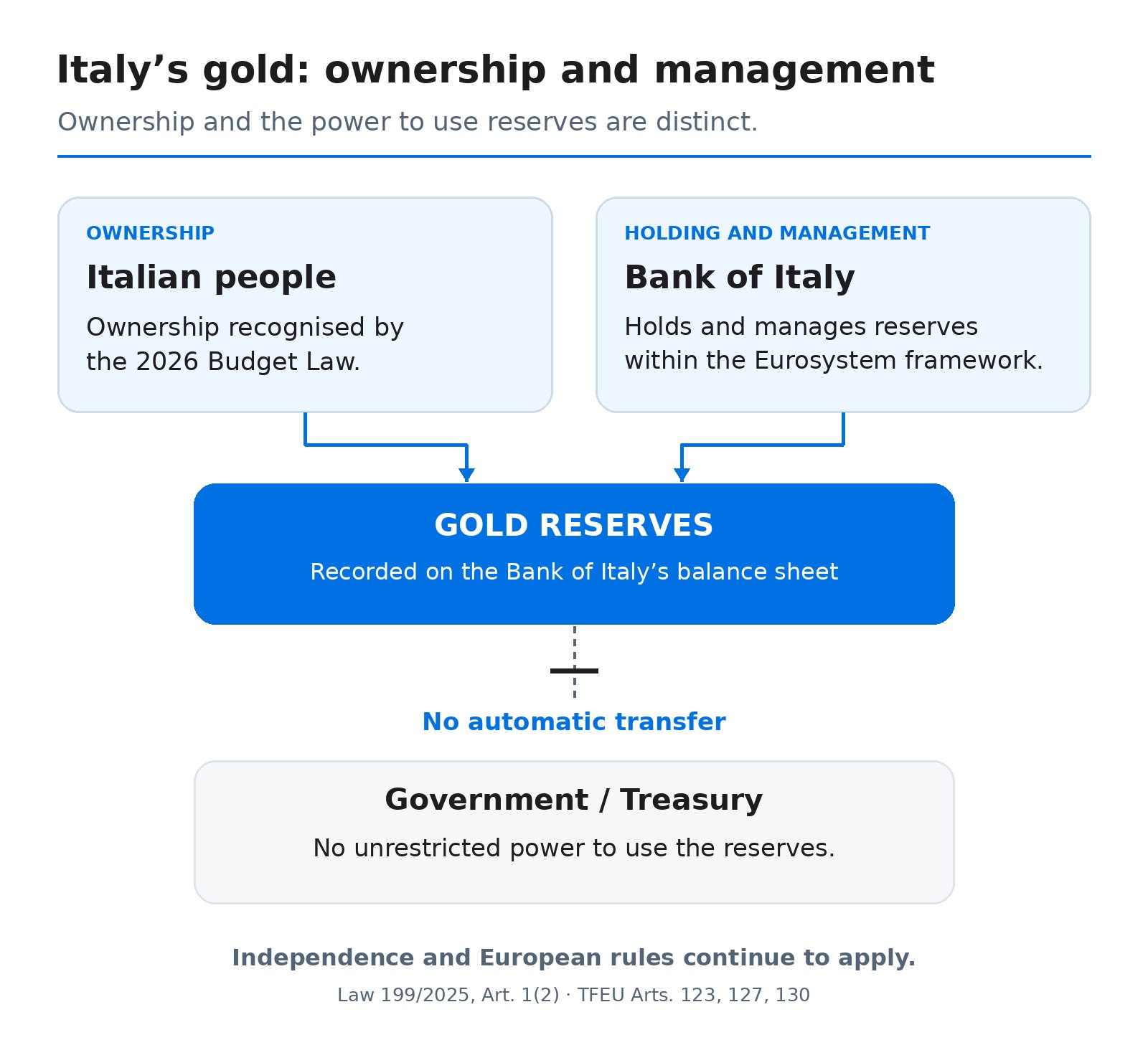
Without prejudice to Articles 123, 127 and 130 of the Treaty on the Functioning of the European Union, paragraph 2 of Article 4 of the consolidated law on foreign exchange, set out in Presidential Decree No. 148 of 31 March 1988, shall be interpreted as meaning that the gold reserves managed and held by the Bank of Italy, as recorded in its balance sheet, belong to the Italian People.
This is a provision of interpretazione autentica, or authoritative legislative interpretation, through which the legislature determines the meaning to be given to an earlier provision.
The legally relevant point is that recognition of the Italian people's ownership of the gold is expressly subject to compliance with the powers and safeguards established by European law.
The law therefore does not authorise the Ministry of Economy to remove the gold from the Bank of Italy's balance sheet, nor does it give the Government the power to use the reserves to finance public expenditure directly.
The amendment was approved, but this does not amount to transferring economic control of the gold to the Treasury.
This is precisely the difference between the political content of the provision and its actual legal effects.
Why did the ECB object? The principle of central bank independence
The ECB formally intervened in the legislative proposal through two opinions adopted on 2 and 8 December 2025: CON/2025/39 and CON/2025/40, respectively.
The European Central Bank's observations should not be interpreted as a claim of European ownership over Italian gold.
The central issue concerns the independence of national central banks, which is a fundamental component of the European Union's monetary architecture.
Understanding the problem requires referring to three provisions of the Treaty on the Functioning of the European Union (TFEU).
Article 123 TFEU governs the prohibition of monetary financing: the ECB and national central banks may not directly grant overdraft facilities or other credit facilities to public authorities, nor purchase public debt securities directly from them.
Article 127 TFEU sets out the objectives and basic tasks of the European System of Central Banks, including defining and implementing monetary policy and holding and managing the official foreign exchange reserves of the Member States.
Article 130 TFEU safeguards institutional independence, stipulating that the ECB and national central banks may neither seek nor accept instructions from governments or other bodies in the exercise of their functions.
These rules do not absolutely prevent a central bank from trading gold. Instead, they prevent the Government from imposing transactions that undermine the monetary authority's powers and autonomy or amount to monetary financing of the public sector.
The distinction is substantive.
If the Bank of Italy decided, within its responsibilities and in compliance with Eurosystem rules, to change the composition of its official reserves, this would be an asset management transaction.
If, instead, the Government ordered the central bank to transfer part of its reserves to it free of charge to finance new expenditure, the transaction would raise entirely different issues.
The ECB's concerns related precisely to the possibility that a law on ownership could become an instrument for interfering with reserve management. In its opinions, the ECB also noted the absence of a sufficiently clear explanation of the proposal's operational objectives.
On the other hand, it would not be correct to argue that every attempt to clarify gold ownership automatically constitutes a breach of European law.
A provision recognising ownership and a measure that actually transfers assets are legally different operations. The final wording of the 2026 Budget Law was designed precisely around this distinction.
What if Italy sold its gold to reduce public debt?
This is probably the most economically interesting aspect of the dispute.
Italy holds gold assets of very substantial value, yet it must also finance public debt which, according to Bank of Italy data published on 15 October 2026, had reached 3,200.8 billion euros in August.
To understand the scale of the issue, we can compare the two figures.
Gold reserves
289.2 bn €
Value at 31 December 2025
Public debt
3,200.8 bn €
Outstanding amount in August 2026
The comparison uses different reference dates.
If, purely hypothetically, all the reserves could be liquidated at their value on 31 December 2025 and the proceeds used entirely to repay the public debt recorded in August 2026, the reduction would be:
This means that selling all the gold could theoretically reduce the debt by approximately 9%, assuming no selling costs, price changes or other economic and accounting effects.
The debt would still exceed 2,900 billion euros.
Simulation: how much debt could be repaid?
The following table presents four purely hypothetical scenarios.
| Share of gold sold | Theoretical proceeds | Remaining debt |
|---|---|---|
| 10% | 28.9 bn € | 3,171.9 bn € |
| 25% | 72.3 bn € | 3,128.5 bn € |
| 50% | 144.6 bn € | 3,056.2 bn € |
| 100% | 289.2 bn € | 2,911.6 bn € |
Hypothetical calculations based on official data. The calculation assumes that all proceeds are legally available to the Treasury, which is not currently the case.
From a purely financial perspective, a reduction in debt could also produce savings on future interest payments.
Suppose, for example, that Italy managed to repay 100 billion euros of debt on which it would otherwise have paid an average annual cost of 3%.
The theoretical saving would be:
This would amount to approximately 3 billion euros in lower annual interest payments. However, the actual benefit would depend on the characteristics of the securities repaid, their maturities and refinancing conditions.
Taken in isolation, this reasoning would seem to favour selling the gold. But it would be incomplete.
The problem is that the proceeds of the sale would not automatically become State revenue.
The reserves are recorded on the balance sheet of the Bank of Italy, which is a separate entity from the Treasury. If the central bank sold gold to market participants, it would normally replace one asset with another, such as foreign currency funds.
In accounting terms, the composition of its assets would change, but this would not mean that the Government immediately acquired the money raised by the sale.
Using it to repay public debt would require a further transfer to the Treasury, subject to legal and monetary constraints.
It is precisely this step that lies at the heart of an essential part of the ECB's concerns.
The accounting problem: why transferring gold to the State is not a simple asset transaction
Understanding the effects of a possible transfer requires considering the Bank of Italy's balance sheet.
Like any entity that prepares financial statements, a central bank reports assets, liabilities and equity.
The fundamental equation is:
Gold reserves are an asset item.
Liabilities, meanwhile, include various items connected with the central bank's activities, including monetary components, positions vis-à-vis the banking system and other financial and accounting obligations.
Suppose the Government could take 100 billion euros of gold from the central bank's assets without paying for it.
If there were no offsetting adjustment to liabilities or through other assets, the central bank's equity would fall by 100 billion euros.
This would therefore not simply mean moving an asset from one public office to another, but significantly altering the institution's financial structure.
For comparison, the Bank of Italy's balance sheet at 31 December 2025 reported total assets of approximately 1,113 billion euros, while the value of its gold was 289.2 billion: approximately 26% of total assets.
This does not mean that a central bank operates like an ordinary commercial business, or that a reduction in equity automatically prevents it from operating. It does mean, however, that transfers on this scale would have accounting, institutional and potentially reputational consequences that would need careful assessment.
What if the Treasury bought the gold from the Bank of Italy?
A second possibility exists: the Ministry of Economy could purchase the reserves at market price, rather than receive them free of charge.
In that case, assuming the purchase was financed entirely by issuing government securities, public debt would increase.
For example, purchasing 100 billion euros of gold by issuing new debt would, as a first approximation, increase the Treasury's liabilities by 100 billion, while it acquired an asset of the same value.
The State would own a new asset, but would also have more debt.
If it subsequently sold that gold to repay the securities issued, it would essentially return to the starting position, after allowing for transaction costs and any changes in prices.
A debt-financed purchase does not, by itself, create any new net wealth.
This consideration matters because it shows that changing the ownership of the reserves is not sufficient to improve the sustainability of public finances.
Do central banks still need gold without the Gold Standard?
Understanding the strategic value of reserves requires remembering that today's monetary system is no longer based on the convertibility of banknotes into gold.
A citizen holding 100 euros cannot ask the ECB to exchange them for a predetermined quantity of precious metal.
The euro is fiat money, whose value depends on the institutional system supporting it, monetary policy, the economy's productive capacity and the confidence of those who use it.
Why, then, do central banks continue to hold gold?
The main reason is that the precious metal retains certain characteristics that are particularly relevant to a monetary authority.
First, physical gold does not represent a promise of payment issued by another entity. Unlike a bond, it does not depend on an issuer's ability to repay a debt at maturity.
In addition, gold reserves can help diversify a central bank's assets relative to foreign currency-denominated holdings and financial securities.
Gold nevertheless has significant limitations: it does not pay interest, involves custody costs, can experience substantial price falls and does not provide a perfect inflation hedge over every time horizon.
Its role should therefore be understood in terms of diversification, financial resilience and risk management, rather than as a guarantee of returns.
It is interesting that the Bank of Italy has previously used its gold reserves for financial transactions without permanently disposing of them: a historical example is the use of gold as collateral for a loan received from the Bundesbank in the seventies.
This shows the difference between leaving reserves completely inactive and managing them within the functions of a central bank.
The political question: why has gold become so controversial?
At this point, the discussion cannot be confined to ownership of the bars.
The broader issue concerns the relationship between the autonomy of monetary institutions, democratic sovereignty and responsibility for managing public finances.
Those supporting the need for legislative recognition of public ownership of the reserves can invoke an understandable principle: wealth accumulated throughout the nation's economic history should be clearly attributable to the community and should not be exposed to ambiguity over its ownership.
From this perspective, the statement that the gold belongs to the Italian people has institutional significance that need not necessarily be interpreted as an attempt to sell the reserves.
On the other hand, defenders of central bank independence identify an equally tangible risk.
If a Government could freely dispose of the central bank's assets, it might be encouraged to use them to finance short-term policies, deferring the economic costs of its decisions.
This risk is particularly relevant in a country with a high ratio of public debt to gross domestic product.
The history of Italian public finances shows that the debt does not stem from a single political decision, but from the accumulation over time of deficits, interest costs, economic growth conditions and different revenue and expenditure choices.
In October 2026, the outlook remains challenging: according to the Bank of Italy's Economic Bulletin, the Documento programmatico di finanza pubblica, the public finance planning document, forecasts net borrowing of 2.9% of GDP in 2026 and 3.4% in 2027, while the debt-to-GDP ratio is expected to reach 138.5% in 2027 before beginning to decline.
It is therefore not difficult to understand why gold assets worth several hundred billion euros might attract political attention.
However, an asset accumulated over decades should not be confused with a recurring source of funding.
Even if it were legally possible to use part of the reserves to reduce debt, the benefit would largely be a one-off. If the public budget continued to run deficits, debt would start growing again.
Would selling some of the gold necessarily be a bad decision?
I do not consider it correct to claim that holding gold is always the economically optimal choice, regardless of market prices and the state of public finances.
As with any asset, a rational decision should compare the expected benefits of holding it with the opportunity cost of not putting those resources to an alternative use.
Opportunity cost is the value of the best alternative forgone when making a particular choice.
In the case of gold reserves, the comparison should consider gold's expected returns and risks, the financial savings that could result from reducing debt, the reserves' contribution to monetary stability and the effects on institutional credibility.
For example, a hypothetical sale of 50 billion euros used to repay debt with an average cost of 3% would produce theoretical annual interest savings of 1.5 billion euros.
But that figure alone would not be enough to demonstrate that the decision was worthwhile.
It would need to be compared with the economic and strategic benefits of retaining the gold, any future appreciation in the metal's value, the costs of the transaction and the effects on the perceived risk of sovereign debt.
Above all, a legally viable route compatible with the European Treaties would need to be identified.
The economic merits of a transaction and its legal permissibility are two different assessments, both of which are necessary.
For this reason, the debate over Italy's gold should move beyond a simplistic choice between those wanting to use it immediately to reduce debt and those wanting to rule out any change in its management.
The economically relevant question is not merely whether Italy should retain all its reserves, but what benefits and risks each possible alternative would entail.
Conclusions: the gold belongs to Italians, but it does not solve the debt problem
The story of Italy's gold reserves highlights a fundamental distinction between asset wealth, available financial resources and management powers.
Italy holds approximately 2,452 tonnes of gold, accumulated largely through post-war economic and trade growth. At 31 December 2025, these assets were worth 289.2 billion euros, following a particularly substantial rise in international prices.
The 2026 Budget Law expressly recognised that the gold reserves belong to the Italian people. However, recognition of ownership does not give the Government the power to use them freely: their management remains governed by national and European rules safeguarding the Bank of Italy's independence.
From an economic perspective, it would be wrong to regard gold as a useless asset simply because it does not generate a regular return. Its diversification and protective functions can become particularly important during periods of financial and geopolitical instability.
It would be equally wrong, however, to argue that selling some of the reserves would necessarily be irrational in every conceivable circumstance. Any serious assessment requires a quantitative comparison of benefits, costs, risks and institutional constraints.
The most important fact remains this: even assuming that all the reserves could be used at their end-2025 value, the theoretical reduction in Italy's public debt, relative to its August 2026 level, would be approximately 9%.
That would not be an insignificant amount, but it would not eliminate the structural problem of public indebtedness.
Debt sustainability depends above all on a country's ability to generate economic growth, keep deficits under control, service interest costs and use public resources effectively.
Gold reserves are an important component of national wealth, but they cannot replace economic policies capable of making public finances sustainable in the long term.
The question, therefore, should not merely be who owns the bars held in Rome, New York, London and Switzerland, but how to ensure that the wealth accumulated by previous generations continues to deliver a real benefit to future ones.
The historical, economic and legal information was checked primarily against the following institutional and journalistic sources: