
For years, Italy was regarded as one of the euro area’s most financially vulnerable countries. Today, however, bond markets are sending a different signal: despite having a lower debt-to-GDP ratio than Italy, France is recording higher ten-year yields. What explains this apparent contradiction, and what consequences could it have for the European economy?

The yield reversal: Paris pays more than Rome
On 23 October 2026, France’s ten-year reference rate, the TEC 10 index published by Agence France Trésor and calculated from the OAT (Obligations Assimilables du Trésor) yield curve, stood at 5.05%, while the Italian ten-year benchmark yield, referring to BTPs (Buoni del Tesoro Poliennali), was close to 4.59%. The indicative difference is approximately 46 basis points, or 0.46 percentage points. This comparison uses two market reference rates, rather than the results of two simultaneous auctions: TEC 10 is a constant-maturity rate, and observations may differ in methodology and timing.
This may look like a modest gap, but it carries an important message in sovereign debt markets: investors are demanding greater compensation to hold French bonds than Italian bonds with a similar maturity. The reversal is particularly significant because France has historically enjoyed a stronger credit reputation than Italy.
The change does not necessarily mean that France is close to default or that Italy has become a country without risks. Rather, it means that the market is reassessing the sustainability of French public finances and, above all, the uncertainty surrounding their future trajectory. To understand why, we need to start with a fundamental principle: a bond’s yield depends not only on the amount of debt already accumulated, but also on the government’s ability and credibility in managing it.
Two economies, two different fiscal positions
According to Eurostat data published on 21 October 2026, covering 2025, the two countries’ positions can be summarised through several indicators.
| Indicator | Italy | France |
|---|---|---|
| Public debt | €3,097 billion | €3,460 billion |
| Debt/GDP | 136.7% | 115.7% |
| Deficit/GDP | 3.1% | 5.1% |
| Annual deficit | €69.7 billion | €151.6 billion |
| Government expenditure/GDP | 51.1% | 57.3% |
| Government revenue/GDP | 48.0% | 52.2% |
| Ten-year reference rate, 23/10/2026 | ~4.59% | 5.05% (TEC 10) |
Public finance data: Eurostat, 2025 outturns; rounded amounts, with deficits expressed as positive shortfall values. Yields: Agence France Trésor and Trading Economics, observations dated 23 October 2026.
These figures reveal an apparently paradoxical situation. Italy’s debt-to-GDP ratio is 21 percentage points higher than France’s, yet its annual deficit is significantly smaller. In 2025, France recorded a deficit of approximately €151.6 billion, compared with Italy’s €69.7 billion. In other words, although France has a larger economy, its government generated a nominal deficit more than twice Italy’s.
Another important factor is government expenditure: in France, it reached 57.3% of GDP, compared with 51.1% in Italy. This does not automatically mean that France wastes more resources. Different pension systems, public services and welfare models can justify different spending levels. The problem arises when total expenditure persistently exceeds revenue and there is no sufficiently credible strategy for reducing that imbalance. The issue, therefore, is not simply how much a government spends, but the balance it manages to maintain between expenditure, revenue, economic growth and borrowing.
Why can a country with less debt be considered riskier?
The debt-to-GDP ratio captures the amount of accumulated debt relative to the size of the economy, but it does not, on its own, describe the future path of public finances. Imagine two countries. The first has debt equal to 140% of GDP, but is gradually containing its deficit and maintaining a relatively predictable fiscal policy. The second has debt of 115%, yet continues to run large deficits, struggles to pass budget legislation and cannot convince investors that it can stabilise its indebtedness.
The first country starts with a heavier debt burden; the second, however, could face a faster deterioration in its future position. It is therefore not irrational for investors, in certain circumstances, to demand higher yields from the second country.
In France’s case, budget difficulties are compounded by political and social tensions. A government with a fragile parliamentary majority may face obstacles when trying to approve tax increases, spending reviews or structural reforms. If market participants believe the necessary measures will be politically difficult to implement, they may incorporate that uncertainty into the yields they demand.
However, it is necessary to distinguish between credit risk, political risk and market risk. A bond’s yield reflects a combination of factors, including expectations for interest rates, inflation, liquidity, investor demand and risk premiums. It is not a direct measure of the probability of default. Credit ratings also support this distinction: in October 2026, Moody’s assigns France an Aa3 rating, higher than Italy’s Baa2, despite French yields being higher.
The real problem: when interest costs feed the debt
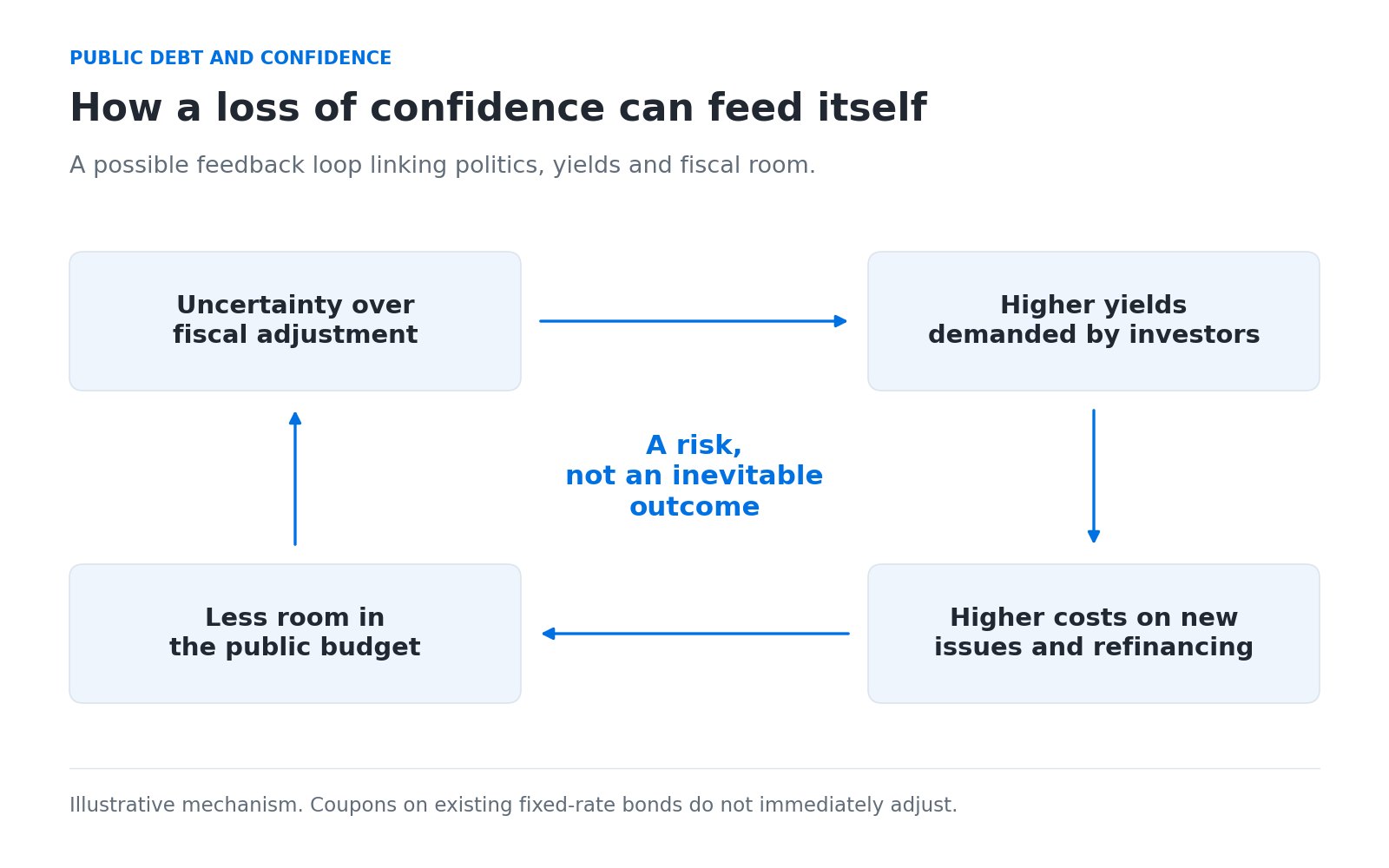
Rising yields can trigger a particularly dangerous mechanism for public finances. When investors demand higher interest rates, the government incurs greater costs on new issues and when refinancing maturing bonds. This can gradually increase interest expenditure, widen the deficit and create further financing needs.
To understand the scale of the effect, consider a numerical example. Suppose a government needs to raise €100 billion by issuing ten-year bonds at par, with an annual coupon equal to the yield. If the annual financing cost were 4.6%, the expense would be around €4.6 billion a year. At a cost of 5.1%, it would rise to approximately €5.1 billion. The difference would be €500 million a year, or €5 billion over ten years, assuming constant annual cash flows and disregarding the time value of money.
Naturally, this increase does not immediately apply to the entire existing stock of public debt. Fixed-rate bonds already issued normally continue to pay their contractually agreed coupons. Higher yields gradually affect the average cost of debt as new bonds are issued and maturing ones are refinanced.
France also has an average maturity of marketable debt exceeding eight years, which cushions the immediate transmission of higher rates to interest expenditure. This means that a surge in yields does not automatically produce a public budget crisis, but can gradually undermine sustainability if it persists.
How much does economic growth matter?
One factor often overlooked in public debate is the relationship between the average cost of debt and economic growth. The dynamics of the debt-to-GDP ratio can be represented, in simplified form, by the following equation:
Where:
- dt represents the debt-to-GDP ratio;
- it is the average nominal interest rate on the debt;
- gt is the nominal GDP growth rate;
- st is the primary balance as a share of GDP, positive in the case of a surplus.
For simplicity, the equation omits stock-flow adjustments. The primary balance is the difference between government revenue and expenditure excluding interest on the debt. If nominal economic growth exceeds the average cost of debt, the debt-to-GDP ratio benefits from a favourable effect. Conversely, when interest costs exceed growth, a stronger primary balance becomes necessary to stabilise indebtedness.
Consider a country with debt equal to 120% of GDP, an average cost of debt of 4% and nominal growth of 2%. Even with a balanced primary budget, the debt-to-GDP ratio would rise by approximately 2.35 percentage points in one year, according to the simplified equation. Stabilising it would require a primary surplus of around 2.35% of GDP.
This helps explain why a policy of spending restraint, on its own, is not necessarily sufficient. If restrictive measures reduce domestic demand and investment too sharply, they can undermine GDP growth and make improving the debt-to-GDP ratio more difficult. Debt sustainability therefore depends both on fiscal discipline and on the ability to generate economic growth.
France and the risk of a political and financial spiral
France’s situation appears particularly delicate because the need to correct its deficit clashes with growing political difficulty in implementing the necessary measures. In October 2026, the French government faces widespread protests, parliamentary tensions and demands for stronger protection of households’ purchasing power.
The draft budget for 2027 includes approximately €43 billion in fiscal consolidation measures contained in the government and social security budget bills, within a stated overall effort of €54 billion. Their approval and practical implementation remain uncertain. The difficulty is clear: to reduce the deficit, the government may need to raise taxes, limit certain transfers or restrain particular categories of expenditure. Yet each of these choices can carry political and social costs, especially during a period of weak economic growth.
The risk is a spiral in which political uncertainty makes fiscal consolidation harder, the lack of consolidation fuels investor distrust, and rising interest costs further restrict budgetary room. This outcome is not inevitable. A credible political agreement, accompanied by a multi-year fiscal consolidation path and measures that support productivity, could reduce the risk premium demanded by markets. But the programme’s credibility would depend on its practical feasibility, rather than merely on its announced targets.
What are the consequences for Italy?
Italy could seemingly benefit from the comparison with France: if French bonds are perceived as relatively less attractive for a given level of risk, some bond demand could shift towards other issuers, including the Italian Treasury. However, interpreting France’s difficulties as an Italian economic victory would be a mistake. Italy continues to have very high public debt and structurally modest growth.
Furthermore, a general deterioration in European financial conditions could push BTP yields higher as well. Italy could therefore improve its relative position against France while simultaneously experiencing an increase in its own financing cost. To understand this distinction, remember that a spread measures the distance between two yields, not the absolute level of borrowing costs.
If the Italian yield rises from 4% to 4.6%, while the French yield moves from 4.2% to 5.1%, Italy improves in relative terms but still pays higher interest than initially. An improvement in the spread therefore does not necessarily coincide with an improvement in overall financial conditions.
What about investors in BTPs and French bonds?
From an investor’s perspective, rising yields can present an opportunity, but they also involve risks. The price of a fixed-rate bond and its market yield generally move in opposite directions. When the required yield rises, the price of the bond already in circulation falls.
Consider a ten-year bond with a face value of €100 and an annual coupon of 4%. If the yield required by the market is 4%, the bond’s theoretical price is €100. If the yield rises to 5%, its theoretical price falls to approximately €92.28, assuming annual coupons and exactly ten years to maturity. Investors who held the bond before yields increased therefore experience a loss in value of approximately 7.7%.
For subsequent buyers, by contrast, the higher yield may be attractive, provided that the price paid is consistent with the risk taken and the issuer meets its obligations. The gross yield to maturity must not be confused with an annual gain guaranteed under all circumstances. Selling before maturity exposes investors to price fluctuations; holding the bond until maturity still exposes them to issuer risk and to the erosion of purchasing power caused by inflation.
A comparison between BTPs and OATs should therefore consider not only yield, but also maturity, liquidity, taxation and the concentration of sovereign risk in the portfolio.
The economic lesson: confidence depends on more than accumulated debt
The comparison between France and Italy highlights a fundamental principle of public finance: debt is assessed not only by its size, but also by the trajectory investors expect it to follow in subsequent years. Italy’s debt-to-GDP ratio remains higher than France’s. It would therefore be wrong to claim that Italy has solved its financial sustainability problem.
At the same time, the French case shows that relatively lower debt does not automatically protect a country from rising yields, particularly when growth slows, the deficit remains high and the political system struggles to find shared solutions. The priority for both countries should be to build a credible fiscal policy capable of distinguishing unproductive expenditure from investments that generate long-term economic benefits.
Indiscriminate spending cuts can damage the economy just as maintaining unsustainable spending levels can. Similarly, increasing taxes without improving public-sector efficiency risks constraining growth without resolving structural imbalances. The real objective should be to reduce financing needs gradually without undermining the economy’s ability to produce income and wealth.
France’s current situation therefore sends an important signal to the entire euro area. Having an advanced economy, a large capital market or an established credit reputation is not enough. When the outlook for public finances becomes uncertain, investors can quickly change the price at which they are willing to finance a government.
This is precisely where the distinction emerges between the amount of debt inherited from the past and confidence in the ability to manage it in the future. A country does not necessarily get into difficulty when its debt becomes very high. It can do so when the market starts doubting that a credible path exists to keep it sustainable.