
Government bonds are often described as simple investments: I lend money to the state, receive interest and get my principal back at maturity. That is indeed the basic structure, but a bond's actual return depends on purchase price, coupons, maturity, taxation and the timing of any sale. Furthermore, “government bond” does not mean “risk-free”: it means exposure to the sovereign issuer's credit risk, interest rate risk and, if sold before maturity, market fluctuations. Truly understanding these instruments requires distinguishing three frequently confused figures: face value, market price and yield.

Face value and price are not the same
A BTP may have a face value of 100 but trade at 96, 103 or any other price determined by supply, demand and market interest rates. If it repays 100 at maturity and we buy at 96, we may benefit from the positive difference between 96 and 100 in addition to coupons, subject to tax effects and calculation methods. If we buy at 103, we receive 100 at maturity, making that component negative. This is why the coupon is not the effective yield. A bond with a 5% coupon bought well above 100 may offer a yield to maturity well below 5%; a low-coupon bond bought below 100 may offer a higher effective yield.
The coupon is only one component
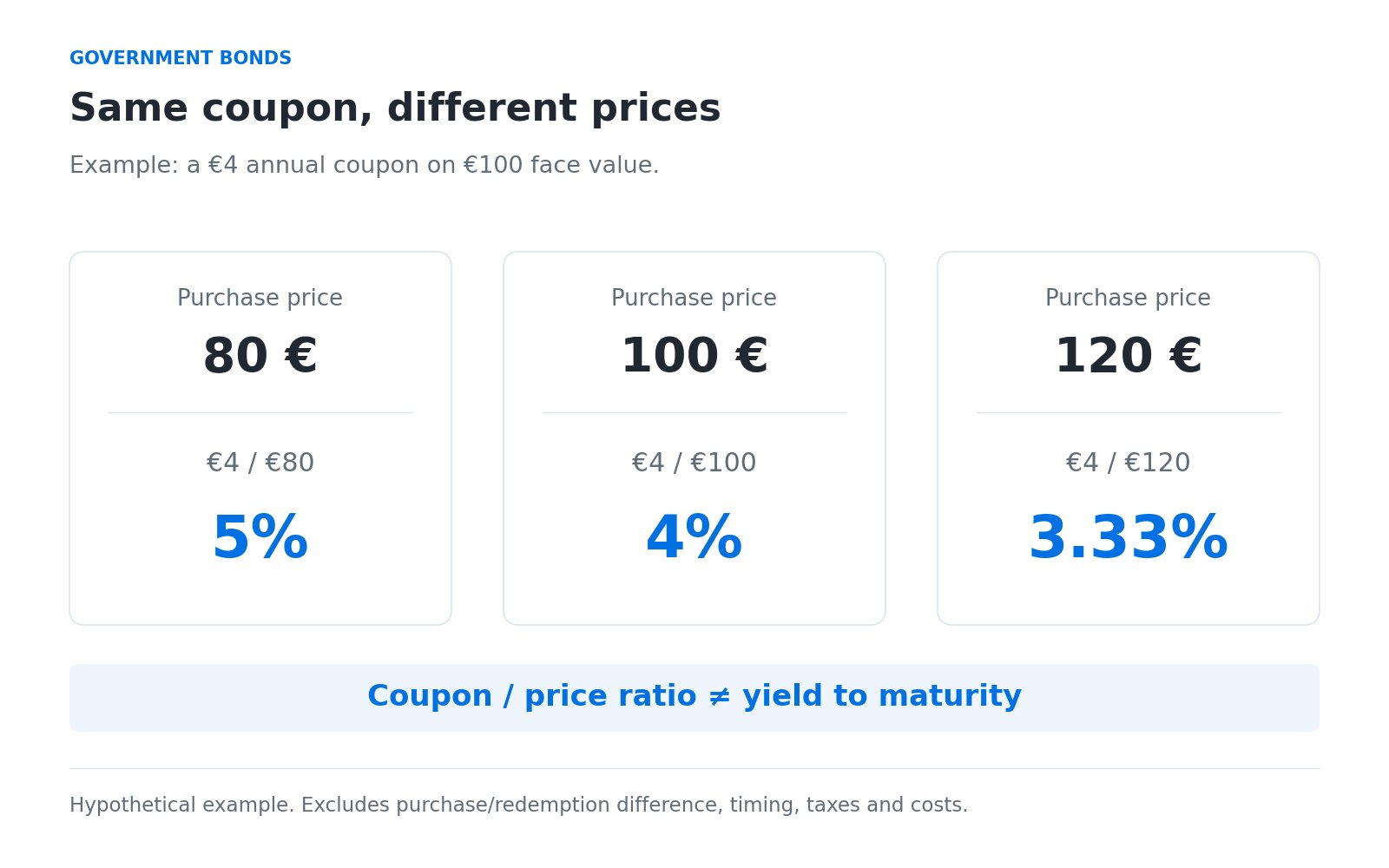
Suppose, simplifying, a bond pays an annual coupon of 4 euros per 100 of face value. If bought at 100, the immediate coupon-to-price ratio is 4%. If bought at 80, the same 4 euros equals 5% of the price paid; if bought at 120, it equals 3.33%. But even this is not the full yield calculation, because it excludes the gain or loss between purchase price and redemption and the time value of cash flows. Properly comparing bonds with different prices and maturities requires yield to maturity, which summarises expected cash flows in a single rate under specified assumptions.
Yield to maturity and reinvestment
Yield to maturity combines price, coupons and redemption assuming the bond is held to the end and cash flows are reinvested according to the calculation's assumptions. It is therefore useful for comparing bonds, but not a promise independent of investor behaviour. If coupons are spent or reinvested at different rates, the actual result may change. Imagine a bond bought at 96, redeeming at 100 in three years and paying annual coupons. Part of the return comes from coupons and part from the four-point price recovery. If sold after one year at 92, the expected maturity gain does not materialise: sale price and coupons received determine the actual result. “The state repays 100” matters only to someone able to wait until maturity and always remains subject to issuer risk.
Why prices fall when interest rates rise
The inverse relationship between bond prices and interest rates is fundamental. The Bank of Italy explains it simply: when market rates rise, prices of existing bonds tend to fall; when rates fall, prices tend to rise. Imagine owning a bond paying 2% while new bonds of the same risk and maturity are issued at 4%. No rational investor would pay 100 to receive 2% when a similar new bond offers 4%. The old bond's price must therefore fall until its overall yield becomes competitive.
Duration matters
Not all bonds react alike to interest rate changes. Duration measures price sensitivity to changes in yield. Generally, other things being equal, bonds with longer maturities and lower coupons tend to be more sensitive. A one-percentage-point rate increase may therefore have a modest effect on a bond maturing in a few months and a much greater effect on a twenty-year bond. This is why saying “it is a government bond, so the capital value does not fluctuate” is wrong when referring to market value before maturity.
Does holding to maturity eliminate price risk?
If the issuer repays the bond properly and we hold it to maturity, intermediate market fluctuations do not themselves cause a realised loss. However, purchase price still matters: buying above par means redemption at 100 includes a loss relative to the price paid; buying below par means the opposite. Holding to maturity also does not eliminate opportunity cost. If interest rates rise sharply after purchase, we remain tied to a bond yielding less than newly available instruments. We may not necessarily lose nominal capital at maturity, but we have committed capital on terms that have become less favourable.
BOTs and BTPs are not the same
BOTs are short-term securities without periodic coupons: their return comes from the difference between purchase price and redemption value. BTPs generally have longer maturities and pay coupons according to the issue's terms. Inflation-linked bonds and other structures also exist. Choosing “a government bond” is therefore not one single decision. It requires choosing maturity, cash flow structure, indexation and purchase timing.
Building a maturity ladder
When money is needed on different dates, concentrating everything at one maturity may be inefficient. A bond ladder spreads redemptions over time: one portion in a year, another in two, another in three, and so on. It does not eliminate interest rate or sovereign risk, but reduces the need to sell the entire position at an unfavourable time and makes liquidity more predictable. Before purchasing, I would compare net yield, duration, the bond's liquidity and alignment with the target date. I would also examine the dirty price and accrued interest, because the outlay may include interest accrued and payable to the seller. The coupon remains the most visible figure, but a complete decision requires understanding what is paid today, what cash flows will arrive and when the capital will be needed.
Issuer risk exists
A government bond is a claim against the state issuing it. Credit risk may be perceived as low for certain issuers, but is not conceptually zero. Differences in yields across countries reflect, among other things, differing assessments of risk, inflation, liquidity and market conditions. Concentrating entirely on one issuer's debt therefore exposes wealth to a specific risk, even if the security is considered relatively safe.
Diversification by issuer matters too
Holding several BTPs with different maturities reduces timing concentration, but not exposure to the same sovereign borrower. If a very large share of wealth depends on Italy, income, pensions, property and bonds may react to the same economic shocks. The choice must therefore be considered within total wealth, distinguishing maturity diversification from issuer-risk diversification.
Taxation and net yield
For an Italian investor, government bond taxation can be more favourable than that of many other financial instruments, but what matters is the net yield after taxes and costs. Comparing a savings account, a corporate bond and a BTP using gross yields alone can lead to wrong conclusions. Trading commissions and bid-ask spreads also matter, particularly for small amounts or frequent transactions.
An example bringing everything together
Imagine two bonds with face value 100 and the same maturity. The first pays a 5% coupon but trades at 110; the second pays a 2% coupon but trades at 90. Looking only at coupons, we would choose the first. Yet the first loses 10 points between purchase and redemption, while the second recovers 10. Effective yield depends on the combination of all cash flows and time remaining to maturity. This is precisely why I would never choose a bond solely by looking at the percentage beside the coupon.
What I would examine before buying
I would check price, yield to maturity, remaining maturity, coupon structure, duration, taxation, liquidity and alignment with the date I expect to need the capital. If I might need to sell earlier, I would give particular weight to price risk. If my horizon matches maturity, I would focus more on net yield and issuer risk. Government bonds can be very useful, but treating them as “simply safe” hides the economic mechanics determining the investment result. The coupon tells us what the bond pays; yield tells us what it returns at the price we pay; duration helps explain how its price may react to interest rates. These are three different pieces of information, and all are needed.
Note. This article is for information only and does not constitute an investment recommendation or an invitation to purchase government bonds.