
Seeing negative equity in financial statements is a strong warning, but should not be interpreted superficially. It does not simply mean “the company has little money”, nor does it automatically mean the business is already insolvent. Equity is an accounting measure which, in simplified terms, represents what remains of assets after liabilities are deducted. When it becomes negative, the carrying amount of liabilities exceeds that of assets: losses have eroded not only accumulated profits and reserves, but also the owners' capital. This situation requires both economic and legal attention. Understanding it means separating three often-confused concepts: equity, liquidity and solvency. A company can have positive equity yet be unable to pay debts as they fall due; it can also have negative equity and temporarily continue operating through shareholder loans, arrangements with banks or sufficient cash flows. These situations differ, although both may be problematic.

How equity becomes negative
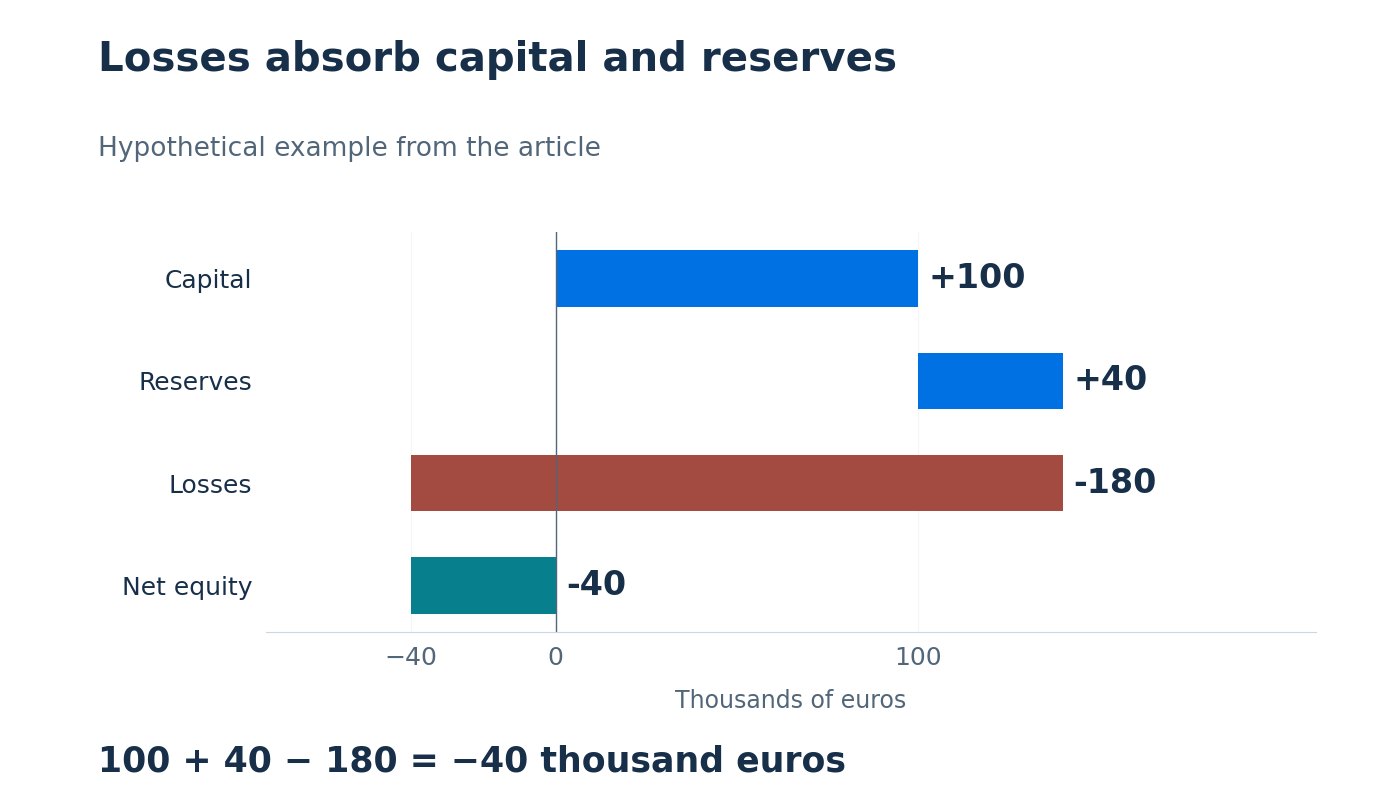
Imagine a company formed with 100,000 euros of capital. Over the years, it accumulates 40,000 euros in reserves, reaching equity of 140,000 euros. If it then incurs a loss of 180,000 euros, equity becomes −40,000 euros. The loss first absorbed reserves and then capital. In accounting terms, the resources attributable to shareholders are now negative. This does not mean every company asset has disappeared, but that total recognised liabilities exceed the assets recorded in the balance sheet.
Negative equity does not mean a negative bank balance
A company can still have 300,000 euros in its bank account and negative equity. For example, it may have debts of 1 million and total assets of 900,000 euros. Equally, a company with positive equity may have very little cash because its assets comprise property, plant, difficult-to-collect receivables or inventory. This distinction is essential: equity describes the accounting balance between assets and liabilities, whereas liquidity concerns the immediate ability to make payments. Understanding whether the business can continue operating also requires analysis of projected cash flows and debt maturities.
When losses also become a company-law issue
The Italian Civil Code imposes specific obligations when losses materially erode share capital. For limited liability companies (S.r.l.), Article 2482-bis governs situations where losses have reduced capital by more than one third and requires directors to convene a shareholders' meeting without delay to take appropriate measures. If losses bring capital below the statutory minimum, Article 2482-ter applies, requiring the situation to be addressed through the mechanisms provided for, such as a capital reduction with a simultaneous increase or conversion to another legal form. Similar rules for joint-stock companies appear in Articles 2446 and 2447. Severely eroded equity is therefore not merely a figure to discuss in the management report: it can have precise implications for governance and shareholder decisions.
Recapitalisation does not erase the economic problem
Suppose a company has equity of −100,000 euros. Shareholders contribute 300,000 euros through a capital increase, bringing equity, in simplified terms, back to +200,000 euros. The balance sheet position improves substantially, but the cause of the losses has not yet been resolved. If the company loses 30,000 euros a month because its business model is structurally inefficient, those 300,000 euros may simply finance another ten months of losses. Recapitalisation buys time and strengthens the capital structure, but creates value only when accompanied by economic and financial recovery.
What recapitalisation should achieve
A capital increase is convincing when it finances a plan capable of restoring sustainable balance. Imagine monthly losses of 25,000 euros and a shareholder contribution of 300,000 euros: without operational changes, the new funding covers approximately twelve months. If, during that period, the business reduces fixed costs, renegotiates contracts, restores margins and achieves positive operating cash flow, the contribution buys the time needed for restructuring. If nothing changes, it merely postpones the problem. To assess the plan, I would compare actual results and targets month by month. Revenue below expectations, margins failing to recover or growing cash requirements signal that assumptions need revisiting. Negative equity therefore requires both corporate action and an economic diagnosis: the former rebuilds equity capital, while the latter establishes whether that capital can be preserved over time.
Why asset quality matters
Equity may be positive and then deteriorate rapidly if certain assets are written down. Imagine 500,000 euros of trade receivables recorded in the accounts. If a substantial portion becomes uncollectible, the write-down reduces assets and creates an expense that can diminish or wipe out equity. The same applies to obsolete inventory, overvalued investments, property whose recoverable value has declined or fixed assets no longer generating adequate economic benefits. Equity therefore cannot be assessed separately from the quality of the assets supporting it.
A three-level analytical approach
Faced with negative equity, I would start with an accounting reconciliation: which losses caused it, in which years and through which items? A loss from an exceptional write-down has different implications from operating losses recurring annually. The former may reflect an isolated event; the latter indicates that the business model systematically consumes capital. I would also examine whether there are reserves no longer available, shareholder contributions already approved or post-year-end transactions changing the picture. The second level concerns finance. I would prepare a debt maturity schedule and at least monthly cash forecasts, distinguishing reasonably certain receipts from mere expectations. A company's capital position may be seriously impaired while it still has time to act; another may have less negative equity but face an immediate liquidity crisis. Without this time dimension, the equity figure remains serious but incomplete.
Negative equity and insolvency are different concepts
The Italian Business Crisis and Insolvency Code defines insolvency through an inability to meet obligations regularly, evidenced by defaults or other outward facts. It therefore concerns payment capacity, rather than a single balance sheet figure. A company with negative equity might, at least for a time, continue paying regularly through credit facilities, shareholder loans or operating cash flows. A company with positive equity might instead face a liquidity crisis if it cannot convert its assets into cash in time. This does not lessen the seriousness of negative equity: it simply clarifies that assessing going concern requires broader analysis.
The opposite mistake: assuming positive equity is enough
If a company owns property worth 3 million, has debts of 2 million and other assets of 500,000 euros, its book equity may look substantial. But if 1 million of debt falls due in the coming months and the property cannot easily be sold or used to obtain financing, the company may still experience financial difficulty. The asset position and financial balance must therefore be considered together. The former answers a stock question: what are the assets, liabilities and equity at a particular date? The latter introduces timing: when will cash be collected and when must payments be made?
What I would examine in accounts showing negative equity
The first thing I would seek to understand is where the losses come from. Are they exceptional and non-recurring, or do they arise from ordinary operations? I would then examine recent years' trends, operating cash flows, financial debt, maturities, banking relationships, any shareholder loans and directors' actions. I would also analyse equity item by item: capital, reserves, accumulated losses and the current year's result. A negative aggregate figure signals a problem, but does not explain how quickly it developed or which resources have already been used to absorb it. The most important point is therefore not to turn negative equity into a label. It is a very serious sign of erosion of owners' capital, with potential company-law and financial consequences, but diagnosing the business also requires profitability, liquidity, debt and prospects. In financial statements, one number rarely tells the whole story.
Note. This article is for information and educational purposes only. It does not constitute legal, corporate, accounting or business distress advice.